Quick definition
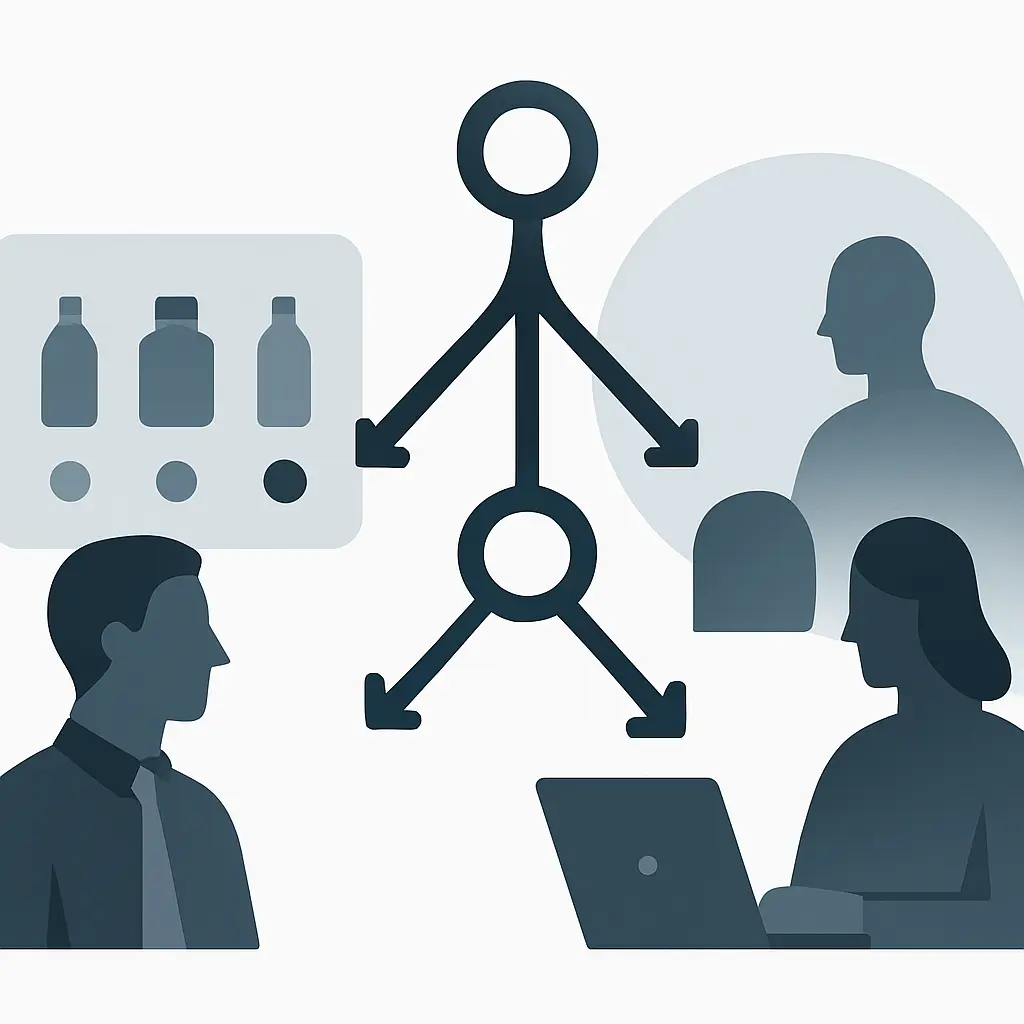
Choice overload and consumer decisions describes the drop in decision quality, speed, or satisfaction that can follow from offering too many alternatives or too much detailed information. It’s not about whether people are smart; it’s about the mental overhead created by options, trade-offs, and ambiguity.
Managers and product owners often see it in sales funnels, procurement processes, and internal approvals: customers or colleagues either delay, ask for more time, opt for the cheapest/easiest option, or ask for one-on-one recommendations.
Key characteristics include:
These characteristics mean you can measure and reduce friction by simplifying choice paths, improving curation, and tracking conversion or completion metrics.
Underlying drivers
**Cognitive overload:** Human working memory has limited capacity; many options increase mental effort.
**Comparison costs:** More items require more pairwise comparisons and trade-off thinking.
**Fear of regret:** People worry about picking the ‘wrong’ option and facing consequences later.
**Social uncertainty:** When choices affect others, social stakes make decisions harder.
**Ambiguous criteria:** Lack of clear decision rules or priorities forces ad-hoc evaluation.
**Poor presentation:** Jargon, inconsistent formats, or cluttered displays amplify complexity.
**Time pressure or lack of deadlines:** Without constraints, people keep searching for a better option.
Observable signals
These patterns are observable signals you can track: rising lead time, increased ticket counts, meeting overruns, and conversion dips often point back to overloaded choice architecture.
Slow or stalled procurement decisions where vendors provide large catalogs
Sales cycles lengthen after showing large product assortments
Customers or internal stakeholders repeatedly ask for curated recommendations
High volume of support tickets about feature differences or contract terms
Teams default to the cheapest or most familiar option to avoid choosing
Low conversion on webpages or demo offers with many simultaneous choices
Frequent change requests after initial selection (indicator of regret)
Decision meetings that extend beyond agenda time due to option lists
A quick workplace scenario (4–6 lines, concrete situation)
A product team launches a B2B pricing page with 10 configurable modules. Prospects request live demos instead of self-serve trials; the sales team reports deals stuck at "proposal" stage. The company introduces a recommended bundle and sees proposal-to-sale time fall and fewer custom quotes.
High-friction conditions
Launching a new product line with multiple SKUs and optional add-ons
RFPs that require clients to rank dozens of features
Internal purchase forms listing every vendor and service tier
Marketing pages showing many similar plan tiers without guidance
Meetings where multiple alternatives are presented without evaluation criteria
Email threads comparing long option lists instead of summarizing pros/cons
Open-ended user configurators that expose all technical parameters
Sales reps offering too many demos or trial variants without curation
Practical responses
Applying these interventions usually reduces time-to-decision and support load; start with the simplest changes (defaults, curation) and measure impact before adding process controls.
Limit options: present a short menu of curated, best-performing choices.
Use defaults: highlight a recommended or popular option as a starting point.
Create decision rules: offer clear criteria (budget, scale, timeline) to filter choices.
Tier complexity: show basic options first and reveal advanced choices progressively.
Provide comparison tools: concise side-by-side summaries with 2–4 key attributes.
Timebox decisions: set reasonable deadlines and communicate consequence of delay.
Train staff: equip sales/support with scripts for recommending one or two options.
Test variations: A/B test simplified menus and track conversion or fulfillment metrics.
Visual clarity: standardize labeling, remove jargon, and use consistent formats.
Offer concierge help strategically: route complex cases to specialists rather than overserving everyone.
Document defaults and rationale: capture why a recommendation is made for repeatability.
Often confused with
Decision fatigue — a buildup of poor choice performance over time; differs because fatigue is temporal, while choice overload is about option set size and structure.
Analysis paralysis — when over-analysis stalls action; closely connected but analysis paralysis emphasizes overthinking, whereas choice overload focuses on the menu that forces comparisons.
Choice architecture — the deliberate design of options and presentation; this is the toolkit for managing choice overload.
Default effect — people tend to stick with pre-selected options; a behavioral lever to counteract overload.
Satisficing vs. maximizing — satisficers pick “good enough,” maximizers search for the best; managing overload often nudges users toward satisficing strategies.
Information overload — excess data rather than excess options; both increase cognitive load but require different fixes (curation vs. summarization).
Nudge theory — small design changes that influence behavior; nudges can simplify choices without removing options.
Product assortment strategy — inventory and SKU decisions aimed at sales outcomes; connects directly because assortment size drives customer choice complexity.
Social proof — using reviews or popularity signals to guide choices; it reduces perceived risk and comparison cost.
Usability testing — empirical testing of choice displays; helps identify where overload appears in real user flows.
When outside support matters
- If stalled decisions are causing repeated, measurable revenue or operational harm, consult an organizational psychologist or UX researcher.
- Bring in a data analyst or product researcher when you need rigorous A/B testing and metrics to evaluate simplification changes.
- Engage HR or an external facilitator when internal decision processes cause team conflict or persistent meeting overruns.
Related topics worth exploring
These suggestions are picked from nearby themes and article context, not just a flat alphabetical list.
Project portfolio choice overload
When too many projects compete for attention, decisions stall and resources scatter. Practical guide to recognizing causes, everyday signs, and manager-level fixes.
Group choice deferral
When teams repeatedly postpone choices in meetings, work stalls. Learn to spot the signs, why it persists, and practical fixes—deciders, timeboxing, defaults, and decision rules.
Sunk cost decisions in projects
How managers can spot and reduce sunk-cost-driven choices in projects: signs, causes, a workplace example, and practical decision gates to focus on future value.
Outcome Bias in Business Decisions
Outcome bias is judging decisions by results instead of the quality of the decision process — learn how it shows up at work and practical steps managers can use to reduce it.
Paradox of choice at work
How extra options at work—tools, vendors, processes—create delays, doubt, and lower throughput, and what practical levers managers and teams can use to restore clarity and speed.
Using defaults to speed team decisions
How pre-set options and path-of-least-resistance choices speed team decisions, why teams accept them, common confusions, and practical steps to make defaults deliberate and reviewable.