Working definition
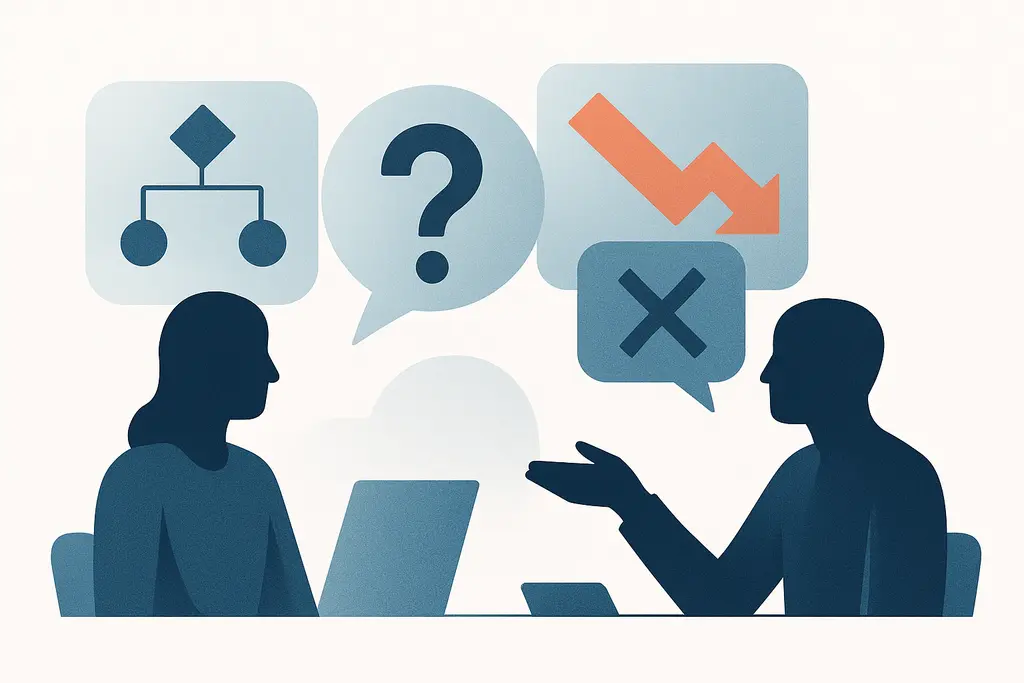
A confidence gap in negotiations is when someone underestimates, hesitates, or shrinks from advocating for a realistic position during bargaining, review meetings, or client conversations. It isn't about lacking knowledge; it's about the moment-to-moment mismatch between capability and assertive behavior.
This pattern often shows when stakes, ambiguity, or social dynamics make it harder for someone to claim value, push for concessions, or close an agreement. It can be temporary (a single big pitch) or recurring (systematic under-asking across deals).
Key characteristics include:
These markers make it possible to spot the pattern without labeling intentions; they point to negotiation behavior that reduces value capture and can undermine team credibility.
How the pattern gets reinforced
Situational and internal factors combine: when someone faces heavy cognitive demands, unclear scope, and a social environment that penalizes pushing back, the confidence gap widens. These drivers are actionable because they point to changes in structure, preparation, or environment.
**Cognitive load:** High complexity or multitasking reduces mental bandwidth needed for assertive choices.
**Perceived risk:** Overestimation of downside consequences makes conservative offers seem safer.
**Social comparison:** Seeing colleagues win bigger terms can trigger self-doubt and withdrawal.
**Audience effects:** Negotiating in public or with senior stakeholders raises performance anxiety.
**Ambiguous authority:** Unclear delegation or mandate makes people default to safer positions.
**Norms and culture:** Environments that reward harmony or punish visible disagreement suppress assertiveness.
Operational signs
These observable patterns reduce leverage in negotiations and can signal to others that the organization will be an easy concession partner. Tracking specific behaviors (e.g., frequency of first concessions) helps identify where coaching or structural changes are needed.
Asking for lower fees, budgets, or timelines than justified by scope
Frequently using tentative language: "maybe," "I think," "if that's okay"
Letting counterparts frame terms without offering counter-anchors
Avoiding setting or enforcing deadlines and consequences
Delegating the final negotiation to others repeatedly
Settling quickly after the first concession instead of exploring options
Seeking excessive reassurance from colleagues before making a bid
Not documenting agreed-upon points or failing to confirm terms in writing
Over-explaining rationale instead of making concise value statements
A quick workplace scenario (4–6 lines, concrete situation)
A project lead faces a vendor renewal meeting. Despite data showing a market rate 15% higher, they accept the vendor's first counteroffer after apologetic hedging and no clear target. The contract renews with less favorable terms and the procurement team only learns about the concessions after the fact.
Pressure points
Triggers create pressure that shifts focus from strategy to risk-avoidance, making under-asking more likely and harder to correct in the moment.
Last-minute meetings with insufficient prep time
Negotiating with a more senior or intimidating counterpart
High public visibility of the negotiation (all-hands, executive presence)
Lack of clear mandate or decision authority
Previous negative outcomes in similar negotiations
Conflicting goals within the team or stakeholder group
Pressure to maintain a relationship at the expense of terms
Unclear success metrics for the negotiation
Moves that actually help
These actions shift the focus from momentary feelings to concrete practices. Over time they close the gap by increasing preparedness, distributing risk, and creating supportive norms for assertive offers.
Establish clear negotiation objectives and walk-away thresholds before meetings
Use role-plays or rehearsal sessions to build muscle memory for key scripts
Set rules of engagement: who speaks, who presents anchors, who closes
Encourage data-backed anchors (benchmarks, past contracts, market rates)
Introduce short cooling-off or preparation time before high-stakes calls
Assign a designated advocate in the room to make the first ask
Normalize rehearsing concise value statements instead of long explanations
Create a post-negotiation debrief to capture learning and adjust strategy
Rotate negotiation leads so experience accumulates across people
Align incentives so outcomes, not just harmony, are recognized
Provide templates for offer/counteroffer language to reduce hesitation
Related, but not the same
Anchoring bias — connects because initial offers shape outcomes; differs as anchoring is a cognitive heuristic while the confidence gap is behavioral underperformance relative to capability.
Impression management — overlaps when people hedge to protect image; differs because impression management can be deliberate while confidence gaps often reduce value capture unintentionally.
Negotiation preparation — related toolset; differs as preparation is a remedy rather than the behavioral pattern itself.
Psychological safety — connects through cultural influence; differs because psychological safety is about the environment that allows pushback, not the individual's negotiation choices.
Imposter feelings — relates to internal doubt that reduces assertiveness; differs because imposter feelings are broader self-evaluations whereas the confidence gap is specific to negotiation moments.
BATNA awareness — connects as stronger BATNAs reduce hesitation; differs since BATNA is an informational lever and confidence gap is an execution gap.
Conflict avoidance — overlaps in outcomes; differs because conflict avoidance is a general preference, while confidence gaps may be situation-specific and correctable with structure.
Decision authority clarity — connects because clear mandates reduce indecision; differs as it is an organizational fix rather than an individual trait.
Debrief culture — related as feedback loops help close the gap; differs since debrief culture is a process that supports behavior change.
When the issue goes beyond a quick fix
Talking with an HR consultant, an experienced negotiation coach, or an organizational development specialist can help diagnose structural causes and design interventions.
- When repeated negotiation outcomes materially harm team or organizational results despite internal attempts to change processes
- If negotiation-related anxiety leads to avoidance of necessary meetings or long-term career constraints
- When mediation or external facilitation is needed to reset relationships or renegotiate standing terms
Related topics worth exploring
These suggestions are picked from nearby themes and article context, not just a flat alphabetical list.
Quiet Confidence Building
Quiet confidence building is the gradual, low‑visible growth of workplace competence—how it develops, how to spot it, and practical ways teams and leaders support it.
Confidence scaffolding for new managers
Practical supports and routines that help first-time managers grow steady confidence—how it shows up, why it forms, what helps, and how leaders can scaffold (and remove) it.
Confidence calibration for career decisions
Practical guidance on aligning confidence with real readiness when choosing jobs, promotions, or stretch roles—how it shows up, why it happens, and steps to improve calibration.
Confidence Rebound After Failure: getting back on track
Practical guidance for managers to restore team confidence after failure—signs, causes, common misreads, and concrete early steps to get people back on track.
Recognition Aversion
Recognition aversion is when employees avoid public praise; learn how it shows up, why it develops, how managers misread it, and practical ways to acknowledge contributions without harm.
Peer success self-doubt
When a colleague’s win makes someone doubt their own ability, managers can misread retreat as low performance; learn signs, causes, and practical steps to respond.