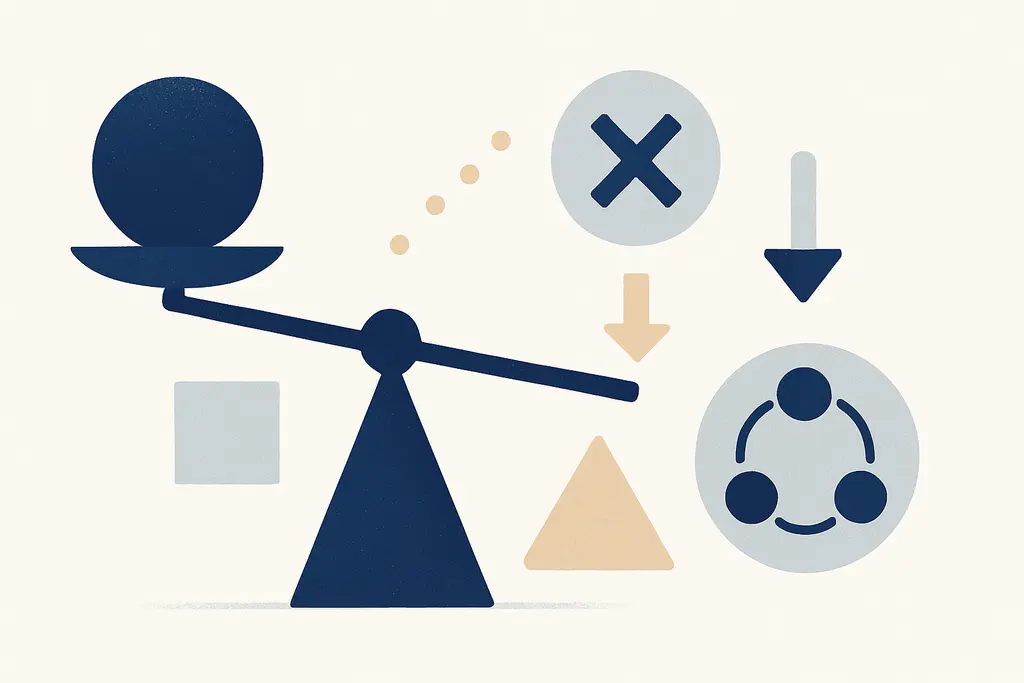
What consensus fatigue really means
At its core this pattern is a gradual erosion of productive decision-making caused by over-reliance on full agreement. Teams stop treating consensus as a tool and start treating it as the default requirement for any step forward.
- Many small compromises: decisions get diluted because everyone must be comfortable.
- Recurrent rehashing: past choices are reopened to placate late objections.
- Invisible withdrawal: quieter members stop contributing, preferring to follow the apparent group view.
These outcomes look mild at first — fewer conflicts, smoother meetings — but the cost is delayed execution, unclear ownership and reduced innovation. Recognizing the pattern early preserves speed without sacrificing legitimate input.
Why teams slide into this and what sustains it
- Social pressure: people prefer agreement to visible dissent, especially under status differences.
- Risk aversion: when decisions have visible consequences, leaders ask for unanimity to avoid blame.
- Poor decision protocols: no clear escalation rules or single-decider authority exist.
- Meeting habits: recurring standing meetings incentivize re-opening issues rather than closing them.
- Cultural norms: a cultural premium on harmony or 'everyone must be happy' sustains the pattern.
These dynamics reinforce each other. For example, if a team lacks explicit decision rules, social pressure and fear of blame will push members toward quieter acquiescence, which then encourages leaders to solicit full buy-in more often, reinforcing the cycle.
How this shows up in everyday work
- Long email threads where new objections appear late.
- Meetings that end with vague next steps or “takeaways” rather than decisions.
- Priorities that shift after a decision because someone raised a concern off-channel.
- Teams that prefer revising scope over defending a choice.
One practical sign: a decision that takes many small iterations and still generates follow-up “actually” emails. When that pattern repeats across projects, it’s consensus fatigue, not just cautious planning.
Where leaders commonly misread or oversimplify it
- Mistaken for groupthink: groupthink implies conformity that suppresses dissent early; consensus fatigue often follows repeated, sincere attempts to incorporate dissent until the process breaks.
- Confused with decision fatigue: decision fatigue is an individual decline in judgment after many choices; consensus fatigue is a social pattern where the pursuit of unanimous agreement slows or degrades outcomes.
- Labeled as laziness or apathy: agreement by silence may look like lack of care, but it often signals exhaustion with the process, not the subject.
Leaders who conflate these make the wrong interventions. For example, pushing faster decisions addresses decision fatigue but won’t fix an absence of clear escalation rules that sustain consensus fatigue. Correct diagnosis directs interventions — change the process, not just the tempo.
Practical steps that reduce consensus fatigue
- Establish decision rules: clarify who decides, when votes replace consensus, and what constitutes adequate agreement.
- Timebox decisions: set explicit windows for discussion and a firm decision point.
- Use structured inputs: require written objections with trade-offs rather than open-ended disagreement.
- Rotate a decision owner: assign accountable leads who synthesize input and sign off.
- Create safe dissent channels: anonymous feedback or pre-meeting red-team comments reduce late surprises.
Start with one change and measure its effect: shorter meeting agendas, fewer reopened items, and clearer action owners. These process changes preserve legitimate input but prevent endless consensus-chasing.
A concrete workplace example and quick scenario
A product team spent six weeks iterating a roadmap. Each meeting ended with a request to “sleep on it.” New objections surfaced from stakeholders who hadn’t attended the working sessions; the backlog swelled and the release slipped twice. The manager introduced a rule: after two review cycles the product lead decides; late objections must be submitted in writing and assessed for new risk. Within a month, decisions closed faster and the team had fewer rework cycles.
Questions worth asking before reacting
- Who is authorized to make the final call on this topic?
- Are objections substantive or procedural (timing/visibility)?
- Have all voices had a chance to contribute in an accessible format?
Answering these reveals whether the problem is process design, psychological safety, or workload—each requiring a different fix.
Related patterns worth separating from it
- Groupthink: a premature convergence driven by suppressed dissent.
- Decision fatigue: individual cognitive depletion after many choices.
- Meeting overload: excessive gatherings that encourage rehashing but don’t automatically require consensus.
Clarifying these helps leaders pick remedies: create better decision rules for consensus fatigue, encourage dissent protocols to counter groupthink, and manage cognitive load to reduce decision fatigue.
Quick takeaways for leaders
- Look for patterns (reopens, diluted outcomes), not single instances.
- Put explicit decision rules in place and enforce them gently.
- Protect mechanisms for legitimate dissent while limiting late-stage reopens.
Applied consistently, these moves restore momentum without silencing necessary debate.
Related topics worth exploring
These suggestions are picked from nearby themes and article context, not just a flat alphabetical list.
Empathy fatigue in managers
When managers' emotional reserves are stretched, their ability to respond supportively drops. Learn how it shows up, why it develops, and practical steps to reduce it.
Quiet Authority
Quiet Authority is steady, low-key leadership that influences through consistent competence and clear boundaries—learn how it forms, shows up, and how to support or evaluate it at work.
Influencing Up
A practical field guide to influencing up: how to present decisions, reduce leaders' friction, spot common misreads, and increase the chance your proposals get approved.
Delegation trust gap
When tasks are assigned but real authority isn’t, work slows and initiative fades. Practical manager steps to spot, understand, and close the delegation trust gap.
Authority Shadowing
How Authority Shadowing shows up when teams mirror leaders' views instead of testing assumptions, why it forms, common misreads, and practical steps managers can use to reduce it.
Praise hoarding
Praise hoarding is when recognition is concentrated or withheld, skewing who gets credit. Learn how it shows up, why it persists, and practical steps leaders and teams can use to correct it.