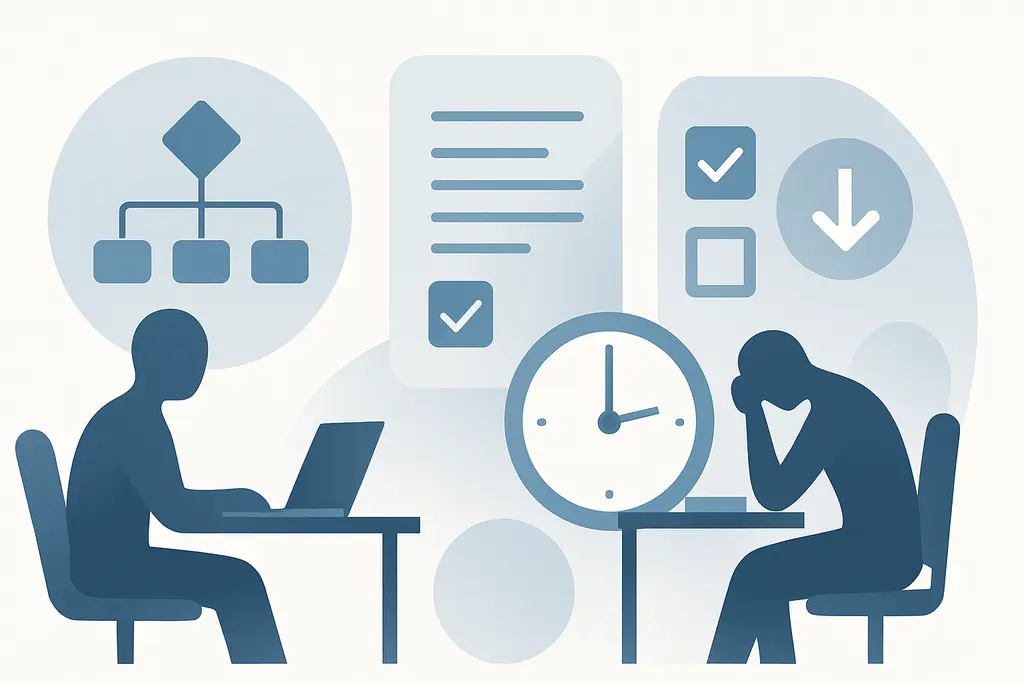
Working definition
Decision fatigue refers to the reduced ability to make well-considered choices after a period of repeated decision-making. In workplace settings this shows up as simpler, faster, or more avoidant choices when cognitive resources are low.
It is not a personality flaw but a normal outcome of bounded attention and mental effort that accumulates over hours and meetings. Different tasks and environments accelerate that build-up: urgent triage decisions, frequent small choices, and high-stakes problem solving all consume the same pool of decision resources.
Seen practically, it affects how consistent decisions are across people and time—morning approvals may look different from late-afternoon approvals even for the same manager or team.
Key characteristics:
Managers and team leads can plan schedules and systems around these patterns to reduce unfair or costly variability.
How the pattern gets reinforced
**Cognitive load:** Repeatedly evaluating options consumes working memory and attention, leaving fewer resources for later choices.
**Self-control depletion:** Tasks requiring willpower (e.g., negotiating, conflict resolution) use the same regulatory resources as decision-making.
**Information overload:** Excess data, unclear criteria, or many concurrent issues increases mental effort per decision.
**Social demands:** Constant interactions, requests, and interruptions force switching costs and extra choices.
**Environmental stressors:** Noise, poor lighting, and time pressure accelerate fatigue.
**Poor process design:** Lack of clear rules or escalation paths forces ad hoc decisions for routine matters.
**Task fragmentation:** Frequent context switching between tasks raises the cost of each decision.
Operational signs
These patterns are observable and measurable: review decision logs, timing, and consistent late-day outcomes to confirm whether decision fatigue is a factor.
Approvals or hiring choices become faster and more superficial later in the day
Meeting agendas are shortened or important items postponed toward the end
Team members default to prior precedent instead of re-evaluating options
Increased use of templates, canned responses, or “safe” options
Higher frequency of pushing decisions downstream or delegating to others
Spike in micro-decisions being automated or ignored (e.g., unread backlog)
Shorter attention in meetings and fewer follow-up questions
Noticeable differences in decisions made by the same people at different times
A quick workplace scenario (4–6 lines, concrete situation)
A product team schedules feature prioritization after three back-to-back customer calls. By the fourth hour, the group approves the easiest-to-implement item without debating trade-offs. The product owner later notes several stakeholder concerns that weren’t discussed.
Pressure points
Long strings of meetings without breaks
High-volume inboxes requiring many micro-decisions
Back-to-back interviews or performance reviews
Tight deadlines forcing rapid sequential choices
Repeated firefighting of unplanned incidents
Lack of clear standard operating procedures for routine decisions
Frequent interruptions and ad-hoc requests
Reviewing long lists of similar items (e.g., claims, tickets)
Insufficient delegation or unclear decision authority
Moves that actually help
These steps focus on changing processes and schedules so people make more consistent, transparent decisions across the workday.
Set decision windows: schedule high-stakes choices early in the day when attention is fresh
Batch similar decisions (e.g., approvals, reviews) to reduce switching costs
Create default rules and checklists for routine choices to preserve mental bandwidth
Reserve “no-meeting” blocks and short breaks after intense decision periods
Use simple scoring frameworks to make comparisons faster and fairer
Rotate responsibilities so the same person is not making all consequential choices
Limit meeting lengths and circulate clear pre-reads to reduce in-meeting evaluation load
Encourage short, documented delegation paths for recurring low-impact decisions
Track decision timing and outcomes to spot late-day drift and correct schedules
Standardize templates for recurring responses to reduce micro-decision volume
Build small pause rituals (1–2 minutes) between intense tasks to reset attention
Related, but not the same
Choice overload: describes how too many options make choosing harder; connected because more options accelerate decision fatigue.
Cognitive load theory: explains how working memory limits affect task performance; it underpins why prolonged decision-making wears people down.
Status quo bias: preference for current state; linked because tired decision-makers often accept defaults rather than evaluate changes.
Decision hygiene: practical practices for cleaner decision processes; overlaps as a set of remedies for decision fatigue.
Meeting overload: too many meetings increase interruptions and choices; it’s an environmental driver that feeds decision fatigue.
Heuristics and biases: mental shortcuts people use under strain; these become more prominent when decision resources are low.
Delegation design: structuring who decides what; differs by addressing organizational authority to reduce individual burden.
Time-of-day effects: performance variation across the day; connects as a predictable pattern managers can exploit to schedule decisions.
Information governance: controls on what data is available and when; reduces unnecessary choices by filtering inputs.
When the issue goes beyond a quick fix
- If decision patterns are causing sustained team dysfunction or serious operational risk, consult an organizational psychologist or workplace consultant
- When persistent overwhelm leads to prolonged absenteeism or significant loss of productivity, consider external HR or occupational health advice
- If individual distress, burnout, or impairment is present, encourage the person to speak with a qualified mental health professional through appropriate workplace channels
Related topics worth exploring
These suggestions are picked from nearby themes and article context, not just a flat alphabetical list.
Post-decision dissonance
Post-decision dissonance is the discomfort after choosing at work; learn how it shows up, why it persists, and practical steps managers can use to reduce defensiveness and improve learning.
Pre-mortem planning
A practical guide to running pre-mortem planning in team meetings: imagine failure, identify causes, and turn insights into tests, owners, and early mitigations.
Present bias at work
How present bias at work leads teams to choose quick gains over long-term value — why it happens, how managers misread it, and practical fixes to nudge better decisions.
Recency bias in reviews
Recency bias in reviews is the tendency to overweight the latest events when evaluating performance or products — learn how it shows up at work and practical ways to reduce its impact.
Prediction Anchoring
Prediction anchoring is when an early forecast or number shapes later estimates and decisions—learn how it shows up in meetings, why it sticks, and practical ways to reduce it.
Sunk Opportunity Bias
How past missed chances (not just spent costs) distort team decisions—why it happens in meetings, real examples, and practical steps to reduce reactive fixes and overcompensation.