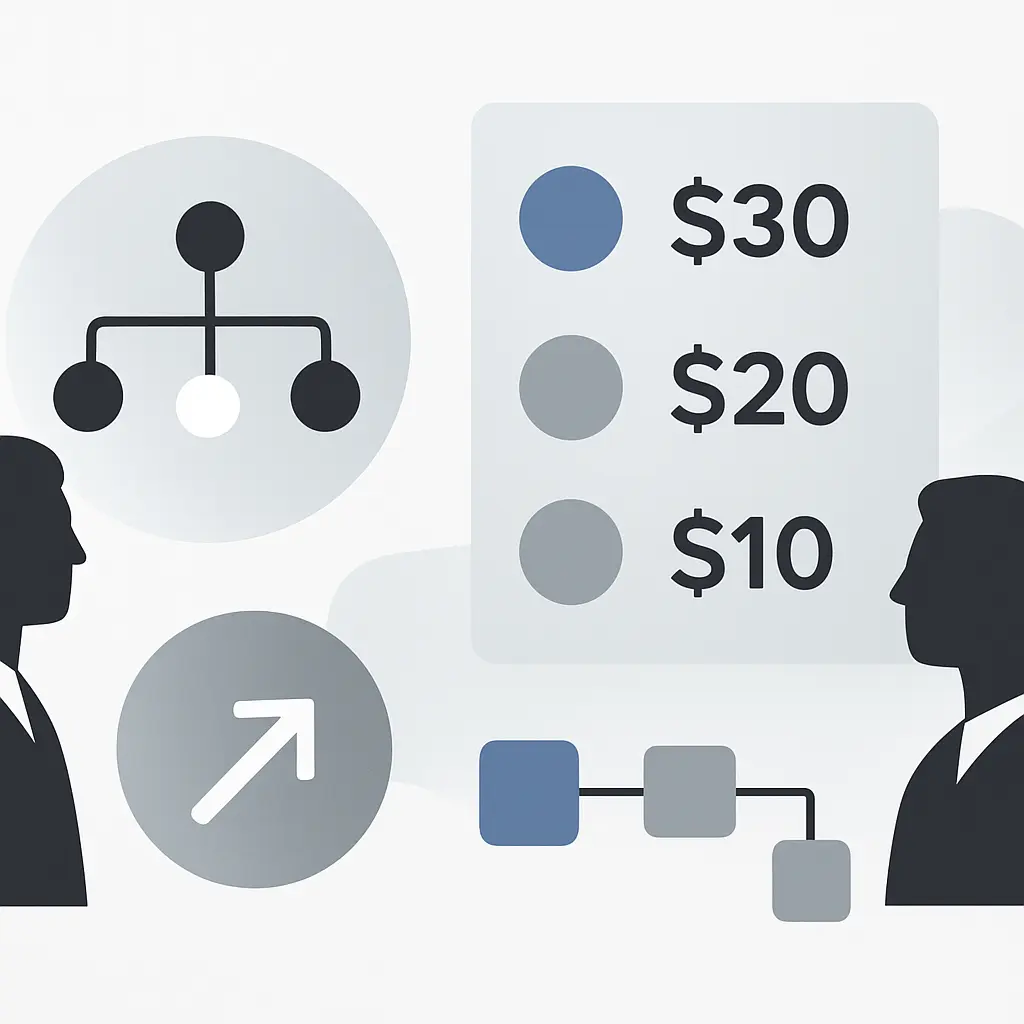
What this pattern really means
The decoy effect occurs when a deliberately placed option (the decoy) makes another option look better by comparison, even though the decoy itself is rarely chosen. In pricing, the decoy is typically priced or feature-framed so that one of the original options becomes the obvious “better” choice by contrast.
In practical terms, the decoy is an asymmetrically dominated option: it is worse than one option on all relevant attributes but may only be partially worse than the other. That imbalance nudges people toward the target option without changing the underlying value of the main two offers.
Leaders should view the decoy not just as a pricing trick but as a design choice that influences behavior and metrics across teams.
Why it tends to develop
**Cognitive shortcuts:** people quickly compare options relative to one another rather than computing absolute value.
**Relative evaluation:** choices are easier when framed as “better than” comparisons instead of standalone judgments.
**Limited attention:** busy customers and sales reps rely on salient contrasts; a decoy creates a clear contrast to focus on.
**Presentation order:** layout, sequencing, or visual emphasis makes the decoy and target more noticeable.
**Social cues:** recommendations, salesperson nudges, or default highlights amplify the decoy’s influence.
**Measurement focus:** teams optimizing short-term KPIs (clicks, add-to-cart) may unintentionally favor decoy tactics.
**Ambiguous attributes:** when features aren’t easily comparable, a decoy simplifies the choice, guiding decisions indirectly.
What it looks like in everyday work
Higher uptake for a middle option after a new “premium-lite” decoy is added to the line-up.
Sales deck updates where a third option is introduced during meetings and causes a sudden shift in executive preference.
Marketing pages with side-by-side plan comparisons that disproportionately highlight one plan by including a clearly inferior alternative.
A/B tests that show lift in conversions but little change in repeat purchase or net promoter scores.
Product teams arguing over adding a low-value tier to drive upgrades rather than to fill a genuine market need.
Procurement or internal vendor choices swayed when a decoy bid makes another vendor appear superior.
Confusion in analytics: revenue per user rises while average customer satisfaction drops, indicating short-term steering.
Sales reps pushing a particular package because it’s easier to sell against a decoy in live demos.
Stakeholder meetings where preference shifts immediately after a third proposal is presented.
Customer complaints or returns indicating the chosen option didn’t meet expectations despite being selected more often.
A quick workplace scenario (4–6 lines)
A product manager adds a low-cost “basic” tier that omits a few features mainly to sit beside the standard tier on the pricing page. After the change, sales of the standard tier jump, but support tickets for missing features also increase. The analytics team flags a mismatch between conversion lift and long-term engagement.
What usually makes it worse
Launching new product tiers without a clear customer-segment rationale.
Pressure from leadership to improve short-term conversion KPIs quickly.
Sales templates that include an extra option to make a target plan look cheaper or richer.
Marketing copy that emphasizes relative benefits rather than absolute value.
Competitive moves that prompt adding a comparison-friendly option.
Website design changes that place plans in a single comparison table.
Ambiguous feature descriptions that make one option seem dominant by default.
Limited customer research before adding or removing plan options.
Incentive programs that reward closing deals over ensuring customer fit.
What helps in practice
Testing and clear rules help teams distinguish deliberate, ethical choice architecture from ad-hoc manipulations that can harm trust.
Establish decision criteria: require documented reasons and target outcomes before adding or changing options.
Use controlled experiments: roll out comparison changes in limited tests and track long-term engagement, not just first-click conversions.
Predefine option sets: keep a catalog of approved product or plan configurations and the business justification for each.
Measure downstream signals: monitor retention, support volume, and satisfaction alongside conversion lifts.
Train sales and product teams to explain absolute benefits, not just relative superiority created by a decoy.
Run customer interviews that ask for absolute valuations (e.g., willingness to pay for features) rather than just preference among preset options.
Audit presentation formats: check comparison tables, order effects, and visual emphasis for accidental decoys.
Create a “why this option” field in proposal templates so whoever adds a new choice states the intended target audience.
Include ethics and transparency checks in go-to-market reviews to assess whether an option is manipulative or misleading.
Use blind tests where users evaluate product features without seeing price to separate true preference from decoy-driven choice.
Coordinate across functions (product, marketing, sales, analytics) before introducing new tiers to align on goals and measurements.
Document and review cases where a decoy was used and analyze whether the outcome matched intended customer value.
Nearby patterns worth separating
Anchoring effect — Anchoring sets a reference point that affects judgments; the decoy is a comparative reference designed to favor one option, while anchoring can be a single price or number that shifts perception more broadly.
Framing effect — Framing changes choices by presentation; the decoy is a specific framing technique that uses an extra option rather than wording or risk framing.
Choice overload — Too many options can paralyze decisions; the decoy intentionally increases complexity in a targeted way to steer choices rather than causing indecision.
Compromise effect — The compromise effect pushes people toward a middle option; a decoy can be used to create or strengthen that middle choice but works through asymmetrical dominance rather than simply being the middle.
Asymmetric dominance — The technical term for what a decoy does: it is dominated by one option and not by another; understanding this clarifies why the decoy changes relative attractiveness.
Defaults and nudges — Defaults set a passive choice; decoys actively alter comparative evaluations. Both are choice architecture tools but operate differently.
A/B testing — A/B tests can reveal decoy impact empirically; unlike a simple landing-page test, decoy effects require tracking downstream metrics and sequential behavior.
Conjoint analysis — Conjoint methods measure attribute-level preferences; they can help reveal whether a decoy actually changes underlying valuations or just surface choices.
Loss aversion — People weigh losses more heavily than gains; decoys may exploit perceived loss avoidance when one option looks safer in relative terms.
Ethical design — While not a cognitive bias, ethical design frameworks guide whether using decoys aligns with company values and customer trust.
When the situation needs extra support
- If repeated experiments show conversion lifts but ongoing harm to retention or customer trust, consult a behavioral scientist or UX researcher.
- Engage data scientists or statisticians when measurement noise or confounding variables make it hard to isolate decoy effects.
- Consider legal or compliance counsel if option presentations risk misleading customers under regulation.
Related topics worth exploring
These suggestions are picked from nearby themes and article context, not just a flat alphabetical list.
Decoy Effect: How Product Positioning Steers Decisions
How adding a clearly inferior option shifts workplace choices — why it happens, how it shows up in proposals and pricing, and how to spot and reduce it.
Endowment Effect in Project Ownership
Why people cling to projects they 'own' at work, how this skews decisions, and practical manager actions to reduce attachment and improve handoffs.
Pre-mortem planning
A practical guide to running pre-mortem planning in team meetings: imagine failure, identify causes, and turn insights into tests, owners, and early mitigations.
Present bias at work
How present bias at work leads teams to choose quick gains over long-term value — why it happens, how managers misread it, and practical fixes to nudge better decisions.
Recency bias in reviews
Recency bias in reviews is the tendency to overweight the latest events when evaluating performance or products — learn how it shows up at work and practical ways to reduce its impact.
Prediction Anchoring
Prediction anchoring is when an early forecast or number shapes later estimates and decisions—learn how it shows up in meetings, why it sticks, and practical ways to reduce it.