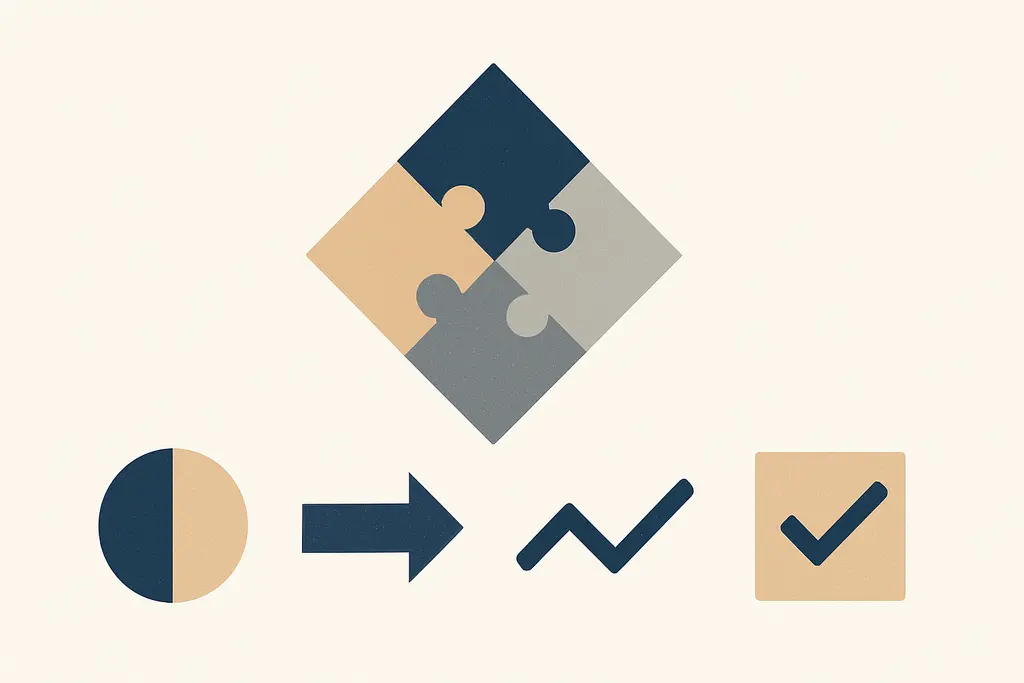
Working definition
Designing task sequences is the deliberate choice of what to do first, next and last so that effort builds on itself rather than grinding to a stop. In practice this involves breaking larger goals into sequenced actions, defining transition points, and ensuring early tasks are achievable and visible.
Good task sequencing balances challenge with attainability and creates a pattern people can follow without repeated reorientation.
Key characteristics:
When these characteristics are present, teams spend less time deciding what to do next and more time executing, which increases efficiency and keeps engagement higher.
How the pattern gets reinforced
Understanding these drivers helps you design sequences that reduce friction and keep teams focused on the next actionable step.
**Cognitive load:** People slow down when a task requires juggling many substeps or remembering context between activities.
**Motivational framing:** Tasks presented as big, vague projects feel harder to start than clearly sequenced steps.
**Social momentum:** Teams follow visible signals—if early steps are neglected, later ones stall.
**Environmental friction:** Tools, approvals, or switch costs between systems interrupt flow.
**Unclear dependencies:** When order isn’t explicit, teams waste time deciding priorities.
**Reward structure:** If incentives favour final outcomes over intermediate progress, intermediate steps get deprioritized.
**Information gaps:** Missing inputs or late decisions force pauses between tasks.
Operational signs
These patterns often look like wasted motion: people busy but not advancing reliably toward milestones. Fixing sequencing turns sporadic effort into a steady stream of completed steps.
Tasks pile up in an "in-progress" column with few items moving to completion.
Team members ask "what next?" frequently during meetings.
Projects have bursts of activity followed by long quiet periods.
Meeting agendas repeatedly restart work that was thought complete.
Small tasks are deprioritized in favor of occasional large pushes.
Handoffs between roles create bottlenecks and idle time.
Checklists exist but are ignored because steps feel disconnected.
Deliverables arrive late despite significant effort being logged.
Pressure points
Ambiguous project kickoff where order of work isn’t set.
A single dependence on one person for multiple tasks.
Tools that require logging into separate systems to complete consecutive steps.
Changing priorities without re-sequencing the backlog.
Overly large first tasks that sap momentum early.
Missing templates or standards that slow downstream work.
Approval or legal reviews placed late in the flow.
Teams distributed across time zones without explicit handoff rules.
Sprint / meeting cadences misaligned with task dependencies.
Moves that actually help
Sequencing is both planning and continual adjustment: put a structure in place, then use short reviews to catch and correct friction before momentum is lost.
Break projects into 1–3 hour tasks and map them so each has a clear next action.
Start sprints with one or two guaranteed quick wins to build confidence.
Define explicit handoff rules: who owns the output and who picks it up next.
Use visual flows (kanban, swimlanes, simple flowcharts) that highlight sequence and blockers.
Time-box transitions: set short windows for review and immediate forwarding to the next owner.
Reduce tool switching by consolidating or scripting routine transitions (templates, automations).
Assign dependency owners to prevent single points of pause.
Pair tasks that naturally fit together to reduce context switching for individuals.
Review and re-sequence work at regular cadence (e.g., weekly backlog grooming focused on order).
Communicate the intended sequence in brief, repeatable language so the team knows the expected path.
Track small-step completion metrics (e.g., percent of tasks that flow without rework) rather than just final delivery.
A quick workplace scenario (4–6 lines)
A product team needs to release a dashboard. The manager splits work into data ingestion, API, frontend views, and deployment checks. The first two days focus on a minimal data pipeline (quick win), then the API is built to read that pipeline, and frontend tasks are queued only after stable endpoints exist. Standups highlight the next owner so handoffs are immediate.
Related, but not the same
Workflow design: focuses on mapping steps; sequencing adds timing and motivation considerations to keep the flow moving.
Dependency management: tracks who or what is required next; sequencing decides order to minimize waiting.
Agile sprint planning: shares the goal of incremental delivery but sequencing emphasizes micro-transitions and visible momentum between sprints.
Handoff protocols: formalize transitions; sequencing ensures those handoffs happen when the next person is ready.
Task batching: groups similar tasks to reduce context switching; sequencing chooses when batches occur to sustain forward progress.
Visual management (kanban): makes flow observable; sequencing uses those visuals to prioritize the immediate next action.
Time-boxing: limits task duration; sequencing uses time-boxes to force short, consecutive completions.
Accountability loops: set expectations for ownership; sequencing ties ownership to specific, ordered steps.
Onboarding checklists: orient newcomers; sequencing integrates new contributors into the ongoing flow without stalling it.
When the issue goes beyond a quick fix
- If process breakdowns cause repeated large delays that harm business outcomes, consult an operations or process improvement specialist.
- When team dynamics around handoffs create ongoing conflict, consider bringing in a trained facilitator or organisational development consultant.
- If workload sequencing contributes to severe burnout or chronic impairment for individuals, encourage them to speak with HR or an occupational health professional.
Related topics worth exploring
These suggestions are picked from nearby themes and article context, not just a flat alphabetical list.
Task aversion loop
A recurring cycle where avoidance reduces short-term pain but increases long-term costs; learn how it forms at work, how it shows up, and practical fixes managers can use.
Post-Win Motivation Dip: Why Momentum Sometimes Fades
Why energy drops after a workplace win, how to tell a short post-win dip from real disengagement, and practical steps managers can use to restore forward momentum.
Designing micro-incentives to keep long-term projects moving
Practical guidance on using small, frequent rewards and signals to keep long-term workplace projects moving—what works, common pitfalls, and how to design them responsibly.
Time scarcity mindset
A practical guide to the time scarcity mindset at work: how habitual urgency forms, how it looks day-to-day, common misreads, and concrete steps to reduce chronic hurry.
Motivation-Job Fit Gap
When a person's motivation and daily tasks don’t match, performance and retention suffer. Learn how this gap forms, how it shows up, and practical steps to close it.
Grit Fatigue
Grit fatigue is when sustained effort keeps rising but returns fall—people work harder yet adapt less. Learn to spot it, what causes it, and how leaders can recalibrate teams.