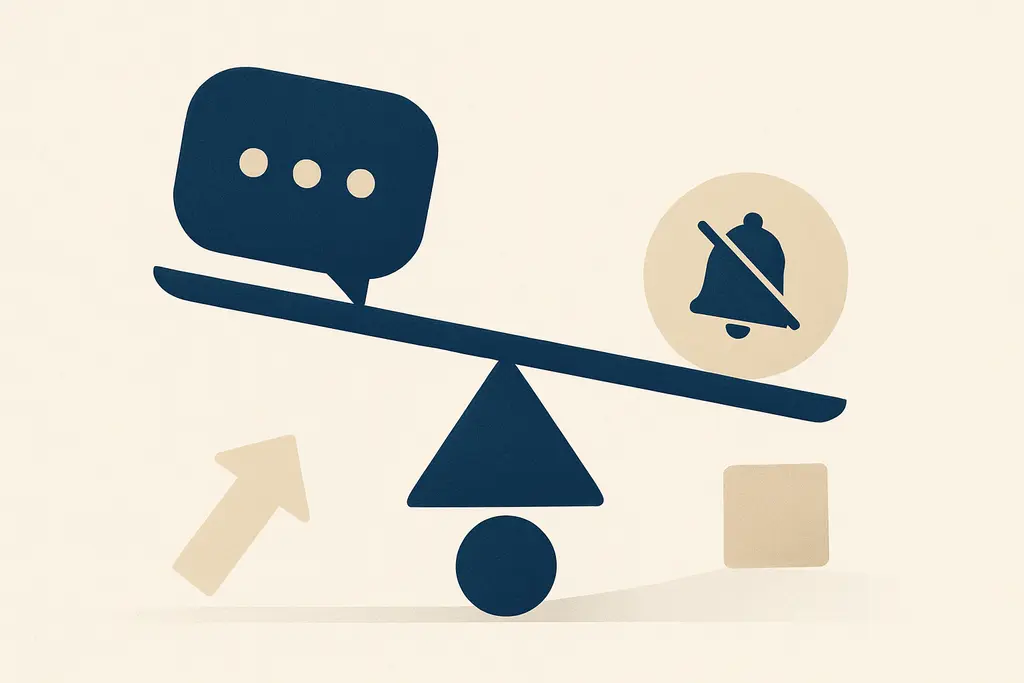
How this pattern shows up in meetings and team workflows
- Late-start check-ins: recurring meetings begin 10–15 minutes late but stay scheduled for the original length.
- Off-form channels: people move coordination from shared documents to fleeting group chats.
- Template decay: agendas, playbooks, or status-report templates get shorter, vaguer, or are skipped.
- Notification choreography: everyone mutes notifications or creates ad hoc rules about when to respond.
These shifts look small in isolation but add up. A meeting that loses its agenda becomes a status dump; a checklist replaced by chat leads to lost decisions. The drift often masks that groups have tacitly re-negotiated expectations without updating formal artifacts.
Why drift develops and what sustains it
Drift grows when incentives, friction, or social signals push people toward convenient shortcuts.
- Convenience and time pressure: shortcuts save a few minutes now and are repeated.
- Social proof: if senior people post updates informally, others follow.
- Tool affordances: new features encourage different behavior (e.g., threaded chat vs. email).
- Invisible costs: lost context is tolerated because immediate responsiveness is rewarded.
Over time, what seemed pragmatic becomes the new normal because the group never pauses to examine trade-offs. The absence of failure signals (nobody blames the pattern) and small immediate gains (faster replies, fewer documents) sustain drift.
A concrete workplace example
An engineering team had a weekly planning meeting with a shared agenda in a repo. Over months:
- Sprint goals were moved to a group chat thread for quick reactions.
- The shared agenda stopped being updated; meeting notes were only in chat.
- New members were onboarded via screenshots rather than the repo, so institutional knowledge fractured.
A quick workplace scenario
During a product launch, the chat thread with the sprint goal was hard to follow; two engineers implemented overlapping fixes because the canonical task list hadn’t been updated. Post-launch, the team blamed communication but the root cause was ritual drift: the ritual of updating the shared repo had been replaced by ephemeral chat interactions.
This example shows how drift causes duplication of effort and increases cognitive overhead for newcomers.
What helps in practice
Start with low-friction corrections: a two-minute note in the agenda reminding contributors where to post decisions often restores the artifact’s authority. The goal is to align social signals (what senior people do) with the formal process so the informal shortcut stops being the default.
**Re-establish canonical artifacts:** pick one authoritative place for decisions and protect it.
**Short agreements:** create 3–5 explicit rules for where to post what (e.g., decisions in doc, quick updates in chat).
**Micro-retrospectives:** add a 5-minute check at the end of regular meetings to surface changes in habits.
**Tool hygiene rituals:** schedule a weekly cleanup for docs, labels, and threads.
How this pattern is commonly misread or oversimplified
- Confused with poor communication: Teams often call ritual drift "bad communication," but the problem is not information transfer alone — it is a shift in where authoritative records live.
- Mistaken for resistance to tools: switching channels is rarely technophobia; it’s usually a pragmatic response to friction or unclear incentives.
Contrast helps: poor communication is about missing or unclear messages; ritual drift is a systemic change in rituals that changes how messages are produced and archived. Treating drift as an interpersonal failing will miss the structural fixes (agreements, artifacts, norms) that restore alignment.
Questions worth asking before you change processes
- Who currently treats which artifact as the source of truth?
- Which short-term gains are we trading for long-term coordination costs?
- Are senior members modeling the behavior we want to normalize?
- When was the last time we reviewed and refreshed our recurring rituals (agendas, templates, channel rules)?
These diagnostic questions prevent premature reactions. If answers reveal that people shifted channels because a document is hard to find, the fix is tooling and discoverability—not another policy memo. If the drift is driven by perceived time pressure, consider shortening rituals instead of enforcing longer ones.
Related patterns worth separating from it
- Meeting inertia: the habit of keeping a meeting because it’s on the calendar, even when it’s no longer useful. This is about schedule bloat rather than where information lives.
- Digital distraction: attention fragmentation from notifications and multitasking. Drift can increase distractions, but distraction has a distinct cognitive-cost profile.
- Process creep: the slow accretion of steps to a workflow. Process creep and ritual drift can co-occur, but creep adds steps while drift relocates or erodes rituals.
Differentiating these patterns helps target interventions—reducing meeting inertia might mean canceling meetings; reversing ritual drift often means re-anchoring the team to an authoritative artifact and updating social norms.
Related topics worth exploring
These suggestions are picked from nearby themes and article context, not just a flat alphabetical list.
Nudge Fatigue
Nudge fatigue is when repeated workplace prompts lose effect and annoy people; learn how it develops, appears in daily work, and which fixes restore impact.
Habit relapse pathways
How workplace habit relapse pathways (cue→response→reinforcement loops) undo change, where they originate, and concrete steps leaders can use to interrupt them.
Team Keystone Habits
How small shared routines—team keystone habits—drive disproportionate outcomes at work and how managers can identify, change, and sustain better defaults.
Micro-goal calibration
How tiny, frequently adjusted short-term targets shape daily work—why teams fall into them, how to spot misleading progress, and practical manager-level fixes.
Habit Stacking Pitfalls
How habit-stacking in the workplace creates brittle routines, why stacks fail, and practical steps managers can take to simplify, test, and rebuild resilient workflows.
Habit friction audit
A practical guide to auditing small workplace barriers that stop intended routines — find the micro-obstacles, test simple fixes, and turn intentions into repeatable habits.