Working definition
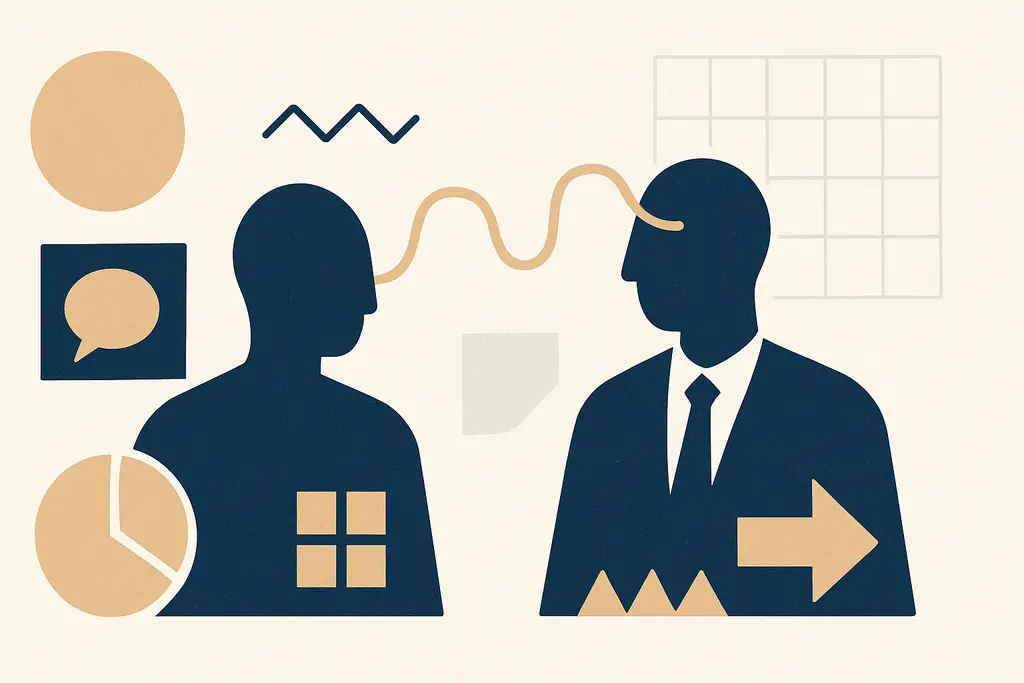
Emotional contagion in meetings describes how emotions travel between people during group interactions. Simple signals — facial expressions, tone of voice, pacing, and even silence — can transfer enthusiasm, anxiety, frustration or calm across the group without anyone explicitly stating those feelings.
In a meeting context this is often fast and unconscious: one participant’s upbeat framing can lift energy, while one person’s visible annoyance can make others withdraw or mirror that agitation. The phenomenon is not about truth or facts; it’s about how feelings influence participation and interpretation of information.
These characteristics explain why the same meeting can feel very different depending on who speaks first, how the agenda is framed, or even where people sit.
How the pattern gets reinforced
**Social alignment:** people unconsciously match others’ expressions to build rapport and predict behavior.
**Mirror neurons:** automatic neural responses make it easy to imitate facial expressions and gestures.
**Norm cues:** visible emotional reactions signal what feelings are acceptable in this group or topic.
**Cognitive load:** when people are processing complex information they rely more on social cues than on independent evaluation.
**Power dynamics:** voices from higher-status attendees set emotional tone that others tend to follow.
**Environmental triggers:** room layout, time of day, or schedule pressure can make mood more volatile.
**Past interactions:** unresolved conflicts or recent wins color baseline affect and readiness to mirror others.
Operational signs
Spotting these patterns helps the group identify whether emotion is helping clarity and collaboration or steering choices away from evidence.
Opening tone sets engagement: an excited start boosts energy; a flat or tense opening suppresses comments.
Rapid alignment: participants begin to mirror a dominant person’s facial expressions or posture.
Participation shifts: when anxiety spreads, fewer people volunteer ideas; when enthusiasm spreads, more jump in.
Faster convergence: teams may agree quickly without full critique when positivity dominates, or stall when worry dominates.
Topic avoidance: certain agenda items get sidelined after a visible emotional reaction.
Echoing language: phrases and metaphors repeat across speakers within the same meeting.
Body language synchrony: gestures, foot positions, or leaning forward/backward become uniform.
Meeting exits: people leave visibly uplifted or drained in groups rather than singly.
A quick workplace scenario (4–6 lines)
A product review starts with a senior engineer tersely pointing out a bug; a few teammates stiffen and stop volunteering updates. The project manager notices the drop in questions and pauses, invites a round-robin update, and the mood gradually shifts back to constructive problem-solving. By the end, the team has concrete next steps and a calmer tone.
Pressure points
A strong opener (positive or negative) from a senior attendee.
Tight deadlines or last-minute agenda changes.
Public critique or praise directed at individuals.
Confusion over goals or lack of a clear agenda.
Technical hiccups (call issues, slide problems) that frustrate several people.
Overloaded meetings back-to-back causing fatigue.
Visible side conversations or micro-conflicts during the meeting.
Cultural differences in expression that are misinterpreted as hostility or indifference.
Announcement of high-stakes outcomes (layoffs, budget cuts, big wins).
Moves that actually help
Applying these steps in team routines reduces the chance that an unplanned emotional spike will drive a group decision.
Set a neutral opening: start with a short factual agenda and a quick check-in to calibrate mood.
Normalize steady pacing: use a timed agenda and checkpoints to reduce emotional drift.
Rotate facilitators: a different facilitator can change the emotional default and invite fresh dynamics.
Signal pauses: when tone escalates, call a 60–90 second silence for notes and regrouping.
Use structured turns: round-robin or speaking tokens prevent dominance and reduce emotional ripple effects.
Reframe language: convert emotionally charged words into neutral descriptions of facts and impacts.
Surface feelings without judgment: invite a brief temperature check (e.g., "Quick pulse: optimistic, worried, neutral?") to make emotion explicit and manageable.
Anchor decisions to criteria: use checklists or decision frameworks so choices are less mood-dependent.
Control environment: optimize seating, lighting, and tech to minimize incidental irritants that amplify mood.
Model regulation: when a leader or facilitator keeps a calm, curious posture, others often mirror that steadiness.
Debrief emotion-sensitive topics: after heated discussions, summarize facts and actions to restore clarity.
Prepare for high-stakes topics: pre-brief key participants on desired tone and how to handle likely reactions.
Related, but not the same
Emotional intelligence — Connects by offering individual awareness skills that reduce unwanted spread; differs because EI is an individual capacity, while emotional contagion is an interactional process.
Groupthink — Related in that shared mood can suppress dissent; differs because groupthink focuses on conformity in reasoning, not the automatic transmission of feeling.
Psychological safety — Connects as a buffer: teams with psychological safety can name emotions and contain contagion; differs because psychological safety is a team climate, not the mechanism of spread.
Nonverbal communication — Directly linked as the primary channel for mood transfer; differs because nonverbal communication covers all signals, whereas emotional contagion is the outcome of those signals being mirrored.
Affective events theory — Connects by explaining how workplace events generate moods that influence behavior; differs because affective events theory frames causes and consequences broadly beyond meeting interactions.
Social facilitation — Related in that others’ presence changes performance and arousal; differs because social facilitation addresses performance effects, not emotional alignment.
Leadership tone-setting — Connects strongly: leader affect often seeds meeting mood; differs because tone-setting is an intentional leadership behavior, whereas contagion can be accidental.
Mirroring and synchrony — Linked as micro-behaviors that transmit emotion; differs because these terms emphasize behavior matching, while emotional contagion emphasizes the resulting shared affect.
When the issue goes beyond a quick fix
- If meeting-related emotional patterns consistently reduce team productivity, consider consulting an organizational development specialist.
- If workplace mood dynamics cause significant ongoing distress for individuals, suggest they contact an employee assistance program (EAP) or a qualified occupational health professional.
- If persistent conflict or morale issues exceed managerial tools, consider bringing in an external facilitator or HR consultant to assess team functioning.
Related topics worth exploring
These suggestions are picked from nearby themes and article context, not just a flat alphabetical list.
Conflict contagion
How interpersonal disagreements spread across teams, why they escalate, what to watch for day-to-day, and concrete steps leaders can use to stop or reverse the spread.
Status Signaling in Meetings
How people use words, posture and timing to claim influence in meetings, why it emerges, how to spot it, and practical ways to reduce status-driven distortion of decisions.
Why only a few people speak in meetings
Why a few people dominate meetings: how design, power, and timing suppress others' input, what it looks like in practice, and practical fixes teams can use right away.
Psychology of silent dissent in meetings
When people privately disagree but stay quiet in meetings, decisions look settled but later stall. Learn how it shows up, why it happens, and practical steps to surface and reduce it.
Request Framing
How the wording, context, and implied expectations around a work ask shape responses—and practical ways to reframe requests to reduce friction.
Feedback aversion
Feedback aversion is the avoidance of candid performance conversations at work; it shows up as silence, shallow reviews, and missed learning—practical fixes for leaders.