Working definition
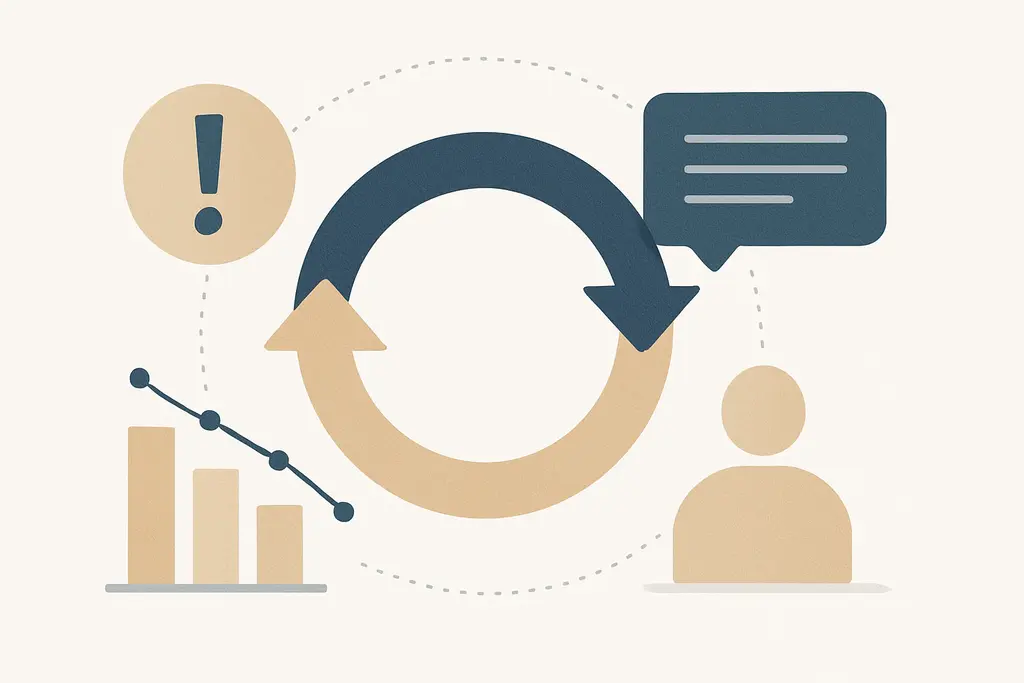
The Feedback Avoidance Loop is a cycle in which concerns about reactions, reputation, or short-term comfort lead people to withhold or soften feedback. That avoidance prevents corrective information from reaching the person who can act, so the original problem keeps repeating — which then reinforces further avoidance.
Key characteristics:
In practical settings, the loop usually involves at least two roles: the person who could give corrective input and the person whose actions would change if they received it. When both sides prefer short-term comfort over constructive friction, the loop closes and becomes self-sustaining.
How the pattern gets reinforced
**Fear of negative consequences:** people worry about harming a relationship, triggering defensiveness, or facing retaliation.
**Self-image protection:** protecting a perception of competence makes delivering candid feedback uncomfortable.
**Social norms:** cultures that prioritize politeness or hierarchical deference discourage direct correction.
**Ambiguity about responsibility:** unclear roles or ownership reduce who feels authorized to speak up.
**Unclear channels:** absent or poorly designed feedback mechanisms push people to avoid ad hoc conversations.
**Time pressure:** tight deadlines make short-term peacekeeping preferable to investing in corrective conversations.
**Past negative experiences:** prior harmful feedback exchanges teach people that speaking up isn’t worth the cost.
Operational signs
Patterns like these often look harmless at first but signal a persistent communication gap. Over time they reduce agility: problems reappear because the information needed to change behavior never traveled through the organization.
Repeated mistakes or low-impact behaviors that never get corrected.
Performance reviews that surface issues for the first time, surprising people who assumed they were doing fine.
Managers or peers softening language (“maybe consider…”) instead of naming the core issue.
Passive disagreement in meetings (silence, eye-rolls, or private grumbling) instead of direct feedback.
Over-reliance on formal documents instead of candid conversations.
Team members only giving praise publicly and avoiding corrective input in private.
Small fixes applied temporarily after a crisis, but no systemic changes follow.
High turnover or disengagement tied to recurring unresolved issues.
Pressure points
A high-stakes project with tight deadlines.
Recent changes in reporting lines or team structure.
Strong hierarchical differences that discourage speaking up.
Performance reviews framed as summative rather than developmental.
Public criticism in prior conversations creating fear of reprisal.
Incentives tied only to short-term outputs, not learning.
Ambiguous success criteria for tasks or roles.
Cultural expectations that emphasize harmony over candor.
Moves that actually help
Consistent, predictable practices lower the emotional cost of feedback. Over time these steps transform one-off awkward conversations into routine learning moments and break the pattern of avoidance.
Create predictable, low-stakes feedback rituals (e.g., brief weekly check-ins) so feedback feels routine rather than punitive.
Model asking for feedback first: openly request input on your own decisions to normalize reciprocity.
Use structured formats (Situation–Behavior–Impact, examples-focused notes) to keep feedback specific and actionable.
Separate corrective coaching from evaluation: make it clear which conversations are developmental and which affect ratings.
Train people in giving and receiving feedback: short workshops or role-plays that practice framing and listening.
Protect psychological safety through ground rules (no public shaming; focus on outcomes not intent).
Signal consequences and follow-through fairly: when feedback leads to a plan, track small wins so the loop breaks.
Offer anonymous or third-party channels for sensitive issues, then act transparently on aggregated themes.
Clarify ownership: assign responsibility for following up on recurring issues so they don’t fall through cracks.
Reduce ambiguity by defining success criteria and observable standards for common tasks.
Use small experiments: try one new feedback practice for a sprint and evaluate whether it changes behavior.
A quick workplace scenario
A product lead notices feature bugs resurfacing each sprint but avoids raising them in standups to keep momentum. After a retrospective, the team adopts a short pre-launch checklist and a one-minute feedback round; the checklist catches common errors and the round makes deviation visible, stopping the loop.
Related, but not the same
Feedback loop (positive vs. negative): a feedback loop is the broader idea of information influencing behavior; Feedback Avoidance Loop specifically describes information being withheld, which prevents corrective negative feedback from reducing the issue.
Psychological safety: lower safety encourages avoidance; this concept explains the emotional environment that makes the loop more or less likely.
Confirmation bias: people favor information that confirms their beliefs; confirmation bias can reinforce avoidance by making uncomfortable feedback seem less credible.
Performance review cycle: formal performance systems can either interrupt avoidance by mandating feedback or worsen it if reviews are the first place problems are mentioned.
Impression management: efforts to protect reputation often motivate avoidance; impression management is one driver behind the loop.
Bystander effect: when many people notice a problem but assume someone else will speak, the effect contributes to collective avoidance.
Escalation of commitment: continuing ineffective practices without feedback commitment amplifies the cost; avoidance helps maintain that commitment.
360-degree feedback: this structured process reduces single-point avoidance by collecting multiple perspectives, but it must be implemented carefully to avoid defensive responses.
Conflict avoidance: a broader pattern of evading disagreement; conflict avoidance creates conditions in which feedback is less likely to reach the recipient.
When the issue goes beyond a quick fix
- If patterns of avoidance lead to sustained workplace impairment, repeated crises, or legal exposure, consult an organizational development consultant or HR professional.
- When interpersonal dynamics cause significant distress or burnout for multiple people, an external facilitator can help mediate and redesign processes.
- For recurring cultural problems that training hasn’t fixed, consider an experienced coach or OD specialist to audit systems and recommend structure-level changes.
Related topics worth exploring
These suggestions are picked from nearby themes and article context, not just a flat alphabetical list.
Feedback avoidance and its team effects
How teams avoid giving or seeking candid feedback, why that pattern repeats in meetings, and practical steps teams can use to surface issues and reduce harm.
Feedback aversion
Feedback aversion is the avoidance of candid performance conversations at work; it shows up as silence, shallow reviews, and missed learning—practical fixes for leaders.
Feedback timing effects
How the moment feedback is delivered shapes learning, trust, and behavior at work — and what leaders and teams can do to align timing with the purpose of feedback.
Feedback priming
How initial cues—tone, first metrics, or opening examples—shape how feedback is heard and acted on, plus practical steps to spot and reduce that bias at work.
Feedback fatigue at work
When feedback becomes too frequent, vague, or conflicting, people tune it out. Learn how it shows up, why it forms, common confusions, and practical steps leaders can take to fix it.
Escalation avoidance tactics
How employees keep issues off leaders' desks, why that happens, and practical steps managers can take to surface problems early and reduce hidden risk.