What it really means
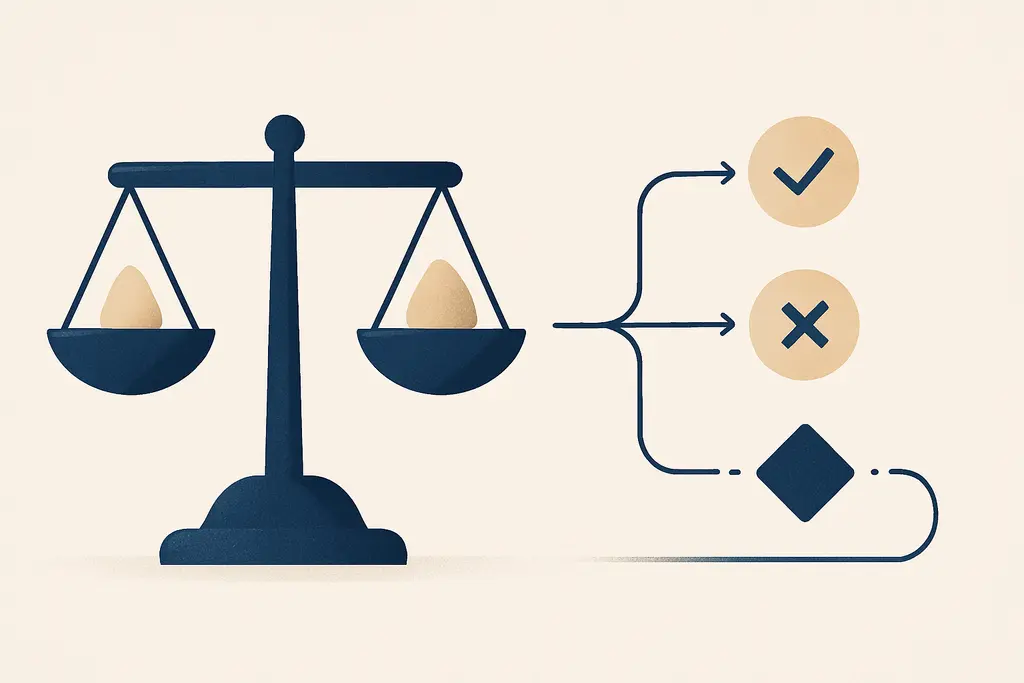
Group choice deferral describes a stable pattern where the collective response to a decision point is to delay rather than decide. It is not just one person hesitating; it’s a social dynamic where responsibility diffuses and the group defaults to waiting—for more data, a different meeting, or a higher-up to step in.
Seen as a pattern, deferral can be both tactical (buy time to gather facts) and symptomatic (a recurring avoidance habit). Distinguishing the two matters because the remedy for purposeful, limited delays is different from the remedy for chronic, culture-driven postponement.
How this pattern takes root in meetings
Group choice deferral usually develops from a mix of structural and social conditions:
- Ambiguous decision rights: No clear owner or RACI for the choice.
- Consensus norms: A high premium on unanimous agreement makes groups prefer delay until everyone signs off.
- Fear of being wrong: Individuals offload risk to the group to avoid personal blame.
- Information gaps: Real or perceived lack of data becomes a convenient reason to postpone.
- Meeting design flaws: Long agendas, lack of timeboxing, and ill-defined outcomes encourage tabling items.
These elements reinforce each other. For example, a culture that penalizes mistakes encourages leaders to avoid assigning a clear decider; without a decider, everyone expects further input, and the decision cycles on. Over time the pattern becomes the default meeting outcome rather than an exception.
How it looks in everyday work
- Repeated "table it": Agenda items are deferred from week to week without diminishing urgency.
- Shifting ownership: Team members say things like “let’s wait for product” or “we need stakeholder sign-off,” so the decision never lands.
- Overreliance on more data: Calls for “one more study” or “another analysis” instead of making a bounded judgment.
- Meeting creep: Multiple follow-ups and special sessions appear, each meant to resolve the same question.
- Silent acquiescence: People avoid voicing strong preferences; outcome defaults to inaction.
Taken together, these behaviors produce hidden costs: missed opportunities, coordination lag, and demoralization when team members see nothing changing despite time invested. Managers often label this as "being thorough," but frequent postponement usually signals a process problem rather than prudence.
A quick workplace scenario
A product team has to decide whether to launch a minor feature now or in the next cycle. In three successive planning meetings the item is postponed: marketing wants more user tests, engineering wants a clearer spec, and leadership wants competitive intel. No one is assigned final sign-off. After six weeks the feature is deprioritized due to other fires — the team spent effort gathering inputs but never made a choice.
This example shows how short-term information requests and absent decision rights convert a concrete choice into chronic deferral.
Practical moves that reduce deferral
- Assign a decider: Make clear who has authority to approve, veto, or choose a default.
- Timebox choices: Limit discussion time and require a decision or a named next step at the end of the slot.
- Set a default: Agree on a default action if the group fails to decide by a deadline.
- Define required inputs in advance: Specify what data is sufficient so “more data” is not a perpetual escape.
- Use structured decision rules: Voting rules, weighted scoring, or a short decision rubric reduce subjective stalls.
- Practice small experiments: Treat the decision as reversible where possible (pilot, A/B test) to lower perceived risk.
These practices work because they change incentives and reduce ambiguity. For instance, assigning a decider resolves diffusion of responsibility; timeboxing removes the option to endlessly re-argue. Implementing one or two changes and tracking meeting outcomes for a month is often enough to see improvement.
Questions worth asking before changing process: Who suffers from the delay? What are the measurable costs? Is the postponement driven by genuine uncertainty or by social friction?
Often confused with
People commonly misread group choice deferral as other phenomena. Two frequent near-confusions:
Leaders often misread deferral as prudence — preferring to call it "due diligence" — when the real issue is unclear decision rights or a culture that punishes mistakes. Conversely, pushing too hard against every delay can break useful caution into rash action. The diagnostic step is to identify whether postponement is strategic (with a clear deadline and owner) or systemic (recurrent, unfounded, and diffuse).
Related concepts worth separating from deferral include groupthink (conformity of opinion), avoidance (individual withdrawal), and delegation (intentional transfer of authority). Each has different remedies: counteracting groupthink requires diverse voices; fixing delegation problems requires clearer role definitions; reducing deferral requires clearer decision rules and meeting structures.
**Consensus-seeking vs. avoidance:** Seeking consensus aims to build shared commitment and can be appropriate; deferral is when the search for unanimity becomes an excuse to avoid choosing. Consensus can be deliberate; deferral is often accidental.
**Analysis paralysis vs. genuine information deficit:** Analysis paralysis is the habit of overanalyzing all options; a genuine information deficit is when relevant data truly isn’t available. The first is cognitive and procedural; the second is situational and should have an explicit plan for data collection.
Quick checklist for meeting facilitators
- Clarify the decision required and the timeline before discussion begins.
- Name who will decide and what constitutes adequate information.
- Timebox the discussion and require an explicit next step (decide, assign, or set a final deadline).
- Record the decision or the reason for deferral and set a revisit date.
Using that checklist consistently converts accidental postponements into purposeful, accountable choices and helps teams turn meetings into productive decision engines rather than endless forums for delay.
Related topics worth exploring
These suggestions are picked from nearby themes and article context, not just a flat alphabetical list.
Paradox of choice at work
How extra options at work—tools, vendors, processes—create delays, doubt, and lower throughput, and what practical levers managers and teams can use to restore clarity and speed.
Project portfolio choice overload
When too many projects compete for attention, decisions stall and resources scatter. Practical guide to recognizing causes, everyday signs, and manager-level fixes.
Choice-supportive memory in postmortems
How teams remember their own choices more kindly in postmortems—and simple practices to surface the true decision record so reviews yield real learning.
Pre-mortem planning
A practical guide to running pre-mortem planning in team meetings: imagine failure, identify causes, and turn insights into tests, owners, and early mitigations.
Present bias at work
How present bias at work leads teams to choose quick gains over long-term value — why it happens, how managers misread it, and practical fixes to nudge better decisions.
Recency bias in reviews
Recency bias in reviews is the tendency to overweight the latest events when evaluating performance or products — learn how it shows up at work and practical ways to reduce its impact.