Working definition
Groupthink is a social decision-making pattern where maintaining consensus becomes more important than testing alternatives or voicing concerns. It often emerges in intact groups that meet regularly and rely on shared norms, where people self-censor to avoid rocking the boat.
In practical terms, groupthink means the team converges quickly on a single idea, treats dissent as disloyal, and overlooks potential risks. This isn’t about one person being wrong — it’s about the group dynamics that suppress useful disagreement.
Typical characteristics include:
These traits usually show up over time in recurring meetings: initial alternatives narrow, quieter members stop contributing, and the group treats early signals as confirmation. That pattern makes it easier to spot and to interrupt.
How the pattern gets reinforced
These drivers mix differently depending on team size, culture, and context; identifying the dominant drivers helps choose the right interventions.
**Social pressure:** Individuals avoid disagreement to escape conflict, criticism, or ostracism.
**Desire for harmony:** Teams value a smooth process and so trade critical debate for faster agreement.
**Authority influence:** Strong verbal or nonverbal cues from leaders steer the group without explicit debate.
**Shared identity:** High team cohesion or a strong in-group identity reduces perceived need to test ideas.
**Cognitive shortcuts:** Time pressure and complex problems encourage reliance on heuristics and the first plausible answer.
**Information asymmetry:** When some members hold most relevant data, others accept the apparent consensus.
Operational signs
When these patterns appear in meeting notes and follow-ups, they often predict rework or missed risks later. Spotting consistent silence or repeated narrow options is a practical warning that the group may have shut down useful debate.
Early closure: decisions reached quickly with little comparison of alternatives
Low dissent: objections are rare, and critical comments get brushed aside
Homogeneous recommendations: options presented sound similar or recycled
Dominant voices set the agenda and others align without pushing back
Private reservations: people express concerns privately but not in the group
False unanimity: team assumes everyone agrees because silence is interpreted as consent
Lack of devil's advocacy: no one is assigned or willing to formally challenge proposals
Overconfidence in execution timelines and underestimation of risks
A quick workplace scenario (4–6 lines, concrete situation)
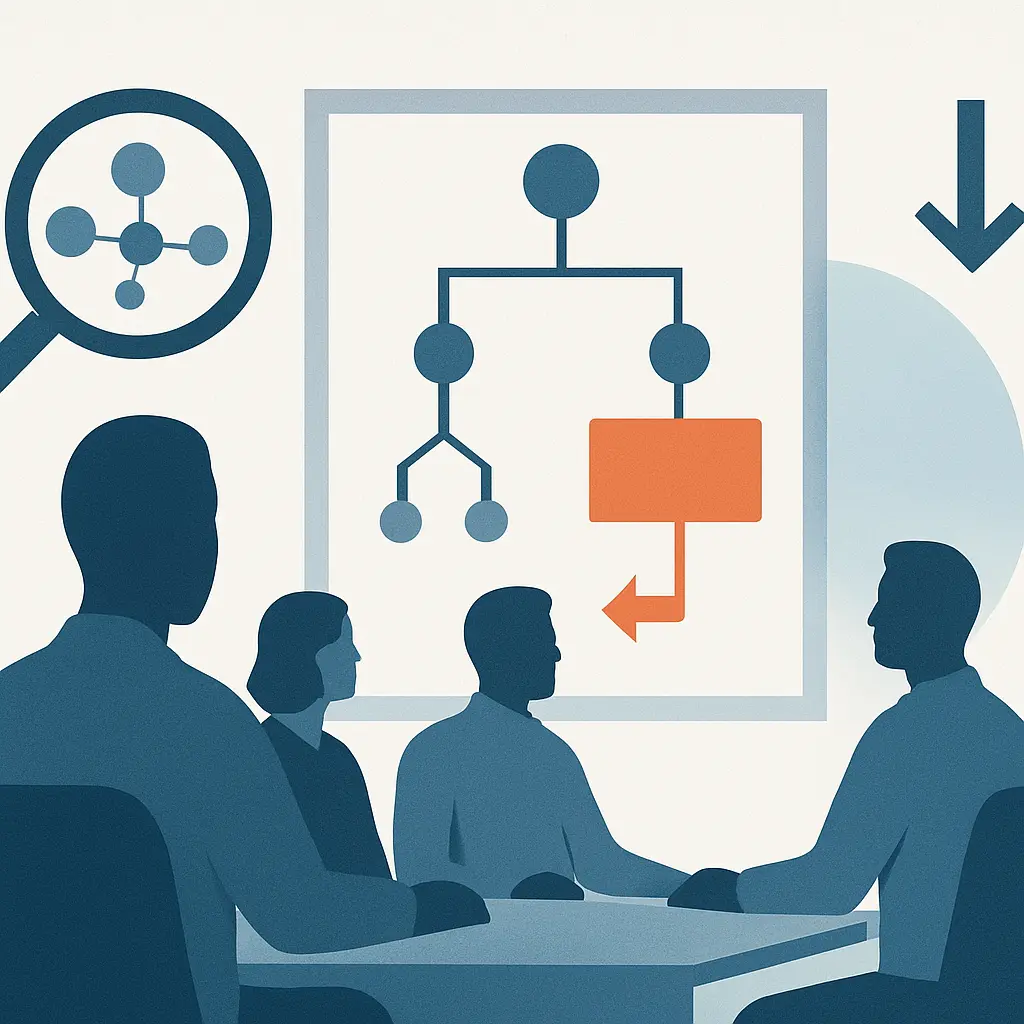
In a product review meeting, the lead presents a single roadmap and pauses for feedback. A few attendees say nothing; two express minor tweaks, but no one challenges the core choice. The team votes to proceed. Two months later, unforeseen technical constraints force a last-minute pivot.
Pressure points
Recognizing these triggers makes it easier to redesign meetings and processes to allow more critical evaluation.
Tight deadlines that reward speed over deliberation
Small or insular teams with strong shared culture
Meetings where a manager or senior expert strongly favors one option
Lack of diverse expertise or missing stakeholders in the room
Incentives that reward consensus or penalize visible conflict
Repeated success that reinforces overconfidence in current methods
Meeting formats that prioritize updates over open discussion
High stakes framed as binary choices (go/no-go) without intermediate options
Moves that actually help
Practical changes to meeting design and decision rules are often low-cost and reduce repeat mistakes. The goal is to widen the window for critical review, not to generate conflict for its own sake.
Rotate roles: assign a different person to play devil's advocate each meeting to normalize challenge
Structure alternatives: require at least three distinct options before a decision
Pre-meeting input: gather anonymous written opinions or ratings on proposals ahead of time
Break into small groups: use parallel subgroup discussions to generate diverse ideas, then regroup
Protect dissent: explicitly invite and validate critical perspectives from quieter members
Delay commitment: avoid immediate decisions; set a follow-up to collect new data or reflection
Use independent review: bring in an uninvolved colleague or stakeholder for fresh critique
Clarify criteria: define decision criteria and success metrics before discussing solutions
Share information widely: circulate relevant data and dissenting analyses with the full group
Equalize airtime: use timed speaking slots or facilitation techniques to balance participation
Document alternatives and reasons for rejecting them so future teams can revisit choices
Related, but not the same
Confirmation bias — both favor information that supports an existing view, but confirmation bias is an individual tendency while groupthink is a social dynamic that suppresses collective critique.
Group polarization — group discussions can push opinions to extremes; groupthink differs because it emphasizes premature agreement rather than escalation of attitudes.
Social loafing — teammates contribute less in groups; social loafing reduces input quantity, while groupthink reduces input diversity and challenge.
Authority bias — deference to leaders shapes choices; authority bias can trigger groupthink when leader cues go unexamined.
Pluralistic ignorance — people wrongly assume their private concerns are unique; this feeds groupthink by making silence seem like consensus.
Decision fatigue — tired teams simplify choices; decision fatigue creates conditions where groupthink is more likely to take hold.
Silo thinking — narrow team perspectives miss alternatives; siloed groups are prone to groupthink because they lack external viewpoints.
Devil's advocacy — an intervention technique that intentionally differs from groupthink by institutionalizing dissent to test assumptions.
When the issue goes beyond a quick fix
Consult trained professionals who specialize in organizational behavior to design and implement interventions rather than relying solely on ad hoc fixes.
- If team dynamics cause persistent conflict, chronic disengagement, or impaired delivery, consider workplace consulting or organizational development support
- Consider a trained facilitator or organizational psychologist when repeated projects fail due to similar decision errors
- Engage HR or an external mediator if power dynamics or bullying prevent open discussion
Related topics worth exploring
These suggestions are picked from nearby themes and article context, not just a flat alphabetical list.
Groupthink detection and prevention
A practical field guide to spotting and reducing groupthink in team decisions, with detection cues, prevention rituals, and concrete workplace examples.
How to avoid confirmation bias in hiring
Practical guidance to spot and reduce confirmation bias in hiring: signs to watch, common traps, and structured steps (rubrics, blind screening, disconfirming probes) to improve decisions.
Pre-mortem planning
A practical guide to running pre-mortem planning in team meetings: imagine failure, identify causes, and turn insights into tests, owners, and early mitigations.
Present bias at work
How present bias at work leads teams to choose quick gains over long-term value — why it happens, how managers misread it, and practical fixes to nudge better decisions.
Recency bias in reviews
Recency bias in reviews is the tendency to overweight the latest events when evaluating performance or products — learn how it shows up at work and practical ways to reduce its impact.
Prediction Anchoring
Prediction anchoring is when an early forecast or number shapes later estimates and decisions—learn how it shows up in meetings, why it sticks, and practical ways to reduce it.