What it really means
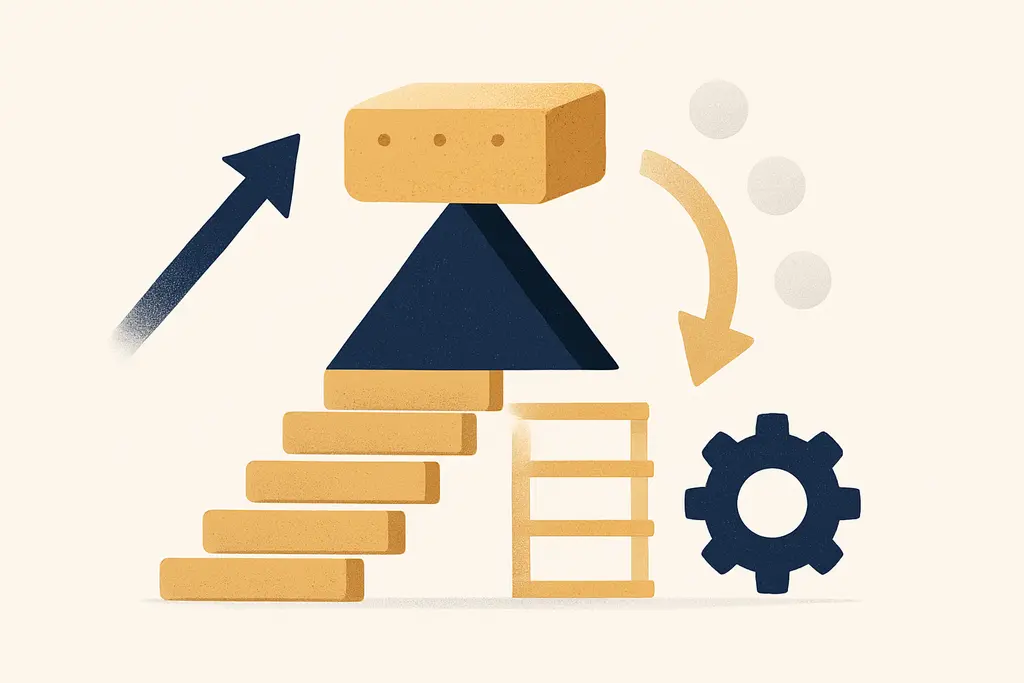
Habit scaffolding is about structure more than willpower. Rather than asking people to "just do it," scaffolding provides tangible supports: consistent cues, reduced friction, and immediate feedback that make a desired behavior the path of least resistance. Over time, the scaffolds are removed or simplified because the behavior becomes self-sustaining.
Underlying drivers
Scaffolding emerges when leaders or practitioners notice a desired outcome but see gaps in the environment or skillset that block consistent execution. Common sustaining forces include:
These factors combine to convert intentional effort into a cue-driven routine. If any element weakens (e.g., feedback slows or defaults change), the scaffolded habit can regress.
**Frequent repetition:** small actions repeated in the same context accelerate automaticity.
**Environmental design:** tool placement, default settings, and templates lower friction.
**Social reinforcement:** peers and norms signal that an action is expected.
**Feedback loops:** quick feedback (success signals or corrective cues) keeps momentum.
Observable signals
These visible elements are often accompanied by invisible supports: small reductions in friction (fewer clicks), task breakdowns that lower perceived difficulty, and social expectation. In practice, scaffolding looks less like a training program and more like an ecosystem change that makes the right next step simpler.
**Checklists and templates:** standardized forms reduce decision points and prompt consistent behavior.
**Calendar anchors:** a standing 10-minute slot each morning that cues a review habit.
**Tool defaults:** pre-filled fields or recommended settings that push users toward a behavior.
**Peer pairings:** a buddy system that prompts accountability and models the steps.
**Micro-prompts:** short, contextual reminders (chatbot nudges, pinned messages) that cue action.
A quick workplace scenario
A product team wants faster post-mortems after incidents. Rather than mandate a long checklist, the lead creates a 5-field incident form in the ticketing system (what happened, immediate fix, owner, 15-minute reflection slot, one action item). The form auto-opens when an incident ticket is closed and assigns the owner a calendar reminder. Within weeks the team moves from sporadic, hour-long post-mortems to short, scheduled reflections that produce concrete follow-ups.
Practical responses
After the list above: These actions work because they target the core mechanisms that keep a scaffolded habit alive—cue reliability, low effort, and reward. Practical next steps for a manager are to map the cue–action–reward chain for the behavior and then test one minimal scaffold at a time.
**Start small:** make the scaffolded step tiny and repeatable so it fits existing workflows.
**Remove friction:** eliminate unnecessary choices, consolidate tools, and pre-fill fields.
**Create immediate feedback:** show tangible progress or short-term benefits to reinforce repetition.
**Timebox removal:** plan for progressive removal of supports as behavior becomes automatic.
**Monitor decay points:** identify where lapses occur (e.g., after role changes) and add lightweight re-supports.
Often confused with
Related concepts that get mixed up with habit scaffolding:
After the list above: Clarifying these separations helps avoid common mistakes: use nudges to change choice architecture, use habit stacking to anchor a new routine to an old one, and treat ritualization as a cultural tool distinct from the practical mechanics of scaffolding.
**Mistaking scaffolding for bribery:** Rewards can help initially, but scaffolding focuses on structure and friction, not ongoing extrinsic payoffs.
**Confusing scaffolding with permanent process mandates:** Effective scaffolds are temporary; durable mandates are often heavier-handed than needed.
Habit stacking: placing a new behavior immediately after an existing habit to piggyback on an already-stable cue.
Nudging (choice architecture): changing defaults or presentation to influence decisions without restricting options.
Ritualization: deliberate symbolic acts that create group identity but may not change underlying behavior.
Questions worth asking before you redesign supports
- What specific cue currently triggers the desired action, and can it be made more reliable?
- Which part of the workflow creates the most friction (time, complexity, uncertainty)?
- Is the scaffold intended to be permanent or temporary, and how will you know when to remove it?
- Who notices and reinforces the action socially, and can that visibility be increased?
Asking these clarifying questions prevents over-engineering and helps prioritize the smallest possible change that will produce consistent behavior.
Research queries managers might use
- habit scaffolding examples at work
- how to scaffold a new routine for my team
- signs scaffolding is failing in workplace habits
- scaffold vs nudge difference workplace
- small scaffolds to improve meeting follow-ups
- how to remove scaffolding without losing behavior
- habit scaffolding checklist for managers
- examples of habit scaffolding in product teams
Related topics worth exploring
These suggestions are picked from nearby themes and article context, not just a flat alphabetical list.
Habit relapse pathways
How workplace habit relapse pathways (cue→response→reinforcement loops) undo change, where they originate, and concrete steps leaders can use to interrupt them.
Habit Stacking Pitfalls
How habit-stacking in the workplace creates brittle routines, why stacks fail, and practical steps managers can take to simplify, test, and rebuild resilient workflows.
Habit friction audit
A practical guide to auditing small workplace barriers that stop intended routines — find the micro-obstacles, test simple fixes, and turn intentions into repeatable habits.
Micro-habit decay
Micro-habit decay is the gradual fading of tiny workplace routines (like quick updates or ticket notes) that causes friction; this memo shows causes, examples, and fixes for managers.
Habit Anchors for Hybrid Work
How small cues—times, places, or rituals—become repeatable triggers in hybrid teams, why they form, how they show up, and practical steps to shape or replace them.
Habit friction in hybrid work
Small practical barriers—extra clicks, unclear norms, and social uncertainty—that prevent teams from forming consistent hybrid work habits and how to reduce them.