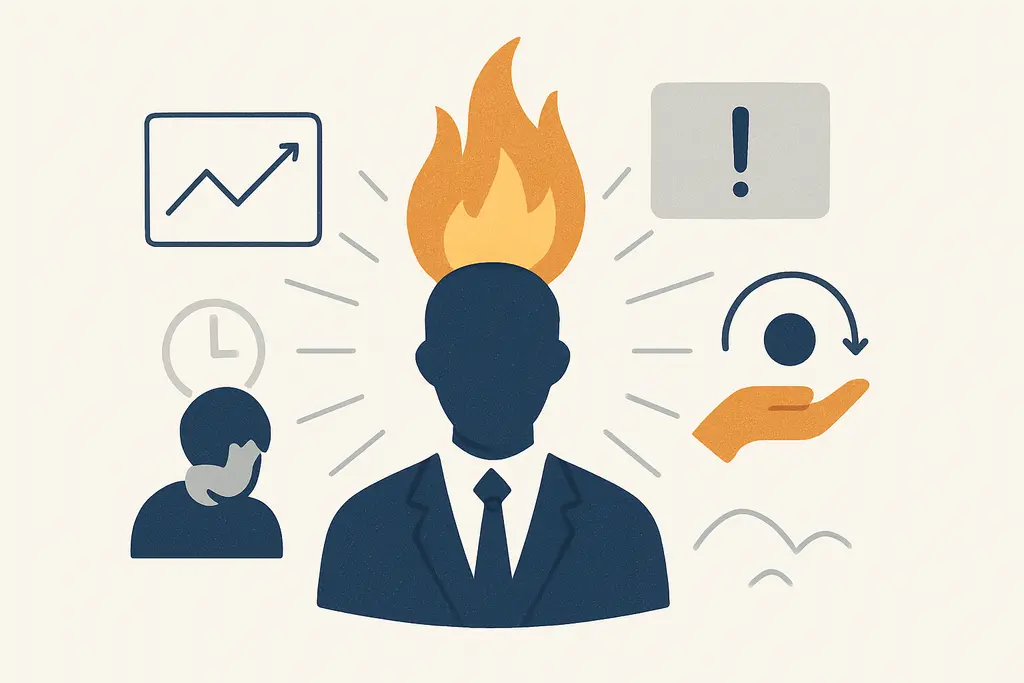
What this pattern really means
Hyper-visibility burnout occurs when repeated exposure, scrutiny, or spotlighting of an employee’s work leads to mental fatigue, withdrawal, or reduced effectiveness. It is not about occasional high-profile tasks; it’s about a sustained cycle where the same person is consistently tasked with visible work or is expected to respond publicly, and that exposure becomes draining.
The pattern is shaped by a mix of external expectations and internal pressures: public recognition, frequent requests to represent the team, persistent feedback loops, and the emotional labor of being on display. Managers often see it in high performers who were once eager to volunteer but now avoid being the focal point.
Key characteristics:
Recognizing these signs early helps leaders redistribute visibility and design recovery opportunities before turnover or serious disengagement occurs.
Why it tends to develop
These drivers combine social expectations and cognitive strain, making hyper-visibility both a behavioral pattern the team reinforces and an individual burden.
**Social pressure:** Teams and leaders repeatedly call on the same person because they are reliable, creating an expectation that they will always step up.
**Role framing:** Job descriptions or informal norms label someone as the ‘face’ of a project, which concentrates public tasks on them.
**Praise without protection:** Public recognition increases demand for visibility but is not accompanied by protected time or resources.
**Cognitive load:** Constantly preparing for visible moments (presentations, demos, stakeholder updates) increases mental effort and decision fatigue.
**Impression management:** Individuals invest extra effort to appear confident and composed in public, using emotional labor that drains energy.
**Environmental signals:** Platforms like all-hands meetings, public Slack channels, or leaderboards make visibility measurable and persistent.
**Feedback loops:** Success in visible tasks leads to more opportunities, creating a self-reinforcing cycle.
What it looks like in everyday work
These patterns are observable and actionable; they point to workload and recognition distribution issues rather than solely personal traits.
Decline in voluntary participation in visible meetings or events
Shorter or less thoughtful responses in public channels while quality remains in private work
Frequent deferral: “I’ll let someone else present” or last-minute substitutions
Increased apologizing in public communications or over-explaining to avoid mistakes
Visible fatigue after public-facing duties (quiet the rest of the day, missed deadlines)
Reduced willingness to accept stretch visible opportunities despite past interest
Overemphasis on polish and safety in visible deliverables, stalling innovation
Resentment from peers who see uneven distribution of high-profile tasks
Higher dependency on a small number of communicators for stakeholder interactions
Private performance remains stable while public engagement drops
What usually makes it worse
Repeatedly assigning the same person to present at leadership or client meetings
Public praise that signals “go-to” status without offering support or backup
Organizational changes that spotlight specific roles (reorgs, product launches)
Tight deadlines for high-visibility deliverables
Lack of rotation in meeting facilitation, demos, or customer interactions
Metrics or awards that emphasize visibility (top performer lists, most talked-about contributor)
High-frequency synchronous events (daily stand-ups, frequent all-hands) that require public updates
Sudden scaling: small teams where a few individuals carry most external interactions
A quick workplace scenario (4–6 lines, concrete situation)
A product manager who always demos new features at company town halls begins skipping voluntary Q&A and requests a co-presenter. After a month, the manager notices the product manager’s post-demo updates are briefer and she declines future cross-functional showcases. Peers comment that she’s "less available" though her deliverables remain on time.
What helps in practice
These steps focus on redistribution and support rather than removing visibility altogether. Managers can reduce burnout risk while keeping the benefits of public-facing work by making visibility a shared, planned resource.
Practical measures are strongest when combined: pairing people, capping frequency, and protecting recovery time create an environment where visible work doesn’t become an endless duty for a few.
Rotate visibility: build a schedule so presentations, demos, and stakeholder-facing roles rotate across the team
Pair and backup: assign a co-presenter or shadow for visible tasks so responsibility is shared
Limit frequency: cap the number of high-visibility engagements an individual can have in a quarter
Protect time: block recovery or deep-work time immediately after public-facing duties
Set clear expectations: clarify who is responsible for visible tasks and why, reducing reactive requests
Normalize delegation: coach visible contributors to delegate parts of presentations and Q&A
Provide rehearsal support: rehearse high-stakes interactions to reduce cognitive load on the day
Offer private recognition: balance public praise with offers of practical support and resourcing
Train spokespeople: develop multiple team members’ communication skills so visibility is distributable
Track visibility load: maintain a simple roster or tracker to make distribution visible to managers
Use asynchronous options: replace some live presentations with recorded demos or shared write-ups
Reassess incentives: align recognition with sustainable practices (e.g., rotate awards or highlight collaboration)
Nearby patterns worth separating
Spotlight effect: explains why people feel more observed than they are; connects because it increases the personal cost of visibility without addressing workload distribution.
Emotional labor: the effort to manage appearances during public interactions; overlaps with hyper-visibility burnout as the hidden cost of being visible.
Role overload: broader than hyper-visibility burnout; role overload includes multiple responsibilities, while hyper-visibility focuses on public-facing exposure.
Presentation fatigue: frequent presenting can be a direct cause; presentation fatigue refers specifically to the act of presenting, whereas hyper-visibility burnout includes ongoing scrutiny and expectation.
Recognition-reward mismatch: occurs when praise is not paired with support; it helps explain why visibility can feel punitive rather than rewarding.
Social identity threat: the pressure of representing a group can amplify the stress of being visible; it’s a social driver that increases burnout risk.
Duty creep: informal expansion of visible responsibilities onto a few people; duty creep often creates the exposure that leads to burnout.
Cognitive overload: the mental capacity limit that visibility tasks eat into; it’s a cognitive mechanism that explains performance drops.
Psychological safety: when low, people hesitate to share or rotate visibility; improving safety helps distribute visible tasks more evenly.
When the situation needs extra support
Seek guidance from qualified workplace or mental health professionals when impairment is significant; managers can facilitate access and accommodations.
- If an employee experiences persistent distress that impairs day-to-day functioning or job performance
- When avoidance of visible tasks leads to significant team dysfunction or recurrent conflicts
- If attempts to rebalance workload fail and symptoms escalate (persistent exhaustion, severe disengagement)
- Consider involving HR or an occupational health professional for workplace adjustments and formal support plans
Related topics worth exploring
These suggestions are picked from nearby themes and article context, not just a flat alphabetical list.
Hybrid Role Ambiguity
When jobs blend functions or reporting lines, unclear ownership and expectations create friction. Practical steps managers can use to identify, document, and reduce hybrid role ambiguity.
Quiet quitting reasons
Why employees pull back to core duties: the causes behind "quiet quitting," how it shows up in daily work, common misreads, and practical steps managers can take.
Role Exit Syndrome
How employees mentally withdraw from a role before leaving, how it shows up at work, why it happens, and practical manager steps to reduce disruption.
Role clarity gap
Role clarity gap occurs when responsibilities and decision rights are fuzzy, causing stalled handoffs, duplicated work, and unclear outcomes—practical fixes for leaders to realign roles.
Career pivot guilt
How career pivot guilt—feeling obliged or morally weighed down by changing roles—shows up at work, why it persists, common misreads, and practical steps managers and employees can use.
Skill vs Title Tradeoffs
How organizations balance formal titles against demonstrable skills—how mismatches show up in hiring, promotions and team performance, and practical steps managers can take.