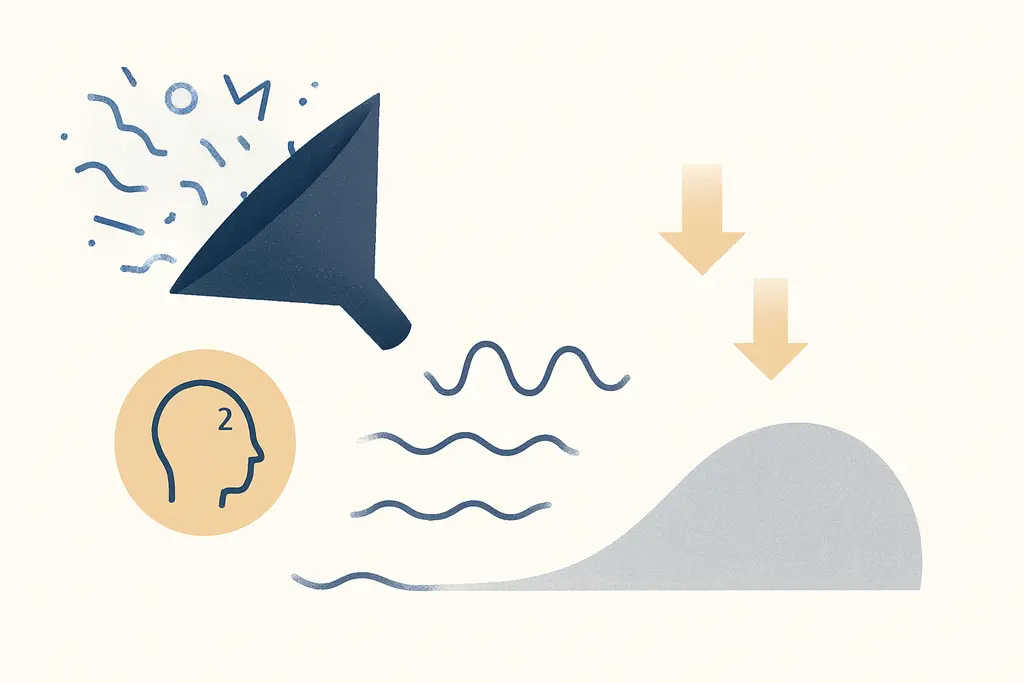
What the pattern really means
Optimization fatigue is not merely being tired of improving; it is a behavioral and cognitive pattern in which repeated cycles of micro-decisions and performance tuning produce diminishing engagement and poorer-quality choices. Teams begin to conserve energy by defaulting to safe, superficial changes rather than pursuing higher-impact work.
This section clarifies the core: the issue is about the ratio of effort to value. When the costs—in attention, coordination, or morale—outweigh the marginal benefits of another optimization, the pattern has taken hold.
How it shows up in everyday work
- Small-request avalanche: frequent asks for minor tweaks to dashboards, copy, or workflows that never resolve bigger blockers.
- Perpetual A/B testing: dozens of simultaneous experiments with unclear prioritization and limited follow-up.
- Slow decisions: teams defer choices, waiting for “one more metric” before acting.
- Checklist compliance: people follow optimization routines mechanically rather than thinking about outcomes.
- Lost context: tuning one metric pushes problems to other teams (e.g., faster onboarding but higher drop-off later).
These behaviors often look innocuous—continuous improvement is valued—yet together they consume attention, fragment work, and create a sense of endless fiddling. The pattern erodes the ability to commit to longer-term bets.
Why the cycle develops and what sustains it
Several forces combine to create and maintain optimization fatigue:
- Incentives that reward incremental gains (monthly metrics, OKRs tied to small experiments).
- Social norms that equate activity with productivity (busywork as status).
- Low-cost tooling that makes testing and tweaking easy and frequent.
- Risk aversion: optimizing existing features feels safer than investing in unknowns.
- Lack of a prioritization framework so every improvement request feels urgent.
These drivers reinforce each other: easy experimentation plus incentives for small wins leads to more experiments, which require governance and attention. Without explicit limits, the activity snowballs.
Where teams and leaders commonly misread it
- Confusing optimization fatigue with simple laziness: teams may appear unmotivated, but often their energy is depleted by microwork.
- Mistaking it for resistance to change: people may accept change but resist continuous, low-value changes.
- Equating optimization with quality: more experiments don’t always mean better outcomes.
Related patterns and near-confusions:
- Analysis paralysis: excessive data review prevents decisions—similar, but analysis paralysis is primarily decision-blocking, while optimization fatigue reflects ongoing maintenance burden.
- Change fatigue: an emotional overload from repeated change initiatives—overlaps with optimization fatigue when tweaks are experienced as constant change.
- Burnout: broader exhaustion across life domains; optimization fatigue can contribute to burnout but is narrower and operationally focused.
Leaders who mislabel the pattern risk applying the wrong remedies (e.g., pushing harder on motivation rather than reducing low-value work).
Practical first steps to reduce optimization fatigue
- Set guardrails: limit the number of simultaneous experiments or tweak requests per team per quarter.
- Prioritize by impact: require a short hypothesis and expected benefit for each optimization before approval.
- Timebox refinement cycles: allocate focused windows for optimization work and protect deep-work periods.
- Rotate ownership: avoid a single person becoming the optimization gatekeeper; spread responsibility to maintain perspective.
- Measure the cost: track time spent on small improvements as a line item to see trade-offs.
Start with one change: introduce a simple intake form that asks for expected impact and estimated time. This creates friction for low-value asks and forces askers to think in terms of benefit. Over time, these practices restore attention to strategic work and reduce the sense that teams must constantly tweak outcomes.
An example, an edge case, and a quick scenario
A product team at a mid-sized company ran dozens of A/B tests across onboarding, pricing pages, and microcopy. Each test produced tiny lifts; engineers spent repeated sprints implementing variants and rolling back changes. Stakeholders praised the activity, but quarterly progress on major roadmap items stalled. The team was not underperforming on experiments, but the cumulative operational overhead left little energy for the next big feature.
A quick workplace scenario
A marketing manager asks for weekly copy changes on a high-traffic landing page. Each change requires engineering time and QA. The operations lead allows it because conversion nudges matter. After six months, conversion gains are marginal and the engineering backlog is full. The right move is not to ban testing, but to require a quarterly review where only the top two hypotheses are implemented and the rest are shelved.
This vignette shows an edge case where data-driven culture and responsiveness create a maintenance burden. The solution blends governance (prioritization, intake criteria) with cultural signals (rewarding impact, not just activity).
Questions worth asking before reacting
- What is the expected impact of this optimization relative to strategic priorities?
- Who will maintain the change and at what ongoing cost?
- Does this improvement displace higher-value work?
- How many similar requests are active right now, and can they be batched?
Answering these helps managers avoid knee-jerk interventions and design targeted constraints that preserve agility without encouraging endless tweaking.
Related topics worth exploring
These suggestions are picked from nearby themes and article context, not just a flat alphabetical list.
Rest guilt
Rest guilt is the anxious feeling that downtime is undeserved; it shows up as skipped breaks, constant connectivity, and over-justifying time off, and can be reduced by clearer handoffs and visible bo
Chronic Task Diffusion
Persistent loss of clear ownership where tasks repeatedly stall between people and processes — how it looks, why it happens, and practical fixes managers can apply.
Busy badge culture
When visible busyness becomes a status signal at work, outcomes suffer. Learn how it forms, how to spot it, and practical steps leaders can take to shift incentives toward impact.
On-Call Burnout
On-call burnout is the cumulative mental and physical strain from repeated after-hours responsibility; learn how it appears, why it persists, and practical fixes for teams.
Vacation guilt
Vacation guilt is the anxiety and behavioral pattern that makes employees check in or avoid time off; learn how it forms, shows up at work, and practical fixes managers and teams can use.
Deadline Creep Anxiety
The steady stress caused by shifting dates and informal deadlines—how it harms team focus, why it happens, and practical steps managers can use to stop the cycle.