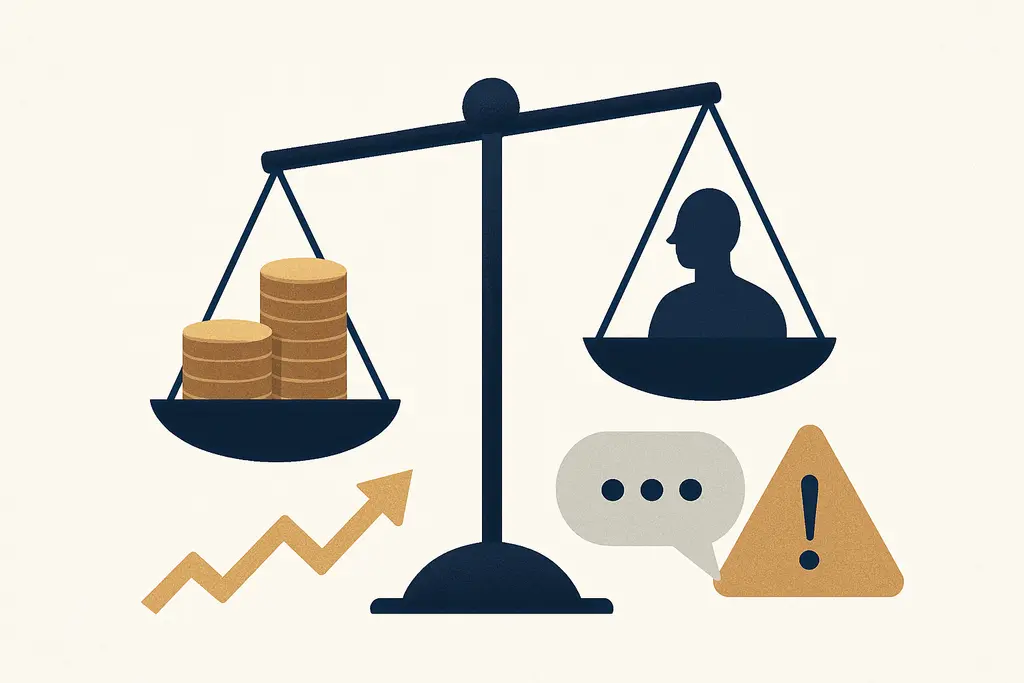
Observable signals
When pay details become visible or even rumored, employees often react in ways that go beyond the numbers. This pattern shows up as changes in conversation, productivity, and willingness to negotiate.
These behaviours are not just individual nervousness — they are relational. Once pay is in the open, the social signals around fairness and status intensify, and ordinary interactions start carrying compensation meaning.
**Social pressure:** people avoid asking about pay to skip awkwardness or perceived disloyalty.
**Comparison focus:** informal benchmarking replaces formal review conversations, and salary becomes a scoreboard.
**Silence or secrecy:** employees with lower pay hide their situation; higher-paid staff may downplay gains.
**Performance shadowing:** managers interpret reduced output as disengagement without checking compensation concerns.
Underlying drivers
Pay transparency anxiety often grows from a mix of structural, cultural, and personal factors.
When organizational processes for setting pay are inconsistent or poorly explained, people fill gaps with stories. Those stories become self-reinforcing: suspicion leads to guarded talk, guarded talk fuels rumors, and rumors increase anxiety.
Unclear pay rules or opaque progression paths that leave employees guessing why numbers differ
Historical secrecy norms that make any disclosure feel taboo
Strong social comparison tendencies in teams with visible hierarchies
Fear of reprisal or being seen as difficult if someone raises pay concerns
How managers and teams commonly misread it
Leaders sometimes assume pay-related reactions are about greed, entitlement, or poor performance. Misreads create poor fixes.
- Treating the response as an attitude problem rather than a signaling problem
- Interpreting quiet withdrawal as disengagement instead of a coping strategy around fairness concerns
- Responding by tightening secrecy or threatening discipline, which heightens anxiety
Two near-confusions worth separating from pay transparency anxiety:
- Salary dissatisfaction: displeasure about pay level. That is one possible outcome, but pay transparency anxiety is specifically the stress or guarded behaviour produced by exposure or discourse about pay.
- Imposter or status anxiety: fears about being unqualified or losing status. Those can overlap with pay transparency anxiety but stem from different beliefs and typically require different managerial responses.
Misreading the pattern as merely a pay number problem misses the relational and communication dynamics that sustain it.
Practical steps that reduce the anxiety
- Create clear pay frameworks and publish criteria for bands or ranges.
- Normalize structured conversations: train managers to open fact-based pay discussions and to document rationales for differences.
- Provide safe channels for questions: allow anonymous FAQs or facilitated group sessions where principles — not individual numbers — are discussed.
- Encourage comparison with role and market data rather than with individual colleagues.
- Coach managers to separate acknowledgement ("I hear your concern") from immediate solutions; transparency often needs explanation more than correction.
Start with process clarity and manager capability. People are more comfortable when they can map a compensation decision to transparent rules and consistent steps. Fixing process and communication reduces the need for rumor-driven sensemaking.
A quick workplace scenario and edge cases
A quick workplace scenario
A product team learns that one senior engineer got a sizeable raise after a public post. Junior engineers start checking past messages and privately asking peers about raises. The manager assumes the juniors are just jealous and tightens the team chat. Instead of calming the situation, chat restrictions increase speculation. A better path: the manager schedules a short all-hands explaining how raises are determined, what performance markers map to pay bands, and how to apply for re-evaluation — while offering private follow-ups.
Edge cases to watch for:
- Small, tight teams where a single raise visibly shifts social status and norms.
- Highly market-competitive roles where outside offers make transparency more volatile.
- Organizations with recent mergers or unequal grading systems where pay histories differ significantly across groups.
Concrete examples clarify that the anxiety often arises from uncertainty about process and social meaning, not just the number itself.
Questions and concepts worth separating before reacting
Before you change policy or discipline staff, ask:
- What do people actually know, and what are they assuming?
- Are pay rules consistent and documented for this role or band?
- Have managers been trained to explain decisions clearly and empathetically?
Related patterns that are often conflated with pay transparency anxiety:
- Pay secrecy culture: an organizational norm that forbids disclosure. This is structural and policy-driven; transparency anxiety can occur even where policies permit sharing, if norms still stigmatize it.
- Perceived procedural injustice: when people see the process as unfair. Procedural concerns often amplify transparency anxiety but addressing fairness processes is a different task than managing the communicative effects of transparency.
Answering the questions above helps leaders pick the right intervention: communication, process redesign, or manager development.
Related topics worth exploring
These suggestions are picked from nearby themes and article context, not just a flat alphabetical list.
Pay Secrecy Culture
How pay secrecy culture—informally or formally hiding salary information—shapes trust, rumor networks, and fairness perceptions at work, and what managers can do first to address it.
Pay transparency and team morale
How visible pay information shapes team trust, cooperation, and motivation — and practical steps managers can use to reduce harm and build fairer pay practices.
Startup equity anxiety
The workplace stress tied to stock options and ownership: why employees fixate on vesting, valuation, and identity, how it shows up day-to-day, and practical steps to reduce it.
401(k) choice anxiety
How stress over 401(k) choices shows up at work, why employees freeze or defer, and practical workplace changes that reduce confusion and avoidance.
Perks-versus-pay tradeoff
How organizations trade visible perks for pay, why that balance forms, how it shows up at work, and practical steps to make compensation fairer and more effective.
Salary transparency pros and cons for teams
A manager-focused guide on how team-level salary transparency affects trust, motivation, and turnover—what it looks like, typical benefits and pitfalls, and practical steps leaders can take.