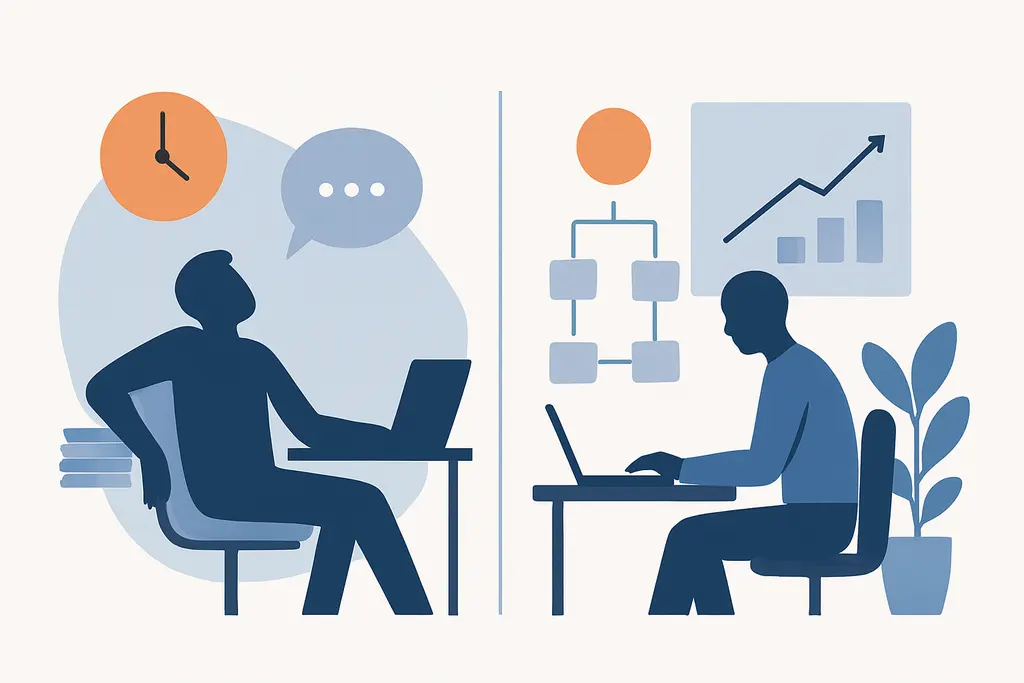
Quick definition
Procrastination is the tendency to postpone tasks that someone intends to complete, often choosing short-term comfort over long-term goals. It typically involves deliberate delays, last-minute rushes, and a cycle of guilt and temporary relief.
Lack of motivation describes a lower level of internal drive or interest in tasks or goals. It shows up as reduced initiative, fewer proactive ideas, and little persistence when obstacles appear.
Key characteristics:
Finding the difference helps decide whether to add clearer deadlines, change task design, or adjust incentives.
Underlying drivers
**Perceived task aversiveness:** People delay tasks that feel boring, difficult, or embarrassing.
**Unclear goals or priorities:** When objectives or success criteria are fuzzy, action stalls.
**Fear of failure or evaluation:** Worry about negative judgment increases avoidance behaviors.
**Immediate distractions and poor time structure:** Competing short-term rewards pull attention away.
**Low relevance or value:** If a task feels disconnected from personal or team goals, motivation drops.
**Cognitive overload or decision fatigue:** Too many choices or ongoing demands reduce the will to start.
Observable signals
These observable patterns help identify whether temporary avoidance or a broader motivational gap is present. Noticing what changes behavior — tighter deadlines, clearer rewards, job redesign — points to different causes and fixes.
Repeated last-minute completions with quality that varies under pressure
Tasks started late but finished when external deadlines loom
Consistently low participation in optional initiatives or idea generation
Frequent requests for clarification on assignments that were clear originally
Regularly missed internal check-ins though external client deadlines are met
Team members who respond well to structure (short deadlines, check-ins) vs those who don’t
High variance in performance depending on how much autonomy vs direction is provided
Persistent low energy for a role or function, not just a single task
A quick workplace scenario (4–6 lines, concrete situation)
A product owner notices one engineer turns in features at the last minute but reliably meets client deadlines; another avoids volunteering for frontend tasks and produces minimal updates even with reminders. The first responds to interim checkpoints; the second improves only after the task is reconnected to personal impact and skill development.
High-friction conditions
Ambiguous task scope or shifting priorities
Overly large, complex assignments without milestones
No immediate feedback or long gaps between reward and effort
High perceived risk of criticism for imperfect work
Excessive context switching and unstructured workdays
Tasks that feel irrelevant to career goals or team objectives
Poorly aligned incentives or unclear accountability
Micromanagement that reduces ownership, or conversely, complete hands-off that removes support
Practical responses
Clear, consistent follow-through after trying a change is often what shifts behavior rather than a single intervention.
Break work into concrete, time-boxed subtasks with short visible wins
Use interim deadlines and progress check-ins to create manageable pressure
Clarify priorities and acceptance criteria so effort maps to outcomes
Reframe task purpose: link assignments to team goals or individual development
Offer autonomy on method but set minimum checkpoints for accountability
Reduce friction: provide templates, clear resources, or remove bureaucratic blockers
Assign pairing or buddy systems to introduce social accountability
Test different incentive structures (recognition, role-relevant rewards) and monitor response
Simplify choices: provide a recommended next step when someone stalls
Adjust workload if cognitive overload is suspected; redistribute or defer tasks
Model small-start behaviors (show how to begin) and publicize quick wins
Use implementation intentions: ask the person to state when and where they will start a specific task
Often confused with
Task avoidance: describes deliberate sidestepping of specific duties and overlaps with procrastination, but task avoidance can also be strategic (not just emotional avoidance).
Employee engagement: broader than motivation; engagement captures emotional and cognitive connection to work, while motivation is one component of that connection.
Time management: tools and skills that reduce procrastination by structuring work; differs from motivation in that it provides external scaffolding rather than changing desire.
Accountability structures: systems like standups and reviews that convert intention into action; these often reduce procrastination but may not fix low intrinsic motivation.
Goal setting theory: explains how clear, specific goals increase effort and focus; useful when lack of motivation stems from unclear or unchallenging targets.
Decision paralysis: inability to choose a course of action due to too many options, which can look like procrastination but is triggered by choice overload.
Job design: changing tasks, variety, and autonomy to boost motivation; unlike short-term fixes, job design alters the role to sustain engagement.
Burnout risk: prolonged overload and chronic stress can lower motivation; burnout is broader and includes exhaustion and cynicism beyond simple lack of drive.
Social loafing: reduced effort in group settings; relates to motivation when individuals feel their contribution won’t be noticed or valued.
Implementation intentions: planning technique that helps convert intention into action, targeting procrastination directly rather than changing baseline motivation.
When outside support matters
- If prolonged lack of motivation or consistent avoidance is causing significant performance decline or team disruption, consult HR or an employee assistance program for organizational support
- Consider involving an executive coach or occupational psychologist for persistent engagement issues that resist internal changes
- Use professional mediation or facilitated team sessions when patterns are systemic and affect group dynamics
Related topics worth exploring
These suggestions are picked from nearby themes and article context, not just a flat alphabetical list.
Motivation-Job Fit Gap
When a person's motivation and daily tasks don’t match, performance and retention suffer. Learn how this gap forms, how it shows up, and practical steps to close it.
Motivation Debt
Motivation Debt is the build-up of deferred work and skipped motivational investments at work; it makes routine tasks harder, creates backlogs, and needs process plus cultural fixes.
Motivation hygiene
Motivation hygiene is the daily systems and habits that prevent motivation from eroding at work — the small fixes managers can make to keep teams engaged and productive.
Anticipatory Motivation
How expectations about future events drive present effort at work — how it shows up, why it develops, how leaders can spot and reshape it for better outcomes.
Velocity Motivation
Velocity Motivation describes the drive to favor quick, visible progress over slower strategic work—how it forms, how leaders misread it, and practical steps to balance speed and impact.
Motivation Alignment Gap
The Motivation Alignment Gap occurs when employee actions and organizational objectives diverge; spot it through misdirected effort and fix it by aligning signals, incentives, and processes.