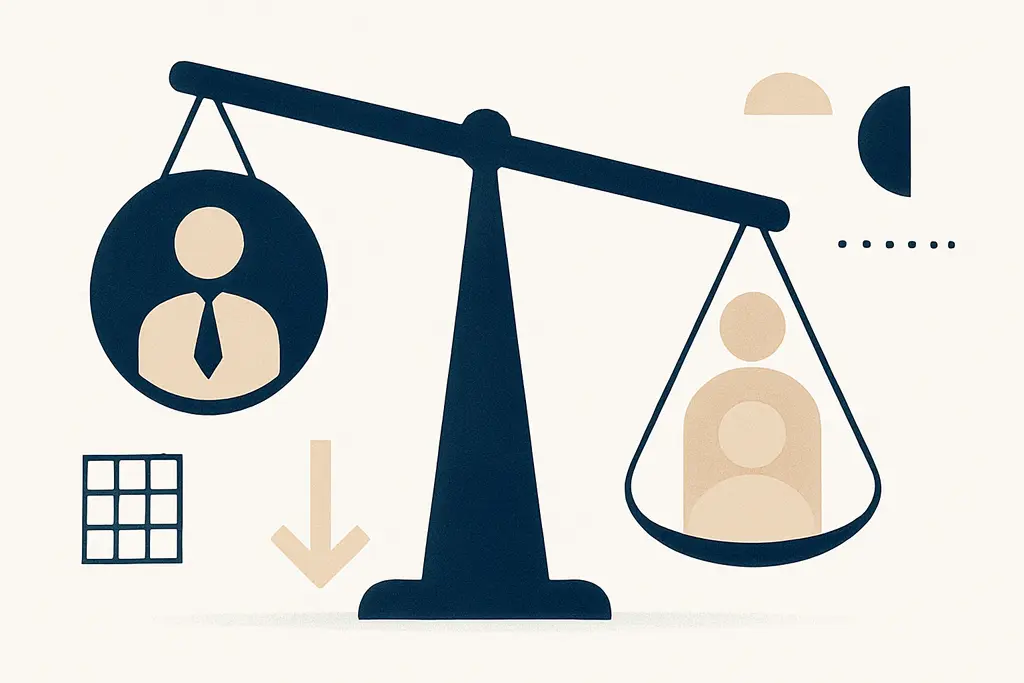
What promotion survivor guilt looks like in everyday work
- Holding back in meetings: the promoted person avoids asserting priorities to avoid upsetting peers.
- Overcompensating: taking on extra tasks, mentoring, or social labor to prove they didn’t "leave people behind."
- Hyper-visibility fatigue: feeling watched and interpreting ordinary questions as accusations.
- Reluctance to enact change: delaying decisions that would benefit the role because they feel responsible for colleagues' outcomes.
These behaviors are practical: they alter day-to-day interactions, slow delegation, and can create unclear boundaries between a new manager and their former peers. Left unchecked, the pattern reduces the promoted person's effectiveness and increases ambiguity for the team.
Why the pattern forms and what keeps it alive
Promotion survivor guilt often grows from social and structural signals rather than personal weakness. Causes include:
- Narrow promotion pipelines or few openings so only a handful advance.
- Strong peer cohesion where the team values equality and shared workload.
- Informal selection processes that leave performance-feedback gaps.
- Cultural norms that stigmatize visible success or create implicit comparisons.
Sustaining factors include continuing proximity to the people affected (e.g., a former peer reports to the promoted person), lack of role clarity, and absence of explicit recognition about the selection process. When organizations avoid naming the interpersonal effects of promotions, guilt can persist and become part of the local culture.
How leaders commonly misread it (and two near-confusions)
Managers often mistake survivor guilt for other, easier-to-address problems. Typical misreads include:
- Treating reluctance to direct as simple lack of confidence.
- Interpreting extra helpfulness as strong engagement rather than atonement.
- Labeling the promoted person as "too soft" or "not leadership material" without probing motives.
Two related concepts worth separating from promotion survivor guilt:
- Impostor syndrome: an internal belief of not deserving success; this can coexist with survivor guilt but is inward-facing, whereas survivor guilt is tied to others left behind.
- Team resentment / envy: peers' negative reaction to the person promoted. That is a separate dynamic (external hostility) and requires different interventions than guilt, which is self-directed.
Misreading the pattern risks prescribing the wrong fix (e.g., confidence training for someone who actually needs permission to set boundaries) and can aggravate tensions.
Concrete steps that reduce survivor guilt
- Clarify role and authority: make expectations, decision rights, and reporting lines explicit and documented.
- Normalize the story: publicly explain the selection process and the business reasons for the promotion without shaming those not chosen.
- Create structured handoffs: allow the promoted person time and tools to transition responsibilities from peers, including temporary shared duties.
- Support boundary setting: coach the promoted person on delegation language and escalation protocols.
- Provide peer transition rituals: framed acknowledgements or role-change meetings that let the team express concerns in a managed way.
These actions reduce ambiguity and remove social guessing. Practical clarity (who decides what and why) is the most direct antidote: it shifts focus from interpersonal guilt to operational function.
A quick workplace scenario
A workplace example
Clara was promoted to team lead over peers she had worked with for five years. She started offering her time for every peer's project review and deferred prioritization decisions to the group. The team began missing deadlines because work lacked a single owner.
The manager intervened by holding a transition meeting: they reviewed the selection criteria used, clarified Clara’s decision-making scope, and set a 30‑day plan where Clara negotiated delegated tasks with each former peer. Clara then used a one-week trial to practice prioritizing, followed by feedback. Within two months, the team regained tempo and Clara reported less exhaustion and more focused work.
Questions managers should ask before reacting
- Did the promoted person receive a clear role description and authority map?
- Are they still expected to do the same individual-contributor workload?
- Is the team culture discouraging visible success or change?
- Are there structural constraints (compensation, promotion scarcity) that make this a frequent issue?
Answering these helps target whether the issue is guilt-driven or rooted in system design.
Quick guidance for next steps as a leader
- Start with clarity: document role, authority, and priorities in writing.
- Create a short transition plan with the promoted person and their peers.
- Hold a facilitated conversation that acknowledges feelings while re-centering operational goals.
- Monitor for two weeks and adjust: check how many decisions are being deferred and who is doing the unpaid emotional labor.
Small, visible structural changes—clear expectations, explicit handoffs, and behavioral rehearsal—scale better than general reassurance. The goal is to re-anchor the promoted employee in a functional role while respectfully acknowledging the interpersonal cost of selection.
Related topics worth exploring
These suggestions are picked from nearby themes and article context, not just a flat alphabetical list.
Career pivot guilt
How career pivot guilt—feeling obliged or morally weighed down by changing roles—shows up at work, why it persists, common misreads, and practical steps managers and employees can use.
Role identity after promotion
How people change who they are at work after a promotion, why that shift happens, everyday signs to watch for, and practical steps to settle into the new role.
Hidden work and promotion impact
How unseen tasks—mentoring, coordination, fixing problems—affect who gets promoted, why they’re overlooked, and practical steps managers can use to surface and reward them.
Promotion waiting paralysis
When employees pause action while expecting a promotion, careers and motivation can stall. Learn how it appears, what sustains it, and practical ways to break the freeze.
Underutilization anxiety after promotion
Anxiety someone feels after a promotion when they doubt they're using their skills or authority—how it shows up, why it forms, and practical ways teams can resolve it.
Hybrid Role Ambiguity
When jobs blend functions or reporting lines, unclear ownership and expectations create friction. Practical steps managers can use to identify, document, and reduce hybrid role ambiguity.