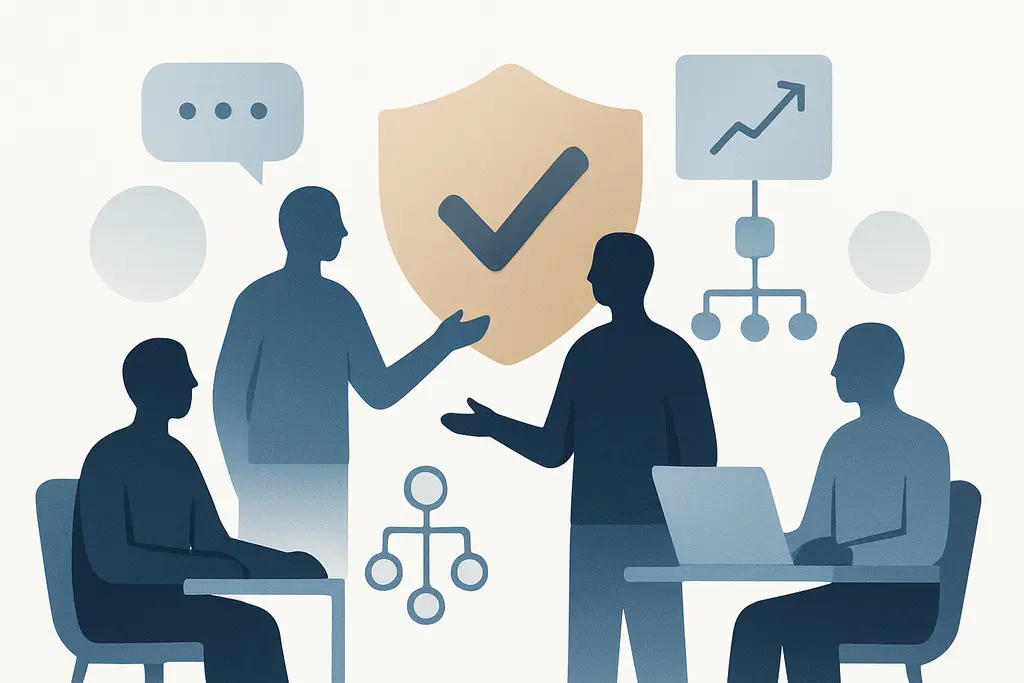
What this pattern really means
Psychological safety in teams describes a shared belief among team members that interpersonal risk-taking is allowed and supported. It is not about being nice all the time; it's about creating an environment where honest feedback and constructive disagreement are possible without damaging relationships or careers.
These characteristics are visible in everyday behaviors and arrangements — from how meetings are run to how failures are discussed. For leaders, the goal is to build predictable routines and signals that normalize candid communication.
Why it tends to develop
These drivers combine cognitive, social and environmental elements: how people think about risk, how groups distribute power, and how systems reward or punish behaviors.
**Power dynamics:** uneven authority or visible favoritism makes lower-status members hold back.
**Blame-focused culture:** when errors lead to punishment, people hide problems instead of raising them.
**Lack of psychological cues:** few invitations to speak, no explicit norms for dissent, and closed meeting formats suppress participation.
**Ambiguous expectations:** unclear norms about openness or accountability create fear about consequences.
**Performance pressure:** unrealistic targets and tight timelines make risk-taking feel costly.
**Past events:** previous public reprimands, layoffs, or visible negative consequences create lasting caution.
**Social identity stress:** members who feel different on race, gender, or background may perceive higher interpersonal risk.
What it looks like in everyday work
These signs often cluster. When leaders pay attention to patterns across meetings, decisions, and informal interactions, they can detect where psychological safety is fragile and intervene before costly mistakes accumulate.
Reluctance to raise small errors until they become big problems.
Few questions during meetings, especially from junior members.
Overly polished proposals with no visible iteration or uncertainty.
Silence or quick agreement when a leader expresses a view.
Private side conversations instead of public discussion of concerns.
Low participation in retrospectives or post-mortems.
Defensive reactions when feedback is given (eye-rolling, shutting down).
Over-reliance on formal channels (emails, tickets) rather than candid conversations.
Repetition of ideas from a few visible voices while others stay quiet.
A quick workplace scenario (4–6 lines, concrete situation)
During a product demo, a junior engineer notices a reproducible bug but stays silent; afterward, the issue causes downtime. The manager reviews the meeting format, notices few open questions were invited, and starts ending demos with a direct invite: "What's one thing you think we missed?" This small shift leads to earlier bug reports and more candid post-demo discussion.
What usually makes it worse
These triggers often reactivate memories of past negative experiences and rapidly reduce willingness to take interpersonal risks.
Public criticism of an individual's idea in front of the group.
Tight deadlines announced without room for questioning scope.
Performance reviews that focus solely on fault-finding.
High-profile layoffs or reassignments linked to a specific mistake.
Sarcastic or humiliating language from senior staff.
Reward systems that recognize only visible wins and not learning.
Sudden changes in leadership or team composition.
Meetings dominated by a single voice with no facilitation.
What helps in practice
These actions are practical leadership moves that change daily experience. Small, consistent rituals and visible follow-through are more effective than occasional speeches.
Invite input explicitly: ask open questions and pause to allow answers.
Normalize small failures: start meetings by sharing one learning and what was changed.
Model vulnerability: leaders acknowledge their uncertainties and mistakes first.
Set meeting norms: rotate facilitators, limit speaking time, and require silent brainstorming.
Give aligned feedback: separate intent from impact and focus on future actions.
Protect dissenting voices: thank people for raising concerns and act on credible points.
Celebrate early warnings: reward raising issues, not just polished successes.
Provide multiple channels: anonymous suggestions, one-on-one check-ins, and group forums.
Train managers in psychological cues: listening, open body language, and neutral reactions.
Make expectations explicit: state that asking questions and raising doubts is part of the role.
Follow up visibly: when someone raises a concern, close the loop so others see consequences.
Adjust incentives: ensure evaluations include collaboration and learning behaviors.
Nearby patterns worth separating
Team trust — Trust is the belief in reliability and competence; psychological safety adds permission to take interpersonal risks without fear of negative interpersonal consequences.
Inclusive leadership — Inclusion focuses on valuing diverse perspectives; psychological safety is a condition that allows those perspectives to be voiced and considered.
Growth mindset — A growth mindset emphasizes learning from failure; psychological safety provides the social environment where that learning can be expressed safely.
Blame culture — A blame culture punishes mistakes; psychological safety is the opposite, encouraging learning and problem-reporting.
Constructive conflict — Constructive conflict is managed disagreement aimed at better outcomes; psychological safety enables conflict to stay constructive rather than becoming personal.
Feedback culture — A feedback culture expects ongoing critique; psychological safety ensures feedback is given without fear of retaliation.
Meeting design — Good meeting design (agendas, facilitation) creates structures that support psychological safety by giving everyone a voice.
Organizational justice — Perceived fairness in processes influences psychological safety because fair processes reduce fear of arbitrary punishment.
Employee engagement — Engagement measures motivation and connection; psychological safety is a driver that enables honest participation and ownership.
When the situation needs extra support
- If workplace stress leads to persistent sleep disruption, severe anxiety, or impaired functioning, consider speaking to a qualified mental health professional.
- If conflicts escalate into harassment, legal or HR intervention may be necessary; consult HR or an employment law advisor for organizational remedies.
- For systemic culture change, consider bringing in an organizational development consultant or executive coach with experience in behavior change and team dynamics.
Related topics worth exploring
These suggestions are picked from nearby themes and article context, not just a flat alphabetical list.
Surface-level psychological safety: why teams say it's safe but still stay quiet
Why teams can say it’s safe but stay silent: surface-level psychological safety masks polite agreement, hides risk, and what leaders can do to invite real voice.
Psychological Safety Cues
Concrete signals — words, timing, and rituals — that tell people if it’s safe to speak up at work, and practical steps managers can use to read and shift them.
Quiet Authority
Quiet Authority is steady, low-key leadership that influences through consistent competence and clear boundaries—learn how it forms, shows up, and how to support or evaluate it at work.
Influencing Up
A practical field guide to influencing up: how to present decisions, reduce leaders' friction, spot common misreads, and increase the chance your proposals get approved.
Consensus Fatigue
When teams stall trying to make everyone happy, decisions become delayed and diluted. Signs, causes and manager-focused steps to spot and reduce consensus fatigue at work.
Delegation trust gap
When tasks are assigned but real authority isn’t, work slows and initiative fades. Practical manager steps to spot, understand, and close the delegation trust gap.