Quick definition
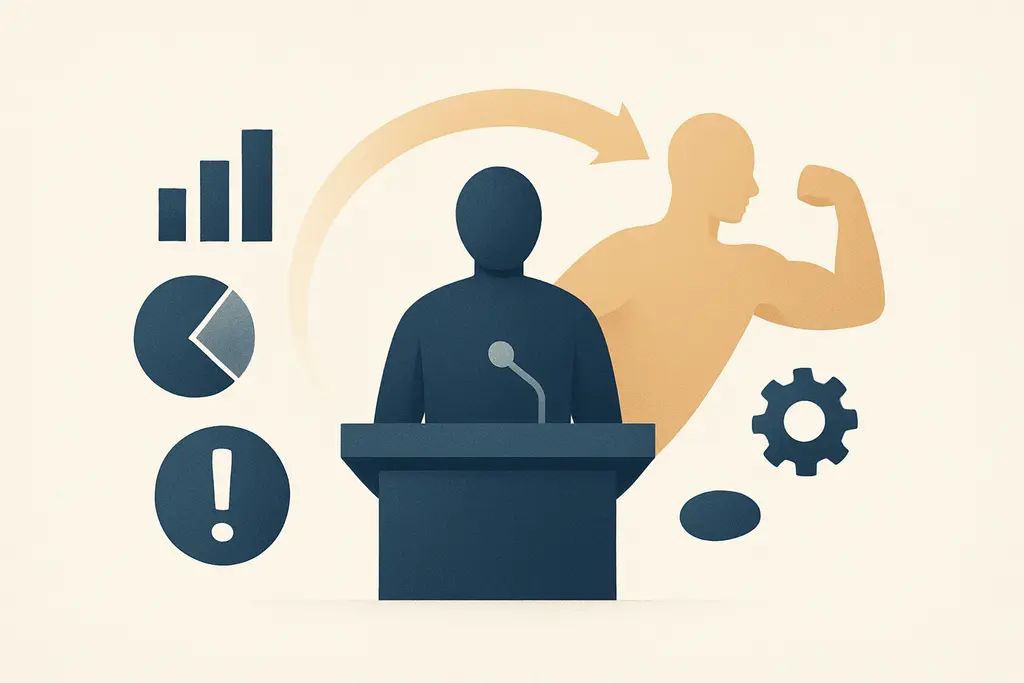
The public speaking confidence gap is a behavioral pattern where capable people under-communicate their ideas in public or group settings. It is not about lack of knowledge; it’s about a mismatch between what someone knows and how often or how clearly they share it in front of others.
This gap can be situational—a person may present well in small teams but freeze in all-hands settings—or persistent across formats. It often looks like avoidance, last-minute remarks, or reliance on written follow-ups instead of verbal contribution.
Key characteristics:
Leaders can view these characteristics as signals rather than fixed traits: they point to opportunities to adjust context, support, and incentives so expertise is more visible.
Underlying drivers
These drivers combine differently for each person; changing the environment or feedback can reduce the gap even when internal doubts remain.
**Cognitive bias:** internal comparisons (e.g., assuming others are more eloquent) lower perceived readiness.
**Evaluation concerns:** fear of negative judgment about competence or language use in front of peers.
**Social dynamics:** hierarchical meeting formats or dominant speakers that suppress quieter voices.
**Skill mismatch:** strong content knowledge paired with limited practice in public delivery.
**Environmental factors:** large rooms, poor acoustics, or remote meeting fatigue that amplify discomfort.
**Role expectations:** job descriptions that reward individual contributor output more than verbal participation.
Observable signals
Seen across teams, these patterns change meeting dynamics: meetings may over-weight the opinions of the most vocal rather than the most knowledgeable. That gap can also lead decision-makers to miss technical risks or innovative ideas.
Regular silence from subject-matter experts during group discussions
Last-minute emails that repeat points someone didn’t say in the meeting
Reluctance to take presentation slots or frequent cancellations
Short, factual answers when questions are asked publicly
Offering to provide written notes rather than speaking for a few minutes
Relying on slides overloaded with text instead of verbal explanation
Avoiding leadership opportunities that require public visibility
Frequent deflection to others to answer verbal questions
A quick workplace scenario
A product lead who knows the roadmap well declines an all-hands demo, then sends a detailed email afterwards. The manager pairs them with a supportive peer for the next demo, offers a five-minute script, and schedules a short rehearsal; the lead attends and speaks for three minutes, helping the team make a faster decision.
High-friction conditions
Large audiences or senior leadership in the room
Ambiguous agenda or highly evaluative meeting frames
New or unfamiliar presentation platforms (video calls, webinars)
Being asked to speak without a clear prompt or prior notice
Previous public mistakes that were visible to colleagues
Language or cultural differences that increase self-monitoring
High-stakes announcements tied to performance reviews
Fast-paced Q&A formats with little time to prepare
Practical responses
Many of these steps are low-cost and reversible; small changes to meeting format and visible support often close the gap quickly.
Create predictable presentation slots with clear time limits so speakers know what to prepare
Offer micro-presentation opportunities (2–4 minutes) to build comfort gradually
Use pre-briefs: privately explain the purpose, audience, and expected takeaways before a speaker goes up
Pair less-confident speakers with an experienced co-presenter for shared delivery
Provide simple templates or starter scripts to reduce cognitive load
Normalize rehearsal by scheduling short run-throughs before public demos
Design meetings that rotate facilitation and spotlight different voices
Give behavior-focused feedback (what helped, what to tweak) soon after a presentation
Reward contribution mechanisms that value insight shared publicly, not just outcomes
Offer optional skill practice sessions (peer-led) rather than mandatory training
Adjust evaluation criteria so verbal visibility is not the only measure of contribution
If someone prefers written follow-up, invite them to present a short summary of their note in the next meeting
Often confused with
Impostor feelings: overlaps when capable people doubt their competence; the gap differs because it specifically concerns public verbal expression rather than global self-assessment.
Presentation skills training: provides technique and rehearsal; it addresses skill components but not always the situational or social drivers of the gap.
Psychological safety: a broader team climate where speaking up feels low-risk; improving it reduces the gap by lowering perceived social penalties.
Communication norms: agreed rules about who speaks and how; changing norms can redistribute airtime and expose hidden expertise.
Social loafing: group phenomenon where some people withdraw effort; unlike the confidence gap, social loafing centers on motivation rather than anxiety about speaking.
Self-efficacy in communication: a person’s belief in their speaking ability; boosting it narrows the gap but typically requires both support and practice.
Meeting design: the structure and facilitation of meetings; it directly shapes opportunities for public contribution and can either widen or shrink the gap.
Feedback culture: how feedback is given and used; constructive, timely feedback helps people progress from avoidance to public contribution.
Role clarity: when roles are vague, people may defer speaking; clarifying who presents what reduces accidental suppression of voices.
Leadership presence: the observable behaviors leaders use when speaking; role-modeling calm, inclusive facilitation helps others feel permitted to speak.
When outside support matters
- If avoidance of public speaking leads to persistent career limitations or repeated missed opportunities
- When anxiety about presenting significantly impairs day-to-day work functioning despite workplace adjustments
- If an employee requests support beyond managerial coaching, consider referral to employee assistance programs or a qualified communication coach
- For intense, persistent distress tied to public situations, suggest consultation with an appropriate licensed professional through workplace health resources
Related topics worth exploring
These suggestions are picked from nearby themes and article context, not just a flat alphabetical list.
Executive Public-Speaking Nerves
How executive public-speaking nerves show up at work, why they persist, and practical leader-focused steps to reduce them and protect message clarity.
Visibility gap anxiety
Visibility gap anxiety: the worry that good work goes unseen. Learn how it forms at work, how it shows up, and practical manager actions to reduce it.
Self-Attribution Gap
How employees under-credit their own contributions at work, why that widens impostor feelings, and practical manager steps to spot and reduce the gap.
Speaking-up anxiety
Speaking-up anxiety is the fear of social or professional cost for raising concerns at work; it quiets useful input and can be reduced through norms, modeling, and low-cost reporting channels.
Quiet Confidence Building
Quiet confidence building is the gradual, low‑visible growth of workplace competence—how it develops, how to spot it, and practical ways teams and leaders support it.
Confidence scaffolding for new managers
Practical supports and routines that help first-time managers grow steady confidence—how it shows up, why it forms, what helps, and how leaders can scaffold (and remove) it.