What this pattern really means
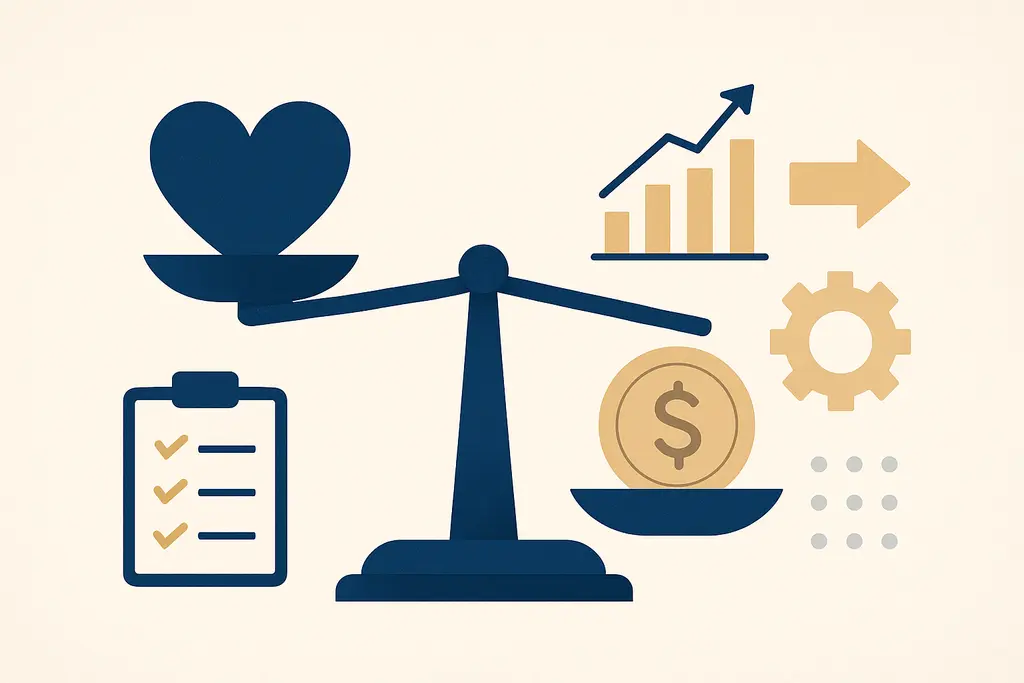
Intrinsic motivation refers to doing a job for its own sake: interest, mastery, purpose, or enjoyment. Extrinsic motivation refers to doing a job mainly for outcomes outside the task itself, such as salary, promotions, or recognition. Over the course of a career, individuals often shift along this spectrum rather than staying fixed at one end.
Shifts can be gradual (slow alignment toward external rewards) or situational (temporary responses to a new role or crisis). They are not inherently good or bad — context matters — but the balance influences engagement, discretionary effort, and decision-making at work.
Common patterns include role-driven change (new responsibilities emphasize measurable outputs), life-stage effects (financial needs or family responsibilities), and cultural pressures (metrics-focused organizations tilt people toward extrinsic motives).
These characteristics help leaders recognize that motivation is dynamic and shaped by role, context, and signals from the organization.
Why it tends to develop
Performance metrics and reward structures that prioritize measurable outcomes over learning and autonomy.
Cognitive load and time pressure that reduce capacity for intrinsic enjoyment (focus narrows to tangible returns).
Social comparison and peer norms that make status or recognition a stronger driver than curiosity.
Career stage and financial needs that increase reliance on extrinsic rewards for security or family responsibilities.
Role changes that move employees away from hands-on craftwork to managerial or administrative tasks.
Managerial signaling (public praise, promotion criteria, or visibility of bonuses) that highlights external rewards.
Organizational uncertainty or restructuring that shifts attention to job security and incentives.
Habit formation: repeated reward-outcome pairings reinforce extrinsic responding over time.
What it looks like in everyday work
These signs help observers separate situational reactions (e.g., after a reorg) from more entrenched shifts requiring structural response.
**Language shift:** employees increasingly talk about bonuses, titles, and numbers rather than learning or impact.
**Task selection:** people choose activities that are measured and rewarded, even if less intrinsically engaging.
**Reduced initiative:** fewer voluntary projects or creative proposals unless tied to external recognition.
**Short-term focus:** decisions oriented around immediate rewards instead of long-term development or relationships.
**Rule-following over craft:** strict adherence to procedures because they safeguard measurable outcomes.
**Visible performance gaming:** behavior that maximizes KPIs rather than true value (e.g., padding metrics).
**Attendance and compliance signals:** presence and deadlines become the main markers of motivation.
**Selective effort:** high energy for rewarded tasks, low for unmeasured but important work.
A quick workplace scenario (4–6 lines, concrete situation)
A mid-career engineer is promoted to a team lead role that now ties bonuses to quarterly deliverables. The new role reduces hands-on work and increases status-related benefits. Over several quarters the engineer stops proposing exploratory projects and focuses on deliverables that secure the bonus, leading the manager to revisit role design and recognition practices.
What usually makes it worse
These triggers often interact: a promotion plus stricter KPIs is more likely to produce a shift than either alone.
Promotion into roles with clearer external rewards and fewer hands-on tasks.
Introduction or tightening of KPIs and bonus schemes linked to short-term outputs.
Public recognition programs that elevate status as the primary reward.
Heavy workload or time pressure that crowds out intrinsic satisfiers like mastery.
Organizational restructuring or layoffs that raise concerns about job security.
Leadership emphasis on metrics and external achievements in communications and reviews.
Loss of autonomy through micromanagement or process-heavy changes.
Unequal reward distribution that signals external rewards matter more than intrinsic contribution.
What helps in practice
Applying several actions together (role redesign, feedback, and blended rewards) is usually more effective than a single change.
Clarify purpose: connect measurable goals to larger team or organizational mission so external rewards map to meaningful outcomes.
Redesign roles: reintroduce elements of autonomy, skill use, and creative tasks where possible.
Blend rewards: combine extrinsic incentives with recognition for learning, mentoring, and craftsmanship.
Adjust metrics: ensure KPIs capture both short-term outputs and long-term value (quality, learning, customer outcomes).
Offer job-crafting opportunities: let employees shape tasks toward areas they find intrinsically motivating.
Create stretch assignments that build mastery rather than just visibility or status.
Provide regular, specific feedback focused on growth and impact, not only on results.
Rotate responsibilities to keep work varied and connected to strengths.
Model balanced language: reward both outcomes and processes in public communications.
Use recognition rituals that honor effort and learning as well as results.
Review compensation design periodically to prevent overemphasis on a narrow set of external rewards.
Nearby patterns worth separating
Job satisfaction — overlaps with motivation but is broader; satisfaction reflects overall contentment while shifts in motivation explain why a specific task becomes more extrinsically driven.
Burnout — connected because loss of intrinsic meaning can precede exhaustion, but burnout focuses on chronic strain and energy depletion rather than motive orientation.
Job crafting — a practical response where workers reshape tasks to increase intrinsic rewards; it reduces the likelihood of shifting toward purely extrinsic motives.
Self-determination theory — a theory that explains the balance of autonomy, competence, and relatedness; it frames how organizational changes tilt people toward extrinsic or intrinsic motives.
Performance management — systems here can cause or mitigate shifts; performance management that values only metrics tends to encourage extrinsic motivation.
Engagement — a broader state that includes motivation; shifts toward extrinsic rewards can reduce deep engagement even if surface-level productivity stays high.
Role identity — when a role’s social meaning emphasizes status or titles, employees are more likely to behave in extrinsically motivated ways.
Gamification — uses external rewards to motivate behavior; unlike sustainable intrinsic motivation, it can encourage short-term extrinsic responses if not designed carefully.
Recognition practices — specific programs for praise and awards; how they’re structured will either support intrinsic drivers (publicly valuing craftsmanship) or push people toward external rewards (status contests).
Career stage effects — life and financial stages that change priorities and therefore shift the balance between intrinsic and extrinsic motives.
When the situation needs extra support
- If shifts in motivation cause sustained performance decline, widespread disengagement, or recurrent conflicts, consult HR or an organizational development specialist.
- Consider an external coach or career counselor when individuals need help aligning long-term career goals with meaningful work and compensation trade-offs.
- If workplace changes raise legal, safety, or severe health concerns, follow company procedures and involve occupational health or employee assistance programs.
Related topics worth exploring
These suggestions are picked from nearby themes and article context, not just a flat alphabetical list.
Motivation-Job Fit Gap
When a person's motivation and daily tasks don’t match, performance and retention suffer. Learn how this gap forms, how it shows up, and practical steps to close it.
Motivation Debt
Motivation Debt is the build-up of deferred work and skipped motivational investments at work; it makes routine tasks harder, creates backlogs, and needs process plus cultural fixes.
Motivation hygiene
Motivation hygiene is the daily systems and habits that prevent motivation from eroding at work — the small fixes managers can make to keep teams engaged and productive.
Anticipatory Motivation
How expectations about future events drive present effort at work — how it shows up, why it develops, how leaders can spot and reshape it for better outcomes.
Velocity Motivation
Velocity Motivation describes the drive to favor quick, visible progress over slower strategic work—how it forms, how leaders misread it, and practical steps to balance speed and impact.
Motivation Alignment Gap
The Motivation Alignment Gap occurs when employee actions and organizational objectives diverge; spot it through misdirected effort and fix it by aligning signals, incentives, and processes.