What it really means
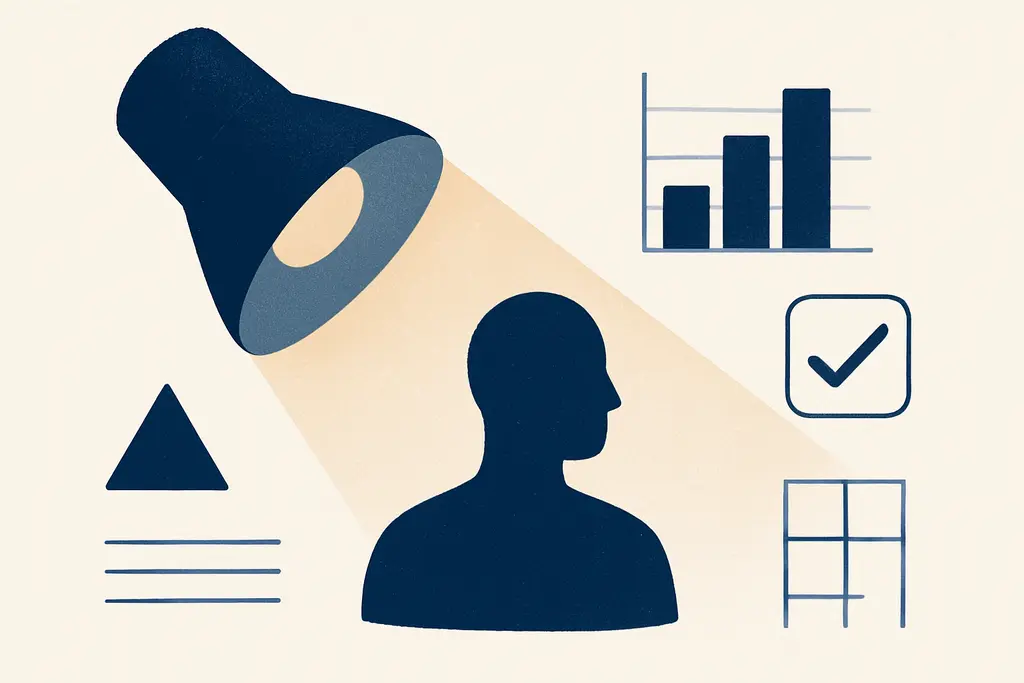
Spotlight anxiety is an anticipatory fear about being intensely noticed and judged in a work context. It is less about objective risk and more about the perception that one’s actions will be scrutinized, amplified, or used to form a lasting impression.
Two quick contrasts: the spotlight effect is a cognitive bias (overestimating how much others notice you). Spotlight anxiety is the emotional response to that bias combined with stakes (promotion, reputation, role expectations). Understanding both helps separate thought from feeling.
How the pattern gets reinforced
These forces interact: culture prioritizes visible behaviors, experiences confirm the risk, and ambiguity sustains hypervigilance. Over time employees learn to either hide or over-prepare, which shifts where cognitive effort goes during work.
**Social pressure:** Teams that reward visible wins and public recognition make visibility the primary currency of success.
**High-stakes visibility:** Presentations, client meetings, or performance reviews create events where perceived errors have outsized consequences.
**Past experience:** A single public mistake, negative feedback aired broadly, or a sharply worded email can leave a lasting expectation of scrutiny.
**Evaluation ambiguity:** When criteria for success are unclear, people assume visibility fills the gap: "If I’m seen, I’ll be judged."
**Cultural messages:** Praise of the charismatic presenter or the outspoken leader sends implicit signals that silence equals low value.
How it shows up in everyday work
- People decline speaking opportunities (presentations, client calls) or accept them but over-prepare and read scripts rigidly.
- Important ideas are shared only in private messages rather than during meetings where credit and critique are public.
- Team members defer in meetings, nodding instead of arguing, even when they know the data contradicts the plan.
- Employees obsess over small formatting or wording choices that are unlikely to affect outcomes.
These behaviors are costly: meetings become consensus machines, risk-taking shrinks, and the organization misses timely corrections. Spotting these patterns early lets managers shift incentives back toward thoughtful contribution rather than performance under pressure.
Moves that actually help
Taken together, these actions reduce the perceived cost of being visible. Leaders who intentionally separate learning from evaluation weaken the feedback loop that sustains spotlight anxiety and invite broader participation.
**Normalize partial visibility:** Rotate who presents and create formats that separate contribution from public evaluation (e.g., anonymous idea boards, written pre-reads).
**Clarify success criteria:** Define what good looks like for a role or task so visibility is not the only signal of competence.
**Offer low-stakes practice:** Provide rehearsal time or dry runs in small groups before public-facing events.
**Frame failure as data:** In public debriefs, model language that treats mistakes as learning, not as fixed character evidence.
**Private calibration:** Give early corrective feedback in one-on-one conversations rather than only in group settings.
A quick workplace scenario
A concrete example
A product manager, Naomi, consistently avoids demoing new features to the whole company because a previous live demo went wrong and a senior leader’s retweet amplified the embarrassment. Managers interpreted her silence as lack of confidence and reassigned visibility tasks to others. After a one-to-one conversation, her manager introduced a staged approach: internal walk-throughs, a team dry run, and a co-presenter for the company demo. Naomi’s confidence returned; she began to share earlier and more often, and the team benefited from earlier user feedback.
This scenario shows how a single visibility incident can calcify into a pattern unless leaders intentionally create stepping stones back to public contribution.
Related, but not the same
Separating these helps diagnosis: if someone avoids meetings because they feel judged on a single action, manage visibility and evaluation. If avoidance is general across social settings, a different approach is needed.
Impostor syndrome: often paired with spotlight anxiety, impostor feelings are internal doubts about deserving success; spotlight anxiety focuses on fear of external scrutiny. The two can co-occur but require different interventions.
Social anxiety at work: social anxiety is broader and can include physiological symptoms across contexts. Spotlight anxiety is specifically tied to perceived evaluative visibility in task or performance settings.
Perfectionism: perfectionists may avoid public tasks to prevent perceived imperfections, but perfectionism is a trait or habit pattern; spotlight anxiety is triggered by the belief that visibility will cause disproportionate judgment.
Questions worth asking before reacting
- Has this person avoided visibility consistently, or did a specific event coincide with the change?
- Are public rewards and recognitions skewed toward a small set of visible behaviors?
- Are expectations and evaluation criteria clear and shared with the team?
Asking these questions prevents misreading reluctance as disengagement and points managers toward structural fixes (changing formats, clarifying criteria) rather than simply pushing people to be more visible.
Related patterns worth separating from it
- Spotlight effect (cognitive bias): people overestimate how much others notice them.
- Evaluation apprehension: anxiety about being judged by specific evaluators (e.g., a boss or client), which may be situational rather than pervasive.
- Performance freezing: temporary inability to act under pressure; may need rehearsal and scaffolding rather than solely reframing.
Distinguishing these patterns lets leaders choose interventions that target the root cause instead of treating surface behaviors in isolation.
Related topics worth exploring
These suggestions are picked from nearby themes and article context, not just a flat alphabetical list.
Visibility gap anxiety
Visibility gap anxiety: the worry that good work goes unseen. Learn how it forms at work, how it shows up, and practical manager actions to reduce it.
Speaking-up anxiety
Speaking-up anxiety is the fear of social or professional cost for raising concerns at work; it quiets useful input and can be reduced through norms, modeling, and low-cost reporting channels.
Credential anxiety
Credential anxiety is the workplace worry that formal qualifications alone determine credibility—how it shows in meetings, why it grows, and what managers can do to refocus on evidence and outcomes.
Status signaling anxiety
Status signaling anxiety is worry about appearing low-status at work—leading to guarded answers, overclaiming, or silence. Learn how it forms, how it shows up, and what managers can do.
Skill-validation anxiety
A practical guide to skill-validation anxiety: the workplace fear that visible tasks will expose competence gaps, how it shows up, and manager actions that reduce it.
Presentation anxiety at work: coping strategies
Practical, workplace-focused strategies to recognize and reduce presentation anxiety—why it happens, how it shows up in meetings, and step-by-step coping tactics.