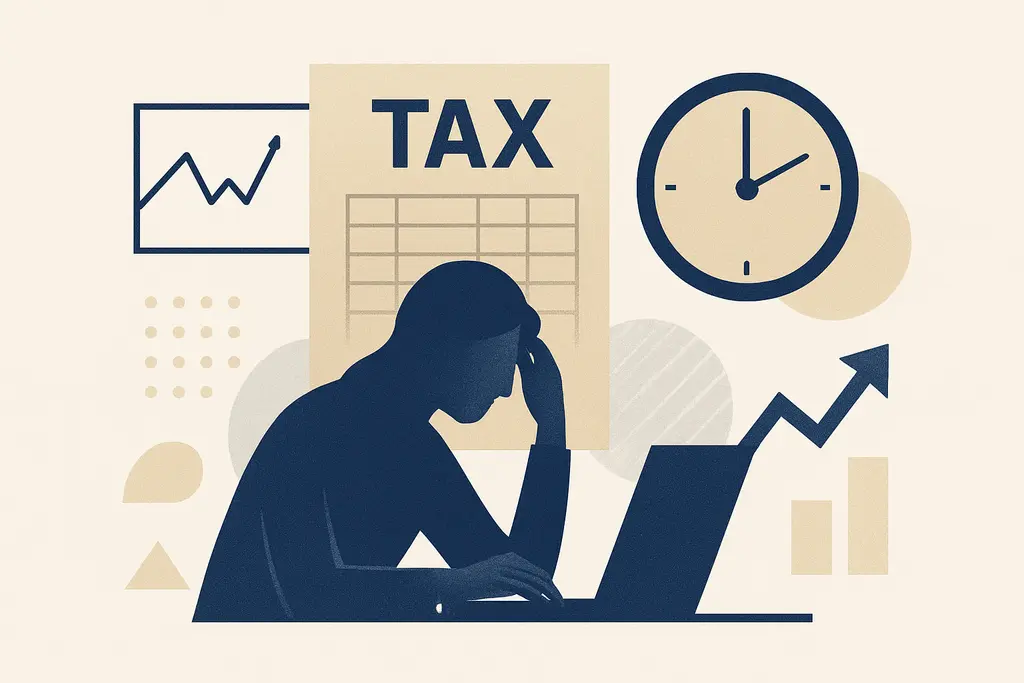
What it really means at work
This pattern is less about a single deadline and more about a recurring activation of financial uncertainty, time pressure, and administrative burden. For freelancers the trigger is predictable (seasonal deadlines) but the experience is subjective: some feel mild distraction, others face paralysis that shifts focus away from billable work.
The workplace consequences are concrete: lower responsiveness to clients, batch processing of invoices at the last minute, and elevated cognitive load when juggling project deadlines and record-keeping. Understanding it as a behavioural pattern helps separate emotional reactions from decisions that can be adjusted.
Why it tends to develop
Several workplace realities feed tax-season stress for freelancers:
Together these factors create a feedback loop: missed records increase perceived risk, which increases avoidance, which in turn increases last-minute scrambling. Isolation—no HR or finance team—means there is no organizational buffer to smooth the surge.
Irregular income and variable invoicing schedules that make forecasting harder.
Fragmented record-keeping: receipts, multiple platforms, and informal agreements.
Task avoidance: administrative work is perceived as low reward and high friction.
Time compression: seasonal clustering of administrative work creates intense short windows.
How it shows up in everyday work
- Skipped calendar planning and last-minute all-nighters to gather documents.
- Procrastinated invoicing until rates or terms are forgotten, affecting billing accuracy.
- Reduced client communication responsiveness during the crunch.
- Scope drift on projects because time is reallocated to administrative triage.
These behaviors often look like ordinary busyness but are patterned: the same weeks each year with spikes in turnover of small tasks, sudden pauses in new client intake, or a flurry of one-off messages asking for contract details. The behavioral signature is timing (seasonal), content (administrative), and side effects (missed opportunities, rushed decisions).
A quick workplace scenario
A freelance designer, usually responsive, starts delaying sending final invoices in late March. On a busy week she discovers receipts scattered across email threads and three payment portals. She cancels a discovery call to reconcile accounts, then rushes the next deliverable and accepts a short-term project at a reduced rate to patch projected shortfalls. The result: client frustration, lower margin, and a persistent sense of being behind.
This scenario shows how administrative friction cascades into client work and pricing decisions.
What helps in practice
Start with tiny, repeatable changes rather than a full overhaul. Small wins lower the emotional barrier to administrative work and rebuild confidence: a cleared folder or a confirmed invoice can reduce avoidance the next week and interrupt the stress loop.
**Small, regular habits:** weekly five–ten minute record checks reduce the bulk later.
**Micro-deadlines:** break the season into smaller, dated tasks instead of one big deadline.
**Capture systems:** one inbox or folder for receipts and contract notes to avoid scatter.
**Social accountability:** a peer check-in or coworking session focused on admin tasks.
**Prioritization rules:** a short list of “must-do” vs “can-wait” admin items for each week.
Nearby patterns worth separating
Misreading tax-season stress as laziness or incompetence is common. That misinterpretation leads to blaming the individual rather than adjusting systems. Separating the pattern from adjacent issues helps managers, collaborators, and freelancers themselves choose targeted interventions—organizational fixes for process problems, time-management tactics for avoidance, and workload changes for burnout.
Cashflow anxiety: often used interchangeably with tax stress, but cashflow worry is about day-to-day liquidity while tax stress centers on reporting and compliance-related tasks. They overlap but call for different immediate responses.
General burnout: tax-season spikes can look like burnout (low energy, irritability), yet burnout is broader and persistent; seasonal tax stress tends to be time-bound and task-specific.
Perfectionism or procrastination: filing every detail perfectly is often a cover for avoidance. The distinction matters because the remedy for perfection-driven delay differs from remedies for pure knowledge gaps.
Questions worth asking before changing course
- What small administrative task, if done weekly, would most reduce the end-of-season pileup?
- Which workflows force you to re-enter the same information across platforms?
- When did a tax-season scramble last interfere with client delivery, and what was the immediate cause?
Answering these anchors the problem to specific, testable changes rather than global resolutions. Focus on altering the work system (timing, capture, accountability) rather than waiting for motivation to appear.
Related patterns worth separating from it
- Payment-cycle behavior: patterns around invoicing and collections that affect liquidity but are not identical to reporting stress.
- Deadline-driven task clustering: how multiple unrelated deadlines create compounded stress.
Recognizing these as distinct but interacting patterns makes interventions more precise. For example, improving capture systems reduces both reporting stress and deadline clustering, whereas addressing payment cycles may require different client communication habits.
Related topics worth exploring
These suggestions are picked from nearby themes and article context, not just a flat alphabetical list.
Salary negotiation fear
Fear of asking about pay that leads people to accept offers or stay silent; explains causes, everyday signs, misreads, and practical workplace fixes.
Lifestyle Creep Trap
How small pay and perk increases become permanent workplace expectations, why incentives and social signals fuel them, and practical steps leaders can use to stop rising baseline costs.
Investment paralysis
Investment paralysis is the habit of repeatedly postponing resource commitments at work, causing stalled projects, lost momentum, and missed learning opportunities.
Frugality guilt
Frugality guilt is feeling ashamed to spend workplace money; it delays purchases, hides needs, and can be reduced by clearer rules, visible budgets, and reframed leadership signals.
Small-fee aversion
When tiny charges trigger outsized resistance at work, managers should treat the objection as social and procedural, not merely economic—then reframe or centralize the fee.
Startup equity anxiety
The workplace stress tied to stock options and ownership: why employees fixate on vesting, valuation, and identity, how it shows up day-to-day, and practical steps to reduce it.