What this pattern really means
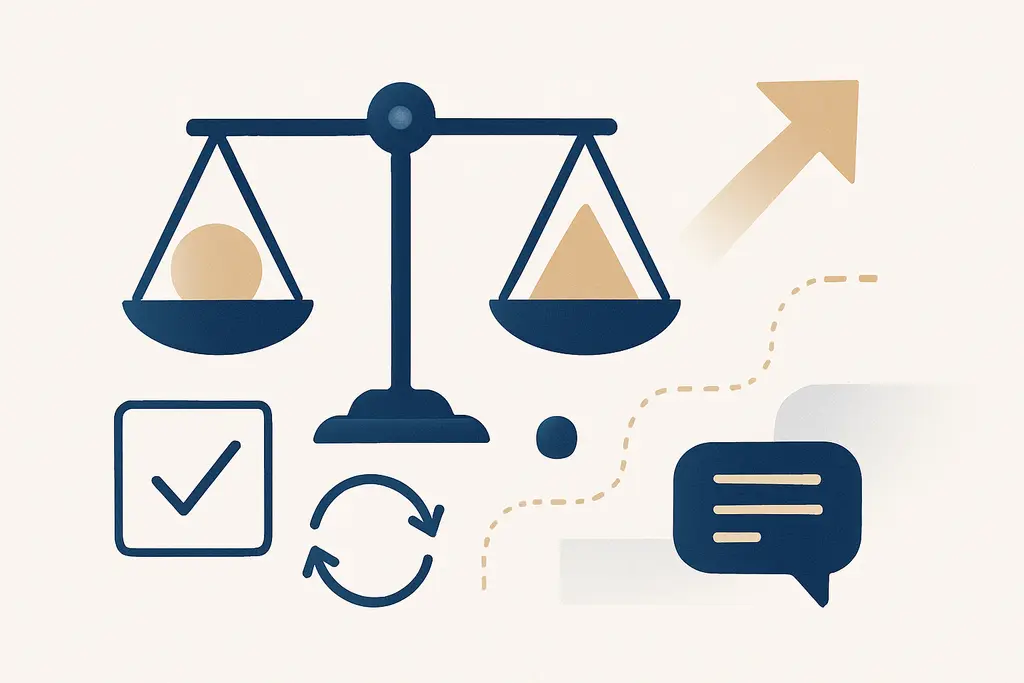
Micro-commitments are short, specific promises made by one or more people in a group to take a small, observable action that addresses part of a conflict. They are intentionally limited in scope and duration so the team can learn from the result and decide what to do next. In meeting settings they are often framed as experiments, pilots, or time-boxed trials that reduce the stakes of disagreement.
These are small-scale, practical choices — for example, agreeing to run a 2-week experiment, to collect three customer quotes, or to try a new meeting agenda for two sessions. The point is not full alignment but forward motion: converting contention into testable actions.
Key characteristics:
Used consistently, micro-commitments turn abstract debate into concrete information the team can use. They make it easier to separate strong principles from negotiable tactics.
Why it tends to develop
**Decision paralysis:** teams face too many options and make small steps to break stalemates.
**Need for psychological safety:** when full agreement feels risky, a small trial reduces exposure.
**Time pressure:** tight deadlines push groups to choose minimal viable actions rather than prolonged debate.
**Differing priorities:** micro-commitments let conflicting priorities be tested rather than adjudicated.
**Information gaps:** teams commit to gather specific data to resolve factual disputes.
**Power distribution:** when authority is unclear, small agreements allow decentralized testing.
**Meeting norms:** cultures that value experimentation use micro-commitments as a default conflict tool.
What it looks like in everyday work
These patterns make it easier to see when a team is using micro-commitments rather than postponing or escalating the conflict.
**Quick trial proposals:** someone suggests a brief test instead of a long decision.
**Time-boxed agreements:** the group agrees to try an approach for a fixed period.
**Split ownership:** tasks are delegated to test each side's assumption.
**Low-stakes language:** participants use phrases like 'let's try', 'test for two weeks', or 'pilot this'.
**Follow-up checkpoints:** the meeting ends with a clear check-in date to review results.
**Fallback plans:** teams specify how to revert if the test fails.
**Documentation of outcomes:** results are recorded and revisited in future meetings.
**Minimal resource allocation:** small budgets or headcount are assigned to the trial.
A quick workplace scenario (4–6 lines, concrete situation)
During a product meeting, two subteams disagree on a feature approach. Instead of escalating, they agree: the UX team will prototype one flow and the backend team will implement a simplified API for two sprints. Both sides commit to a demo in 10 working days and to measure user clicks and error rates. If metrics don't improve, the group reconvenes to choose an alternative.
What usually makes it worse
Tight delivery timelines that force faster decisions
Vague requirements that make long debates unproductive
Strongly held but untested assumptions from different stakeholders
Meetings with mixed seniority where no single authority resolves the issue
Previous failed long-term decisions that created skepticism
New information or customer feedback that requires quick validation
Resource constraints that make large-scale changes risky
Cross-functional dependencies that need short experiments to align teams
What helps in practice
Micro-commitments are most effective when they are concrete, time-limited, and reviewed openly. Teams that formalize the tiny-test habit reduce repeated arguments and build a culture of learning.
Propose a specific micro-commitment: define action, owner, timeframe, and success indicator.
Use meeting timers: limit discussion and reserve a short segment to decide the micro-step.
Frame tests as experiments: label them pilots to lower perceived stakes.
Assign clear reviewers: who will check results and when the group will reconvene.
Keep costs explicit: note the time, budget, and rollback plan before agreeing.
Document the agreement in writing (notes or ticket) to avoid scope creep.
Start with the smallest useful test: prefer the minimum viable step that informs the debate.
Use binary outcomes where possible: did metric X improve? yes/no.
Rotate ownership for fairness: let different stakeholders propose and own micro-commits.
Agree on fast feedback channels (short demos, quick reports) instead of long reports.
Set an automatic sunset: the test ends and requires explicit renewal to continue.
If results are ambiguous, schedule a short follow-up to refine the next micro-step.
Nearby patterns worth separating
Rapid prototyping — connected by using quick, tangible outputs to test ideas; differs because prototyping focuses on product artifacts while micro-commitments emphasize the agreement and timeframe.
Time-boxing — similar in limiting duration; time-boxing is broader (applies to tasks), while micro-commitments pair time limits with explicit interpersonal agreements.
Action-oriented facilitation — connected as a meeting technique; differs because facilitation is a role or skill, while micro-commitments are a specific tactic teams can adopt.
Pilot programs — related through small-scale testing; pilots often involve more formal evaluation and resources than a micro-commitment.
Checkpoint planning — connects by scheduling reviews; differs because checkpoint planning is broader project governance, while micro-commitments originate from resolving a specific conflict.
Consensus-minus-one — connected as a decision shortcut; differs because micro-commitments accept partial agreement through testing rather than counting votes.
Experiment logs / learning records — related in capturing outcomes; micro-commitments feed these logs with short-cycle results.
Reversible decisions — connected by the principle of low-cost reversal; micro-commitments operationalize reversibility in meetings.
Small wins strategy — connected as building momentum through incremental progress; micro-commitments produce those small wins in conflict contexts.
When the situation needs extra support
- If conflicts repeatedly escalate into personal attacks or ongoing team dysfunction, consider consulting a qualified organizational development professional.
- When patterns of avoidance or chronic stalemate persist despite process changes, an external facilitator or coach can observe and intervene.
- If psychological safety concerns are widespread (people fear speaking up), an expert in team dynamics can help rebuild norms.
- When workplace stress from recurring conflicts significantly impairs productivity or wellbeing, HR or an appropriate qualified advisor can guide next steps.
Related topics worth exploring
These suggestions are picked from nearby themes and article context, not just a flat alphabetical list.
Tacit norm conflicts
When unspoken workplace rules clash, teamwork stalls. Learn how tacit norm conflicts show up in meetings, why they form, and practical steps teams can use to surface and resolve them.
Request Framing
How the wording, context, and implied expectations around a work ask shape responses—and practical ways to reframe requests to reduce friction.
Feedback aversion
Feedback aversion is the avoidance of candid performance conversations at work; it shows up as silence, shallow reviews, and missed learning—practical fixes for leaders.
Message Friction
Message friction is the extra effort communications require—unclear asks, wrong channels, or missing ownership—that slows decisions. Learn signs, causes, and practical fixes for work.
Expectation Drift
Expectation Drift is the slow shift in team norms—what counts as ‘done’—that accumulates in meetings and routines, causing misalignment unless teams explicitly track and revisit standards.
Feedback timing effects
How the moment feedback is delivered shapes learning, trust, and behavior at work — and what leaders and teams can do to align timing with the purpose of feedback.