Quick definition
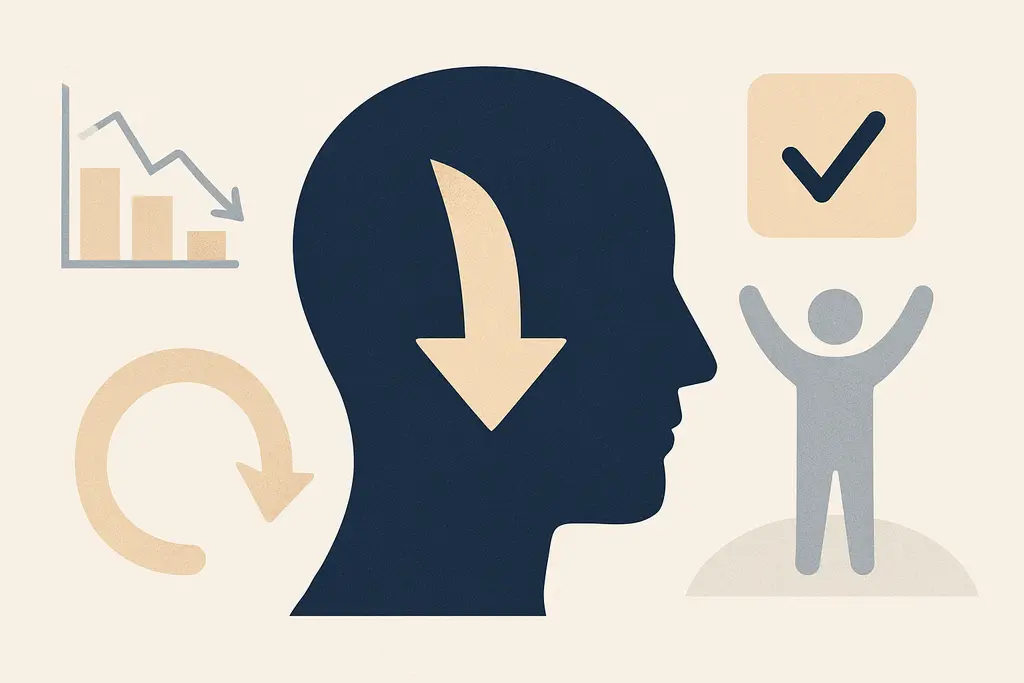
This phenomenon describes the short-term reduction in self-belief or task confidence that follows receiving feedback meant to help someone improve. It is usually transient: the person still has skill and potential, but their immediate sense of competence is shaken. The drop is often fueled by surprise, interpretation of the message as judgment, or comparison to standards rather than an objective gap.
Common characteristics:
Seen in everyday work: people perform well overall but temporarily pull back after critique. With constructive follow-up it typically rebounds; without support it can linger and affect longer-term confidence and contribution.
Underlying drivers
**Cognitive threat:** Feedback can trigger the mind’s quick assessment of "am I competent?" and amplify negative self-talk.
**Social evaluation:** Being judged (or feeling judged) by coworkers activates concern about reputation and belonging.
**Ambiguity of intent:** When the purpose of the feedback isn’t clear, recipients default to assuming negative motives.
**Identity overlap:** If competence is closely tied to someone’s work identity, critique feels like a personal setback rather than an opportunity to learn.
**Mismatch with expectations:** Criticism that contradicts prior praise or expectations creates cognitive dissonance and doubt.
**Contextual stressors:** Tight deadlines, fatigue, or high-stakes settings reduce bandwidth for processing corrective input.
**Power dynamics:** Feedback coming from a higher-status person or in public situations carries extra weight and threat.
Observable signals
These are observable patterns a workplace observer can track over days or weeks. They affect team rhythm (fewer contributions, slower iteration) and can be mistaken for disengagement if the feedback context isn’t considered.
Reduced participation in meetings or huddles; they stop volunteering ideas
Hesitancy to take on stretch assignments or visible projects
Over-preparing or hyper-detailing work to avoid future critique
Short-term drop in output speed while accuracy or caution increases
Seeking frequent reassurance or clarification about performance
Defensive language or minimizing the feedback in group settings
Increased silence or withdrawal after public comments
Avoiding collaboration with the person who gave the feedback
A quick workplace scenario (4–6 lines)
You tell a contributor in a project review that their slide deck needs tighter storytelling and clearer data calls-to-action. They nod but stop speaking up in the next two meetings, decline a presentation slot, and email their next draft with many caveats. A private check-in clarifies the intent, sets a small revision goal, and they return to normal participation within a week.
High-friction conditions
Receiving corrective comments in front of peers or stakeholders
Feedback that focuses on general traits ("your style") rather than specific behaviors
Sudden, unanticipated critiques that contradict earlier praise
Written feedback without an accompanying conversation or tone cues
High-stakes reviews (quarterly evaluations, client debriefs)
Cross-functional comments where standards aren’t shared
Vague suggestions without clear next steps or examples
Repeated micro-corrections over time without recognition of progress
Practical responses
These steps focus on repairing immediate confidence and setting conditions for productive learning. They are practical to implement in routine workplace interactions and aim to shorten recovery time while maintaining developmental rigor.
Pause and acknowledge: let the person know you understand this can feel unsettling and that the intent is to help.
Offer a private follow-up: give space to process then arrange a one-on-one to clarify specifics.
Anchor with strengths: begin the follow-up by naming concrete successes before listing improvement areas.
Provide small, achievable next steps: break the suggestion into a single, visible action they can take within a few days.
Use clear examples and data: make feedback actionable so it feels solvable rather than personal.
Give time to digest: avoid expecting immediate change; allow the person to reflect and respond.
Invite co-creation: ask how they’d like to address the point and what support they need.
Normalize the reaction: explain that momentary doubt is common and part of learning.
Offer a short skill-building resource or peer model to observe (template, example, mentor pairing).
Create opportunities for quick wins: assign a low-risk, public opportunity to rebuild visible confidence.
Follow up publicly with balanced recognition after improvements: reinforce progress in the same setting where critique happened.
Calibrate frequency and intensity of corrections: avoid piling critiques in a single interaction.
Often confused with
Impostor phenomenon — connected because both involve doubts about competence; differs in that the described dip is usually short-lived and directly triggered by recent feedback rather than a chronic pattern.
Psychological safety — a contextual factor that determines whether constructive criticism produces learning or erosion; low safety amplifies the confidence drop.
Feedback culture — the broader system that shapes frequency, tone, and clarity of critique; a strong culture reduces surprise and speeds recovery.
Self-efficacy — the belief in one’s ability to execute tasks; the temporary erosion affects self-efficacy in the short term, while long-term changes reflect learning experiences.
Attribution bias — the tendency to assign causes (internal vs external); people who attribute critique internally may experience larger confidence dips.
Growth mindset — a framing that encourages viewing feedback as a path to development; it connects by providing cognitive tools to reinterpret criticism.
Social comparison — comparing one’s performance to peers can magnify the impact of feedback and shape recovery speed.
Performance review timing — periodic formal reviews can intensify reactions if corrective points are clustered there rather than distributed.
Validation-seeking behaviors — immediate requests for reassurance after feedback; these are symptoms rather than causes and can be redirected into action planning.
Resilience practices — workplace routines (mentoring, micro-acknowledgement, mentoring circles) that help individuals bounce back faster from critique.
When outside support matters
- If feedback-related distress is persistent and significantly interferes with day-to-day work or relationships, consider suggesting an employee assistance program or HR referral.
- When the reaction includes prolonged withdrawal, sustained inability to perform usual duties, or escalating workplace safety concerns, consult occupational health or an appropriate workplace wellbeing professional.
- If a person requests it, help them access qualified support (EAP, career coach, or mental health professional) rather than trying to provide clinical help yourself.
Related topics worth exploring
These suggestions are picked from nearby themes and article context, not just a flat alphabetical list.
Why Successes Can Feel Like Luck
Why workplace wins sometimes feel like luck: how attribution gaps, feedback and culture make people downplay their role — with signs, examples, and practical steps to clarify cause and credit.
Quiet Confidence Building
Quiet confidence building is the gradual, low‑visible growth of workplace competence—how it develops, how to spot it, and practical ways teams and leaders support it.
Confidence scaffolding for new managers
Practical supports and routines that help first-time managers grow steady confidence—how it shows up, why it forms, what helps, and how leaders can scaffold (and remove) it.
Confidence calibration for career decisions
Practical guidance on aligning confidence with real readiness when choosing jobs, promotions, or stretch roles—how it shows up, why it happens, and steps to improve calibration.
Confidence Rebound After Failure: getting back on track
Practical guidance for managers to restore team confidence after failure—signs, causes, common misreads, and concrete early steps to get people back on track.
Recognition Aversion
Recognition aversion is when employees avoid public praise; learn how it shows up, why it develops, how managers misread it, and practical ways to acknowledge contributions without harm.