Working definition
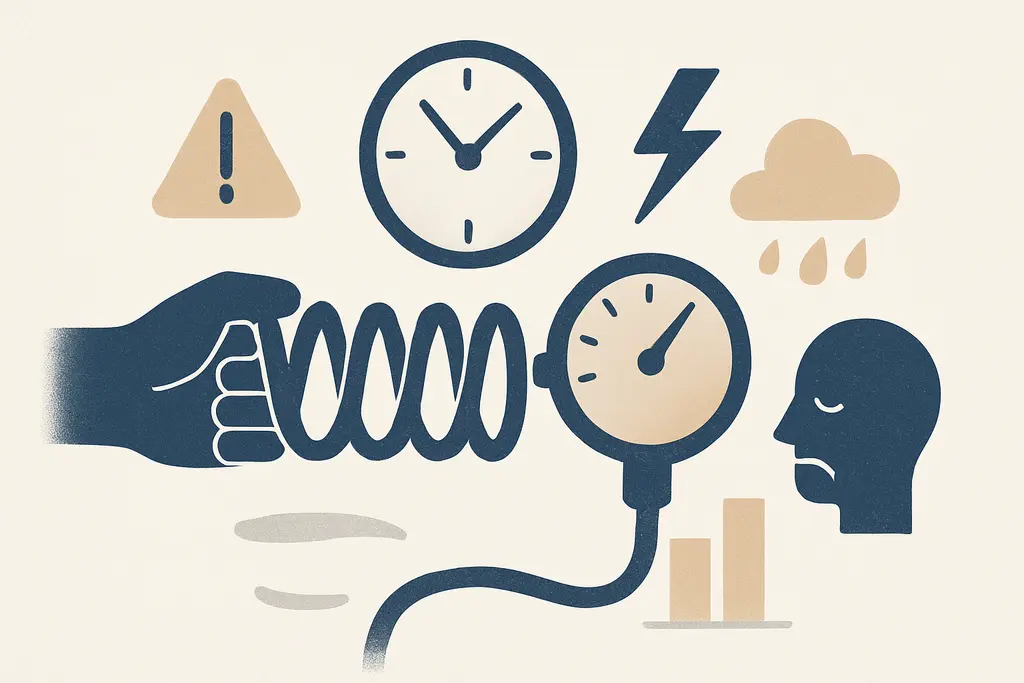
A constant-urgency culture is an organizational pattern where short timelines, last-minute priorities and visible activity are treated as the norm. Stress in this context arises from the mismatch between how work is measured or rewarded (fast output, immediate responsiveness) and the time and attention necessary for thoughtful, reliable work.
This stress is not just individual tiredness: it is produced by systems of measurement, recognition and escalation that make urgent responses the safest way to meet expectations. Over time, teams learn to prioritize what shows up in performance reviews, dashboards or bonus calculations—even when that sacrifices stability, learning, or long-term outcomes.
Key characteristics:
These features produce predictable behaviours: people optimize for what is measured and rewarded, often by cutting corners or working longer hours. The culture reinforces itself because short-term wins show up quickly on metrics and reviews.
How the pattern gets reinforced
**Short-term targets:** KPIs and quarterly goals that reward immediate output prioritize speed over planning.
**Visibility bias:** Work that is visible in dashboards or meetings gets rewarded more than behind-the-scenes maintenance.
**Rewards for heroics:** Bonuses, recognition or promotions tied to emergency responses teach people that urgency is rewarded.
**Poor workload design:** Lack of buffers and unrealistic estimates make every task prone to becoming urgent.
**Escalation incentives:** Fast escalation paths and urgent tags are used to get attention, creating a feedback loop.
**Social proof:** When leaders praise quick fixes or applaud all-night pushes, others follow to fit in.
**Information silos:** Incomplete handoffs and poor coordination make last-minute firefighting necessary.
Operational signs
These patterns are visible across calendars, dashboards and reward practices: if the organization structurally benefits from rapid responses, behavior will follow. Over time the pattern becomes normalized and harder to undo.
Meeting agendas filled with “urgent” items and frequent ad-hoc meetings.
KPIs that spike attention toward response time, tickets closed, or deliverables shipped this week.
Teams habitually working late or skipping breaks to meet shifting deadlines.
Frequent context-switching as priorities are re-ranked on short notice.
Projects that lack time for testing, documentation or handover.
Firefighting praised in town halls; steady delivery receives little acknowledgment.
Quick patches or temporary fixes accepted as standard practice.
Managers or reviewers asking for updates several times a day instead of trusting plans.
Pressure points
Last-minute executive requests tied to external events or investor updates.
Quarterly targets that reward immediate gains instead of steady progress.
Incident-driven metrics (e.g., SLA breaches) that escalate attention toward firefighting.
Public dashboards that highlight short-term numbers without context.
Performance reviews focusing on visible accomplishments in a short window.
Tight product launch schedules with no buffer for delays.
A one-person subject-matter expert being unavailable and causing urgent handoffs.
Sudden market or competitor moves generating reactive directives.
Short planning cycles (weekly or biweekly) that reset priorities frequently.
A quick workplace scenario (4–6 lines, concrete situation)
A product team’s weekly sprint is judged by the number of tickets closed and time-to-ship metrics. When a stakeholder requests a late feature tweak, the item is marked "urgent," the sprint is reshuffled, and testers are pressured to skip regression checks. The metrics spike, leadership praises the fast turnaround, and the next cycle starts with less time for planning.
Moves that actually help
Define balanced KPIs: include measures for predictability, quality and cycle time—not just speed or volume.
Build explicit buffers into timelines (planned slack) so not every task becomes urgent.
Limit escalation channels: set rules for what qualifies as urgent and who can tag items as such.
Make hidden work visible: track maintenance, documentation, and technical debt alongside feature delivery.
Reward steady delivery: recognize teams that meet commitments without last-minute heroics.
Schedule focus blocks: protect regular periods for deep work and block them on calendars.
Create clear handoffs: standardize how tasks are passed between teams to reduce surprises.
Rotate on-call or escalation duties so urgency doesn’t always fall on the same people.
Require brief impact statements for urgent requests (what is the cost of not doing it now?).
Run blameless post-mortems to learn from emergencies rather than normalize them.
Leaders model behavior: avoid praising 24/7 availability and make after-hours communication optional unless specified.
Regularly review incentive structures: check whether bonus and promotion criteria favor quick fixes over sustained outcomes.
Related, but not the same
Metrics gaming — Connects because both arise from narrow KPIs; differs since gaming is deliberate optimization of numbers, while constant urgency can be an emergent cultural pattern.
Heroic overtime — Related outcome where individuals are praised for last-minute effort; differs because the focus here is on systemic incentives that produce many such heroes.
Busyness signalling — Connects through visible behaviours (being busy as status); differs by emphasizing social signaling rather than formal KPIs.
Technical debt accumulation — Connects as a consequence: constant urgency often increases short-term fixes that create debt.
Time poverty — Connects in the experience of lacking discretionary time; differs by focusing on personal time scarcity rather than organizational metrics.
Decision fatigue — Connects because frequent urgent choices wear down capacity; differs as a cognitive load concept rather than a reward-structure cause.
Psychological safety — Connects because low psychological safety magnifies urgency responses; differs since safety concerns relate to speaking up and learning.
Continuous delivery vs. reactive shipping — Connects to delivery practices: continuous delivery can reduce urgency when implemented well; differs because the execution model alone doesn’t fix misaligned incentives.
When the issue goes beyond a quick fix
- If stress from constant urgency is impairing job performance, relationships or daily functioning, consider speaking with a qualified occupational health or mental health professional.
- If persistent anxiety or sleep disruption follows from workplace pressure, contact employee assistance programs (EAP) or a licensed counselor for assessment and guidance.
- HR or an organizational development consultant can help review incentive structures and workload design when the pattern is systemic.
Related topics worth exploring
These suggestions are picked from nearby themes and article context, not just a flat alphabetical list.
Adaptive stress vs toxic stress at work
How to tell when pressure at work fuels growth (adaptive) versus when it becomes chronic harm (toxic), what creates each, and practical steps leaders can take.
Busy badge culture
When visible busyness becomes a status signal at work, outcomes suffer. Learn how it forms, how to spot it, and practical steps leaders can take to shift incentives toward impact.
Urgency Addiction
A concise guide for leaders on how 'Urgency Addiction' turns routine work into constant crisis mode, why it forms, how it shows up, and practical steps to reduce it.
Perpetual On-Call Stress
Chronic expectation of immediate responsiveness at work that blurs boundaries, harms planning, and hides capacity issues — how it shows up and what managers can do.
Quiet stress at work: sustained low-level strain
Sustained low-level pressure at work that quietly drains focus and quality—how it forms, how it shows up day-to-day, common misreads, and practical manager actions to reduce it.
Rest guilt
Rest guilt is the anxious feeling that downtime is undeserved; it shows up as skipped breaks, constant connectivity, and over-justifying time off, and can be reduced by clearer handoffs and visible bo