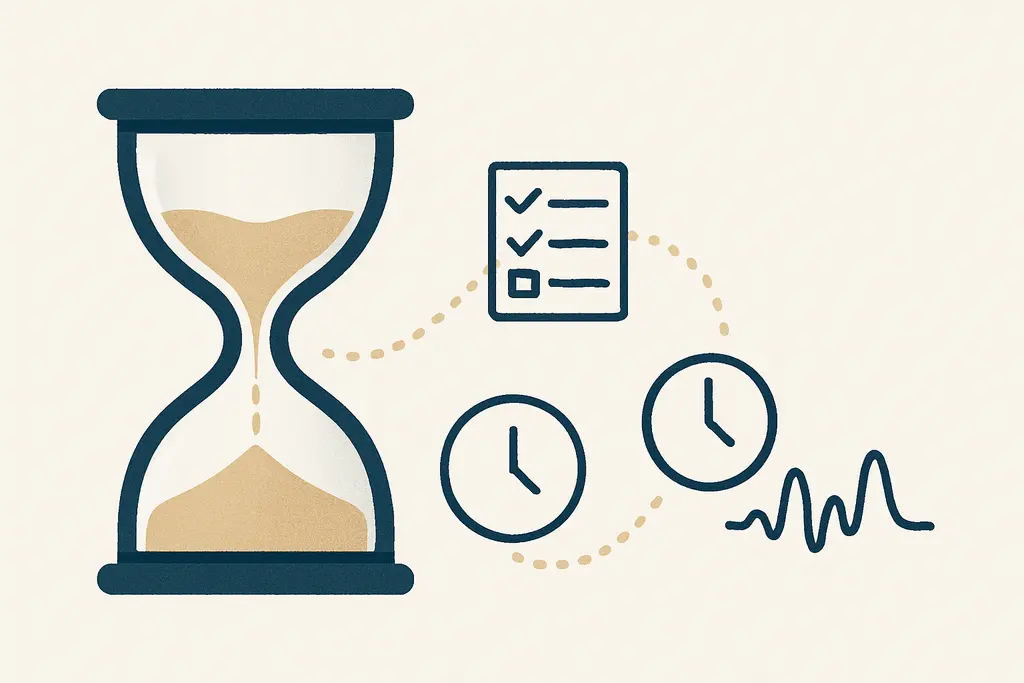
What it really looks like
Deep Work Interruptions show up as short events that break an employee’s concentrated flow: a Slack ping, a manager asking for a quick update, or an unplanned meeting request. They aren’t only loud events; they include habitual checks or context switches that feel minor but add up.
- Instant messages: quick pings that demand a response or create a sense of obligation.
- Ad-hoc meetings: brief calendar grabs that slice into blocks of focused time.
- Drop-by queries: colleagues stopping by a desk or pinging on video without scheduling.
- Self-interruption: switching tabs to check email, news, or notifications.
- Process friction: lack of clear async protocols that forces synchronous work.
These interruptions are often short but cumulative. A single ten-minute break can produce attention residue that makes the following thirty minutes less productive, so frequent micro-interruptions have outsized effects.
Why it tends to develop
Several workplace dynamics create and reinforce deep-work interruptions. They arise from systems (tools and schedules), social norms, incentives, and individual habits.
Taken together, these create feedback loops. If visible responsiveness wins credit, people substitute deep work for reactive behavior. Over time, both managers and teammates stop planning for sustained blocks and the interruption pattern becomes expected behavior.
Tool affordances: messaging apps and open calendars make instant contact easy.
Reward signals: rapid responsiveness is often praised or rewarded implicitly.
Unclear priorities: when goals and ownership aren’t explicit, people ask for quick clarifications.
Lack of buffers: no protected focus blocks or meeting-free days in the schedule.
Cultural norms: availability equals engagement in some teams.
How it shows up in everyday work (with a quick example)
In daily practice the pattern is easy to spot: calendars with many short meetings, engineers who start tasks but produce partial work, or writers who report finishing later because of frequent context switches.
A quick workplace scenario
A product manager schedules a series of 30–45 minute check-ins across the week while remaining reachable on chat. Engineers book time for design deep work but get interrupted by clarifying questions; their tickets slide as they re-open the task several times. The manager interprets slow ticket churn as low effort, asks for daily updates, and the cycle continues.
This example highlights that interruptions are not neutral: they change estimates, increase coordination, and create a mistaken narrative about effort vs. outcomes.
What helps in practice
Start with low-friction, systemic changes that align behavior with the value of uninterrupted focus. These changes work much better than exhortations to "focus more."
Adopting these steps reduces interruptions by changing the system that rewards them. Practical policies combined with visible leadership behavior create permission for teams to use long focus blocks.
Set protected focus blocks on shared calendars (e.g., two morning hours) so everyone can schedule around them.
Create async-first norms: define which issues require immediate reply and which can be handled by status documents or ticket comments.
Use clear meeting triage: require purpose and decision outcomes for every meeting invite.
Limit shallow meetings: replace recurring status calls with written updates and a short weekly sync.
Train and model: managers should visibly block deep work time and decline nonurgent interruptions.
Where leaders commonly misread interruptions and related confusions
Leaders often misinterpret interruptions or confuse them with other patterns. Misreads lead to ineffective fixes.
- Mistake 1: Treating interruptions as purely an individual problem. If only the employee is told to "focus more," system drivers remain.
- Mistake 2: Equating busyness with impact. A calendar full of short calls looks productive but fragments deep work.
- Mistake 3: Assuming tools are neutral. Tools shape norms—expecting immediate replies makes interruptions a default.
Two related concepts that are often mixed up with deep-work interruptions:
- Multitasking / Context switching: the cognitive cost of shifting between tasks. Deep-work interruptions cause context switching, but multitasking often implies attempting two tasks at once rather than discrete breaks.
- Shallow work vs. deep work: administrative tasks or quick operational emails are shallow work. Interruptions can be both shallow work and the mechanism that prevents deep work.
Understanding the difference matters: fixing the wrong variable (e.g., banning chat without clarifying async rules) can worsen coordination. Managers should separate symptoms (slow output) from causes (norms, incentives, and tools).
Questions worth asking before you act
Before changing policy or calling out employees, diagnose the interruption ecology with a few targeted questions.
- Who typically initiates interruptions and why? Are they seeking decisions, information, or reassurance?
- Which tools or routines make interruptions cheap? Are there alternatives?
- What calendar structures or incentives encourage responsiveness over concentration?
- What metrics are you using to judge productivity—are they capturing deep outcomes or just activity?
A short diagnostic will reveal whether you need cultural norms, tooling changes, clarified priorities, or a mix. Small experiments—one-week protected focus, stricter meeting agendas, or a pilot async protocol—give quick feedback without heavy enforcement.
Closing note: modest, systemic fixes win
Deep Work Interruptions are rarely eliminated by willpower alone. The most reliable improvements come from changing the environment: synchronous load, calendar rules, response norms, and leadership modeling. Start with one policy that reduces the cheapest interruptions, measure the effect on output and morale, and iterate.
Related topics worth exploring
These suggestions are picked from nearby themes and article context, not just a flat alphabetical list.
Deep Work for Managers
How managers create, protect, and scale focused, high-value work time—practical steps, pitfalls, and examples for turning attention into better decisions and fewer interruptions.
Two-hour deep work blocks: how to structure them
How to plan, protect and use two-hour deep work blocks at work—practical rituals, chunking strategies, common pitfalls, and examples for sustained focus.
Inbox zero myth
Why aiming for an empty inbox is often symbolic, how it shapes daily work behavior, common confusions, and practical fixes to reduce busywork and distraction.
Notification anxiety
Notification anxiety is the anticipatory stress about pings and messages at work — it fragments focus, shapes habits, and can be reduced by norms, batching, and targeted notification settings.
Focus residue recovery
How leftover attention from one task slows the next—and practical steps managers and teams can use to clear it, from short buffers to one‑line handoffs.
Decision batching
Decision batching groups similar workplace choices into scheduled sessions; it can boost focus and consistency but also cause delays and bottlenecks if misused.