What it really means
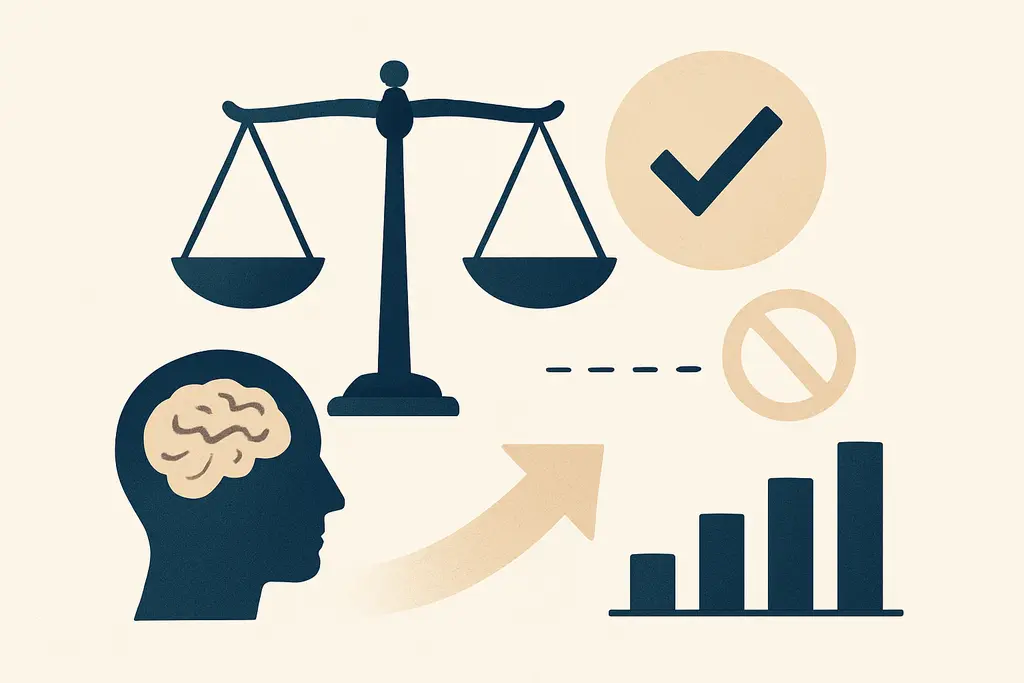
Moral licensing is a cognitive pattern: an initial decision perceived as moral or generous reduces the felt need to justify later choices. For leaders, that can translate into small compromises that accumulate—spending budget on a pet project, cutting corners on process, or giving themselves leniency others don't get.
Leaders don’t need to be bad people for moral licensing to occur. The pattern is psychological: past good behavior becomes a mental credit that lowers moral friction for subsequent actions that might otherwise cause hesitation or accountability.
Why the pattern develops and stays in place
- Social signalling: Publicly visible good acts (donations, fairness statements) create a reputation buffer.
- Self-concept maintenance: Leaders want to see themselves as moral; one good act preserves that identity, easing later choices.
- Cognitive budgeting: People mentally treat virtue like a resource—‘I did X good thing, so Y is acceptable.’
- Organizational ambiguity: Vague rules and discretionary powers make it easy to translate moral credits into exceptions.
These forces compound in hierarchies. The higher the discretion and the more applause for visible virtues, the stronger the psychological license. Over time, exceptions become precedents and the organizational moral baseline shifts.
How it shows up in everyday work
- A leader who publicly champions fairness but then awards a contract to a friend because they 'deserve it.'
- Celebrating one high-profile diversity hire and then ignoring systemic hiring biases the rest of the year.
- Taking long weekend leave after a charity day and expecting the team to cover without acknowledgment.
- Approving a low-risk experimental product after touting a safety-first culture.
These behaviors are often subtle and episodic rather than dramatic. Teams notice uneven enforcement of rules, private deals, and rationalizations framed as earned rewards. Over time those small episodes shape team expectations about what leaders really value.
A quick workplace scenario
A mid-level director organizes an employee mental-health week and promotes it loudly. A month later, when budget pressure appears, she cancels a team wellbeing program and cuts counselling hours, explaining that her earlier initiative has already "done the heavy lifting." The team sees the initial event as virtue signalling and the cuts as expected trimming, reducing trust.
This scenario shows how a visible moral act can be used (consciously or not) to justify retrenchment, especially when outcomes are hard to measure.
Nearby patterns worth separating
Leaders and observers commonly misread moral licensing as hypocrisy, simple hypocrisy being intentional contradiction between words and actions. Licensing may be less about deception and more about an internal accounting error—still harmful, but different in origin.
Moral balancing vs. moral licensing: Moral balancing is the broader idea of trading moral behaviors; licensing is a specific form where the earlier good act reduces restraint for a later lapse.
Moral credentialing: Often used interchangeably, credentialing emphasizes the reputational shield a prior act provides—credentials protect subsequent choices in the eyes of others.
Rationalization and motivated reasoning: These are mechanisms that help leaders explain decisions after the fact, but licensing is distinctive because the earlier behavior actively reduces internal resistance beforehand.
Practical steps to reduce moral licensing in leadership
- Set visible rules: Reduce discretionary gray areas so private justifications have less room to operate.
- Require decision records: Ask leaders to briefly document trade-offs for discretionary choices; archived rationales limit retrospective license.
- Split responsibilities: Rotate approvers for decisions where the leader might benefit personally or where moral credits can be leveraged.
- Measure outcomes, not signals: Track sustained behaviors (process compliance, equitable hiring) rather than one-off symbolic acts.
- Introduce accountability partners: Peer review, skip-level checks, or ethics committees make moral credits harder to spend unilaterally.
- Reflective prompts: Encourage leaders to ask, 'Would I allow this if I hadn't done X earlier?' before approving exceptions.
These actions reframe moral decisions as part of continuous governance rather than one-off reputation events. Structural changes—clear policies, shared oversight, and measurable follow-through—are the most reliable way to prevent a single virtue from functioning as a free pass.
Questions worth asking before you react
- Was the earlier good act public or private, and who perceived it? Public acts create larger reputation buffers.
- Is the later decision a clear trade-off or a distinct issue being rationalized? Look for causal links.
- Who benefits and who bears costs? Licensing often concentrates benefits on leaders or their allies while externalizing costs.
Answering these helps separate genuine trade-offs from moral licensing and directs whether to pursue coaching, process change, or accountability mechanisms.
Where to watch for early signs
- Patterns of one-off visible virtues followed by unexplained exceptions.
- Increasing frequency of "special cases" that benefit the same person or subgroup.
- Growing mismatch between public values and private resource allocation.
Spotting these early allows managers to intervene with light governance fixes before norms shift.
Related topics worth exploring
These suggestions are picked from nearby themes and article context, not just a flat alphabetical list.
Quiet Authority
Quiet Authority is steady, low-key leadership that influences through consistent competence and clear boundaries—learn how it forms, shows up, and how to support or evaluate it at work.
Influencing Up
A practical field guide to influencing up: how to present decisions, reduce leaders' friction, spot common misreads, and increase the chance your proposals get approved.
Consensus Fatigue
When teams stall trying to make everyone happy, decisions become delayed and diluted. Signs, causes and manager-focused steps to spot and reduce consensus fatigue at work.
Delegation trust gap
When tasks are assigned but real authority isn’t, work slows and initiative fades. Practical manager steps to spot, understand, and close the delegation trust gap.
Authority Shadowing
How Authority Shadowing shows up when teams mirror leaders' views instead of testing assumptions, why it forms, common misreads, and practical steps managers can use to reduce it.
Praise hoarding
Praise hoarding is when recognition is concentrated or withheld, skewing who gets credit. Learn how it shows up, why it persists, and practical steps leaders and teams can use to correct it.