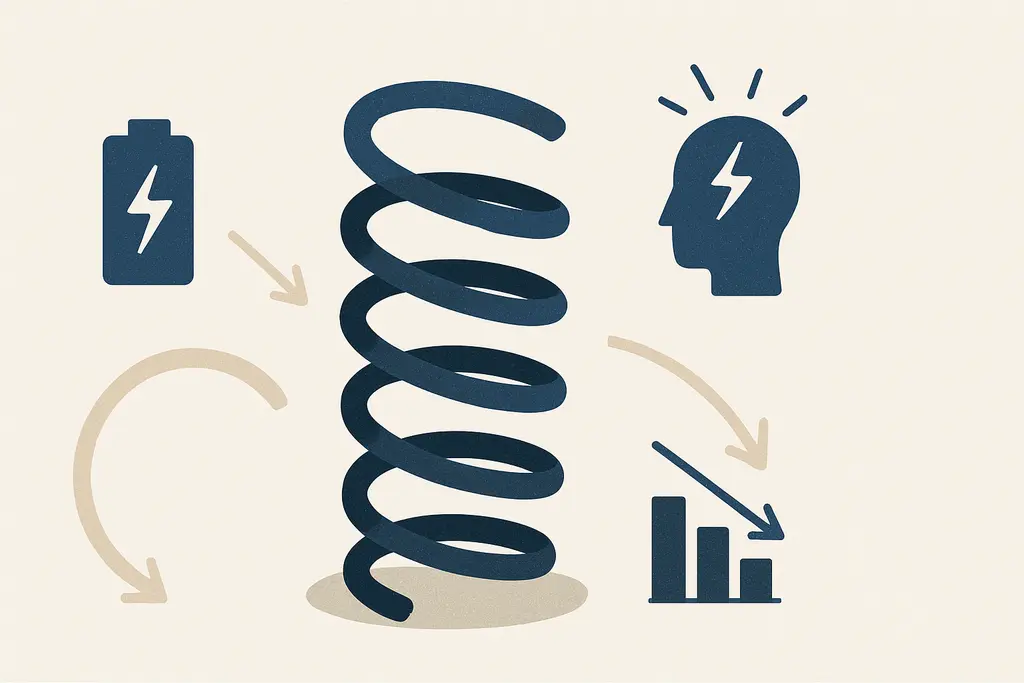
What quiet burnout looks like in day-to-day work
- Consistent over-delivery: still meets core deadlines but declines optional effort and innovation.
- Muted affect: fewer expressions of enthusiasm; fewer contributions in meetings even when knowledgeable.
- Short attention span for long tasks: starts many things but completes fewer value-added follow-ups.
- Higher friction with peers: small conversations escalate; tone subtly more defensive.
- Attendance but not engagement: shows up physically, but participation is minimal and task focus narrows.
These signs tend to be incremental and easy to justify at the moment: a high performer can plausibly attribute them to busier weeks or tight deadlines. That plausibility is why the pattern often goes unnoticed until impact accumulates.
Why top performers drift into quiet burnout
High performers get pulled into this pattern for a mix of structural and social reasons:
- Role overload: amplified expectations plus unclear limits on availability.
- Identity linkage: tying self-worth to output or being seen as the "go-to" person.
- Invisible costs: emotional labor, mentoring or fixing others’ mistakes that aren’t tracked in KPIs.
- Reward mismatch: recognition for short-term wins but not for sustained reliable work.
- Normalization of intensity: cultures that glamorize hustling or reward constant responsiveness.
The pattern sustains itself because the person still produces results. That productivity reduces external pressure to change, while internal pressure (to maintain status) drives them to keep up the pace. Over time energy is siphoned toward essentials only, leaving less capacity for learning, risk-taking, and teamwork.
A workplace example
A quick workplace scenario
An engineering lead, Maya, is consistently the first to respond to urgent tickets and the last to leave. She quietly drops ownership of cross-team initiatives, stops volunteering for brainstorming sessions, and begins delegating polishing tasks but keeps core debugging work. Peers note fewer creative proposals from her and more terse feedback. Her manager sees her meeting deadlines and assumes everything is fine.
The key elements in this example are visible delivery with shrinking discretionary effort and reduced collaborative signal. Without checking the "why," a manager might mistake this for improved efficiency rather than the start of quiet burnout.
Where managers commonly misread what’s happening
- Efficiency label: treating narrowed scope as better prioritization instead of reduced capacity.
- Motivation deficit: assuming lack of interest rather than exhaustion or resource misallocation.
- Performance anxiety: viewing guarded communication as defensiveness meant to hide incompetence.
These misreads are dangerous because they push managers toward performance corrections (e.g., stricter targets, punitive feedback) instead of structural support. Quiet burnout can be confused with related concepts — important distinctions include:
- Disengagement vs. quiet burnout: disengagement is a loss of connection to work; quiet burnout includes continuing to care but with depleted energy.
- Quiet quitting vs. quiet burnout: quiet quitting is a deliberate boundary choice to do only assigned work; quiet burnout often begins involuntarily as capacity erodes.
- Depression vs. burnout: depression is a clinical condition that may overlap with burnout but requires care from health professionals; treat observations as workplace capacity signals, not a diagnosis.
Managers should separate these possibilities rather than jump to one explanation. The right response depends on whether the person is protecting boundaries, exhausted from unsustainable load, or facing personal health challenges.
Practical responses
Start with small, reversible changes: adjust one recurring meeting, reassign a nonessential ownership, or formally recognize mentoring contributions for a quarter. These micro-shifts reduce the cognitive load quickly and let a manager test whether capacity recovers without dramatic interventions.
Conduct a focused workload review: map responsibilities, recurring firefights and invisible tasks.
Re-balance visible and invisible work: credit mentoring, fixes and coordination in assessments.
Re-set role expectations: agree core hours, response windows and discretionary limits.
Create recovery space: temporary reduction in non-critical projects or protected "no-meeting" blocks.
Signal reciprocity: normalize saying "I can’t right now" and model it from leadership.
Questions worth asking before reacting
- What sustained deliveries have they kept up, and what discretionary tasks have stopped?
- Which expectations are implicit versus documented for this role?
- Has this person’s downstream work (team learning, handoffs, error rates) changed?
- What support have they previously declined or accepted, and why?
Asking targeted questions avoids the two worst default moves: assuming the person is merely disengaged or immediately escalating performance management. The goal is to diagnose workload and relational dynamics, not to pathologize behavior.
Quick checklist for managers following an observation
- Check recent workload and hidden tasks.
- Have a private fact-finding conversation (listen for energy, not just excuses).
- Offer short-term capacity relief and a plan to re-evaluate.
- Adjust recognition and KPI framing to include collaborative, invisible work.
A brief, practical sequence like this preserves trust and gives the manager data to decide between coaching, role redesign, or further support. Quiet burnout in high performers is often reversible with timely structural changes and clearer expectations; leaving it unchecked tends to reduce both individual and team resilience.
Related topics worth exploring
These suggestions are picked from nearby themes and article context, not just a flat alphabetical list.
On-Call Burnout
On-call burnout is the cumulative mental and physical strain from repeated after-hours responsibility; learn how it appears, why it persists, and practical fixes for teams.
Burnout rumination
How recurring, work-focused negative thinking drains teams, how it shows up, why it persists, and practical manager actions to reduce it.
Post-project burnout
A practical guide to post-project burnout: how the post-delivery slump shows up, why it persists, and concrete manager steps to restore team energy and follow-through.
Burnout recovery guilt
Burnout recovery guilt is the shame or hesitation people feel when returning from burnout. It shows as secrecy, overcompensation, and reluctance to use supports; clarified expectations and visible bou
Re-entry burnout after leave
When employees return from extended leave and face overload, confusion, or exhaustion—how it shows up, why it happens, and practical manager steps to ease the transition.
Boundary erosion burnout
A manager-focused guide to boundary erosion burnout: how blurred work/life lines build up, how it shows in team behaviour, and practical first steps to restore healthy boundaries.