Working definition
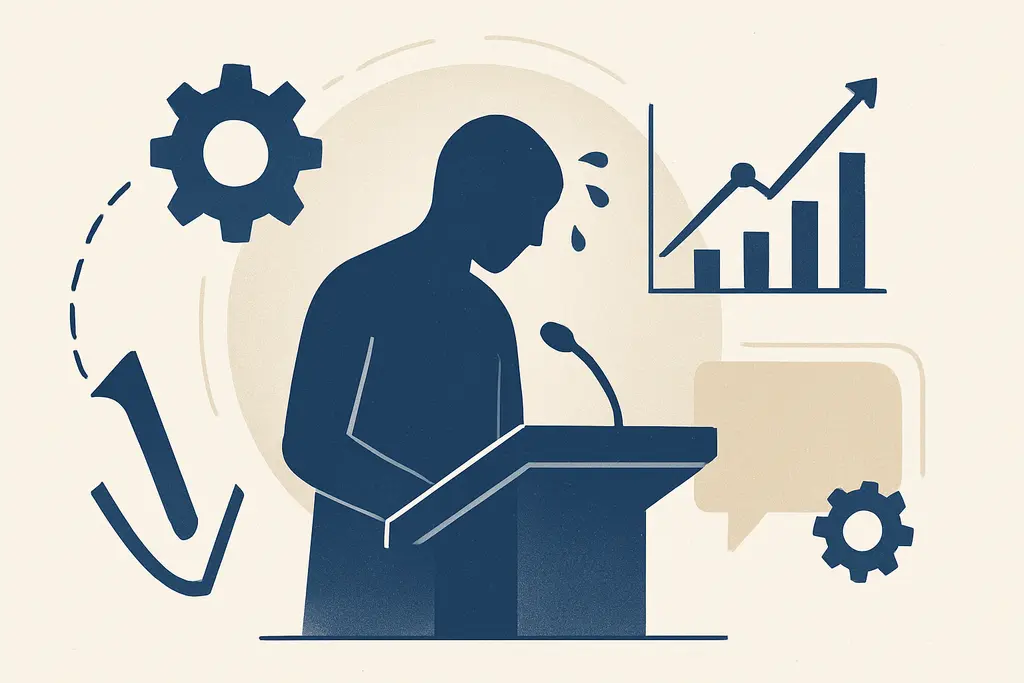
Showcase anxiety at work refers to heightened nervousness, self-monitoring, or avoidance that occurs specifically around public displays of one’s work. This can include live presentations, demos, walkthroughs of projects, portfolio reviews, or any situation where work is exposed to scrutiny. It is distinct from general job stress because it centers on evaluation in a public or semi-public setting.
Key characteristics include:
These traits are practical signals rather than labels: they help observers recognize patterns that may reduce contribution and learning in teams. When noticed early, small adjustments to process and environment often make a meaningful difference.
How the pattern gets reinforced
These drivers combine cognitive (thought patterns), social (peers and audiences), and environmental (meeting formats, stakes) factors that amplify nervousness around showcasing work.
**Evaluation risk:** perceived high stakes when work is judged publicly
**Social comparison:** worrying that peers will judge competence or rank
**Perfectionism:** belief that only flawless presentations are acceptable
**Unclear expectations:** not knowing what the audience wants increases anxiety
**Past negative feedback:** earlier harsh critique linked to similar events
**Lack of practice or exposure:** infrequent spotlight moments make each one feel larger
Operational signs
Noticing several patterns together can indicate that the workplace setup is amplifying showcase anxiety rather than an individual's isolated preference.
Repeated last-minute edits to slide decks or demos
Team members declining to present or asking others to do it
Over-preparation on visuals but poor spontaneous answers
Delivering content in a monotone or reading verbatim from slides
Using overly technical language to shield uncertainty
Skipping Q&A or deflecting questions back to others
Requesting evidence of every claim to avoid open discussion
Excessive apologizing at the start of a presentation
Asking for small-group feedback instead of broader sharing
Volunteers quietly contributing ideas after meetings instead of during them
A quick workplace scenario (4–6 lines, concrete situation)
At a product review, an engineer prepares an impeccable demo but insists on running it alone in a private session. During the sprint demo they defer questions to the product manager, avoid live changes, and afterward say they felt their work "wasn't ready"—despite stakeholder interest. A short, low-stakes practice session could bridge that gap.
Pressure points
Formal all-hands or company-wide demos with senior leaders present
Unknown audience composition (not knowing who will attend)
High-stakes reviews tied to promotion or budget decisions
Live technical demos with potential for visible errors
One-on-one feedback delivered immediately after a showcase
Short preparation windows for unexpected presentations
Highly critical or public feedback norms in the team
New role or recently joined employees presenting to established peers
Presenting to clients or external stakeholders
Moves that actually help
These actions focus on changing the immediate environment and norms so that skill and contribution are visible without forcing sudden exposure. Over time, a pattern of safe, predictable showcases reduces the signal that every public display is a high-stakes test.
Offer low-stakes rehearsal opportunities (peer run-throughs before the main event)
Use structured formats that limit unpredictability (e.g., fixed Q&A time, templates)
Encourage co-presenting so responsibility and attention are shared
Normalize failure by sharing small mistakes and learnings from leaders
Provide clear audience briefings and explicit expectations beforehand
Rotate showcase roles gradually to build experience without overload
Create a written “showcase checklist” with deal-breakers and acceptable workarounds
Offer alternative formats (pre-recorded demos, written walkthroughs) when appropriate
Give specific, constructive feedback focused on observable behaviors, not personality
Recognize effort and improvement publicly to decouple visibility from perfection
Schedule shorter, more frequent demo slots instead of rare high-pressure events
Related, but not the same
Impostor syndrome — overlaps when people fear being exposed as inadequate; showcase anxiety is specifically about public displays rather than a global sense of fraudulence.
Performance anxiety — broader term that includes physical symptoms; showcase anxiety narrows this to work-related presentations and demos.
Psychological safety — a team climate that reduces showcase anxiety by allowing mistakes; weaker psychological safety often increases showcase-related stress.
Perfectionism — drives excessive polishing of visible work; perfectionism fuels showcase anxiety but also shows in private work areas.
Public speaking fear — a related skill-based fear; some people have showcase anxiety even when not fearful of speech, because the content—not the delivery—is being judged.
Feedback sensitivity — heightened reactivity to critique can intensify anxiety during showcases; improving feedback practices can reduce the trigger.
Meeting design — how meetings are run can either reduce or amplify showcase anxiety; poor formats make showcasing more stressful.
Role ambiguity — unclear responsibilities for presentations can create unexpected exposure and raise anxiety; clarifying roles helps.
Presentation skills training — focuses on technique; useful for some but less effective if the root cause is social evaluation or team norms.
When the issue goes beyond a quick fix
- If an employee’s showcase anxiety causes repeated missed opportunities, significant work avoidance, or career impact, suggest a confidential conversation with HR or an employee assistance program.
- If anxiety is accompanied by persistent sleep problems, concentration issues, or functional impairment, recommend speaking with a qualified mental health professional for assessment.
- Offer to support referrals to occupational health or workplace counseling resources where available.
Related topics worth exploring
These suggestions are picked from nearby themes and article context, not just a flat alphabetical list.
Visibility gap anxiety
Visibility gap anxiety: the worry that good work goes unseen. Learn how it forms at work, how it shows up, and practical manager actions to reduce it.
Speaking-up anxiety
Speaking-up anxiety is the fear of social or professional cost for raising concerns at work; it quiets useful input and can be reduced through norms, modeling, and low-cost reporting channels.
Credential anxiety
Credential anxiety is the workplace worry that formal qualifications alone determine credibility—how it shows in meetings, why it grows, and what managers can do to refocus on evidence and outcomes.
Status signaling anxiety
Status signaling anxiety is worry about appearing low-status at work—leading to guarded answers, overclaiming, or silence. Learn how it forms, how it shows up, and what managers can do.
Skill-validation anxiety
A practical guide to skill-validation anxiety: the workplace fear that visible tasks will expose competence gaps, how it shows up, and manager actions that reduce it.
Presentation anxiety at work: coping strategies
Practical, workplace-focused strategies to recognize and reduce presentation anxiety—why it happens, how it shows up in meetings, and step-by-step coping tactics.