What this pattern really means
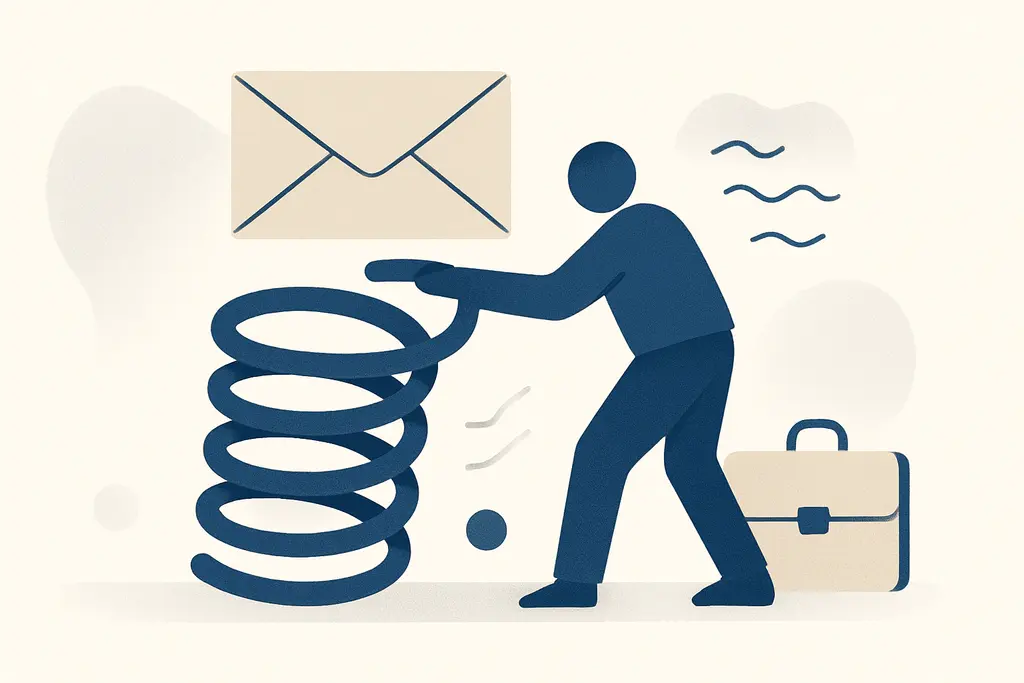
After-hours email stress is a workplace pattern where email activity outside agreed working hours leads to ongoing concern or behavior changes across colleagues. It isn't about a single late message; it's about recurring expectations, habits and signals that affect how people plan their time and coordinate work.
This pattern typically involves blurred boundaries between work and non-work time, repeated checking or replying outside hours, and uncertainty about whether a message requires immediate action. It often spreads through team norms rather than being imposed by a single directive.
Key characteristics:
These features make it visible in daily workflows and in how decisions are escalated across the group.
Why it tends to develop
Those drivers combine cognitive shortcuts (assume urgency), social signaling (reciprocity, impression management) and environmental enablers (always-on devices).
**Pressured timelines:** tight deadlines or last-minute changes push people to send or expect messages after hours
**Visibility signaling:** some people use late emails to show commitment or to nudge visibility with senior stakeholders
**Distributed schedules:** different time zones and flexible hours mean one person's day is another's evening
**Lack of norms:** absent or vague team agreements leave people guessing about acceptable response times
**Tool affordances:** email clients and mobile notifications make sending and checking easy at any hour
**Workload imbalance:** uneven task distribution leads some team members to work late to catch up
What it looks like in everyday work
These are observable behaviors you can track without making clinical judgments.
Late-night reply chains that restart the next morning
A spike in "sent" timestamps after typical close-of-business times
People copying wide distribution lists on non-urgent items
Colleagues mentioning they "got it at 10pm" as if it matters
Multiple follow-up emails instead of using a single consolidated update
Increased last-minute task reallocations or emergency asks
Team members routinely disabling notifications during off-hours — or not doing so
Calendar changes or deliverables adjusted in response to late emails
Informal rules like "don't send after 8pm" being unevenly followed
New hires mirroring response patterns they observe in others
A quick workplace scenario (4–6 lines, concrete situation)
At 9:15pm a project lead sends an email asking for a revised slide deck by 8am. One team member replies at 9:40pm apologising for the late night; another drafts changes at 7am and flags them as 'urgent.' By 8:30am the team has shifted priorities to meet the request, and a weekend expectation has become set for future rounds.
What usually makes it worse
End-of-day pressure to "wrap up" outstanding tasks
Executive emails sent late that imply availability expectations
Time-zone driven handoffs between teams in different regions
Unexpected client requests outside core hours
Automated alerts or reports that arrive at night
Performance metrics tied to rapid turnaround times
Informal praise for people who respond quickly at night
Tight launch windows or patch releases
File-sharing platforms with edit histories showing late activity
What helps in practice
Adopting a mix of technical tools (delayed send, filters) and social norms (what's urgent, who covers) reduces ambiguous signals and makes team expectations explicit.
Establish and communicate clear email-response windows for the team
Model boundary behavior by scheduling sends during working hours and delaying delivery when needed
Define what qualifies as "urgent" and which channels to use for emergencies
Use delayed-send or scheduled delivery to avoid creating after-hours expectations
Create an on-call rotation for true out-of-hours issues, so others know when to step in
Agree on compact daily updates to reduce back-and-forth late at night
Encourage use of subject-line tags (e.g., [ACTION] vs [FYI]) to clarify expectations
Limit large distribution lists for non-urgent communication
Turn off non-essential notifications or create notification rules for evenings
Train people on effective handoffs so work can be picked up during normal hours
Review workload and deadlines periodically to reduce last-minute rushes
Recognize and reward planning and clear communication rather than late-night responsiveness
Nearby patterns worth separating
Psychological safety: connects because safe teams discuss boundaries openly; differs as it focuses on willingness to speak up rather than timing of emails
Boundary management: directly related; this term covers individual strategies for separating work and personal time, while after-hours email stress is the team-level pattern that challenges those strategies
Asynchronous work: connects as a design choice to reduce real-time pressure; differs because poor asynchronous norms create after-hours stress
On-call culture: overlaps when true out-of-hours responsibility exists; differs because on-call is formal and scheduled, while after-hours email stress is often informal and unscheduled
Notification overload: related as the technical side of interruptions; differs because notification overload can come from many apps beyond email
Impression management: connects through the social signaling that drives late messages; differs because it explains motives rather than effects on schedules
Time-zone coordination: ties in as a structural cause; differs in that it’s logistical rather than purely cultural
Escalation pathways: related because clear escalation reduces late-night emails; differs since pathways are formal processes while stress is the emergent outcome
Workload planning: connects as a prevention strategy; differs because planning is a proactive practice and after-hours stress is often reactive
When the situation needs extra support
Consider consulting HR, occupational health, or an external organizational consultant to address systemic patterns and policies.
- If team functioning or productivity is significantly impaired by persistent after-hours expectations
- If multiple people report sustained difficulty recovering between workdays due to work-related demands
- If workplace conflict about boundaries escalates and internal resolution steps (HR, mediation) are not helpful
Related topics worth exploring
These suggestions are picked from nearby themes and article context, not just a flat alphabetical list.
After-hours work guilt
Why employees feel compelled to check or do work after hours, how that becomes a team norm, and practical ways managers can reduce the guilt and reshape expectations.
Adaptive stress vs toxic stress at work
How to tell when pressure at work fuels growth (adaptive) versus when it becomes chronic harm (toxic), what creates each, and practical steps leaders can take.
Re-entry burnout after leave
When employees return from extended leave and face overload, confusion, or exhaustion—how it shows up, why it happens, and practical manager steps to ease the transition.
Perpetual On-Call Stress
Chronic expectation of immediate responsiveness at work that blurs boundaries, harms planning, and hides capacity issues — how it shows up and what managers can do.
Quiet stress at work: sustained low-level strain
Sustained low-level pressure at work that quietly drains focus and quality—how it forms, how it shows up day-to-day, common misreads, and practical manager actions to reduce it.
Rest guilt
Rest guilt is the anxious feeling that downtime is undeserved; it shows up as skipped breaks, constant connectivity, and over-justifying time off, and can be reduced by clearer handoffs and visible bo