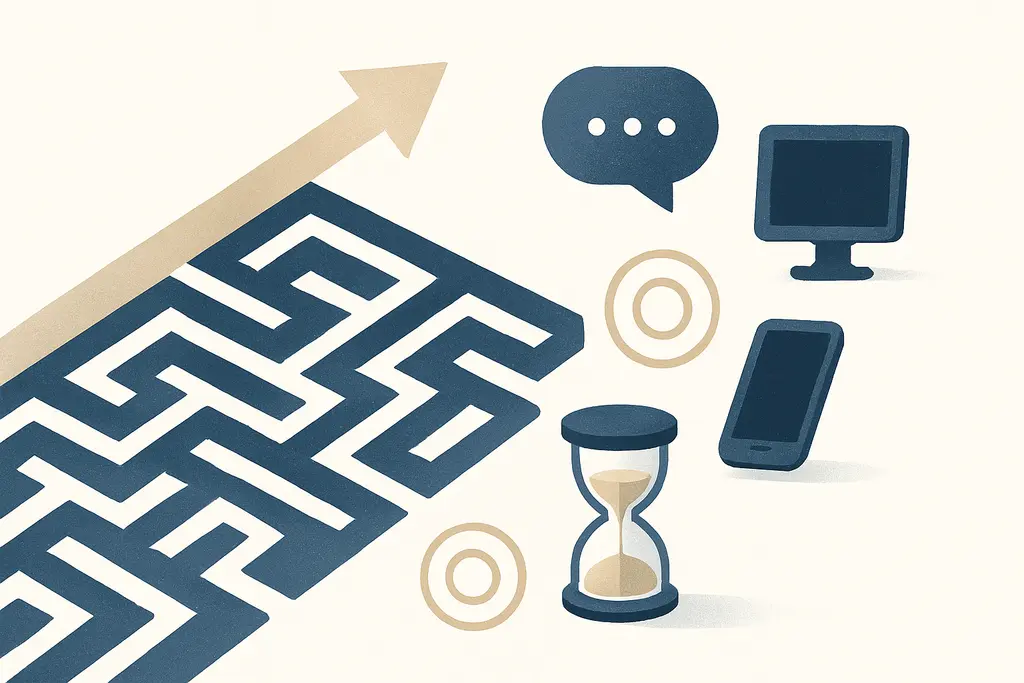
What this pattern really means
Context switching costs are the hidden overheads—time and mental energy—lost when someone stops one task and starts another. In open-plan offices these costs are amplified by visual and auditory distractions, frequent informal interruptions, and overlapping workflows.
Open-plan layouts are designed to increase visibility and informal collaboration, but they also make unplanned switches more likely. The term doesn’t only mean the literal time spent switching windows or documents; it includes re-orienting attention, re-establishing context and recovering the thread of work.
Key characteristics:
These characteristics explain why output in open-plan settings can look unpredictable: bursts of visible activity but less reliable deep work. Measuring and responding to these effects focuses not only on layout but on norms and process adjustments.
Why it tends to develop
**Auditory distraction:** conversations, phone calls and ambient noise that pull attention away from tasks.
**Visual interruption:** movement, gestures or screens in peripheral vision that trigger a cognitive re-orientation.
**Social pressure:** norms to be available and responsive encourage immediate replies rather than deferring interruptions.
**Task fragmentation:** multiple short tasks or notifications that force rapid context changes.
**Poor signaling:** lack of visible cues (like a "do not disturb" indicator) so coworkers aren’t sure when someone is in focus mode.
**Unclear boundaries:** ambiguous expectations about when it’s appropriate to engage colleagues for quick questions.
**Workspace layout:** desks clustered without dedicated quiet zones or meeting rooms for private conversations.
What it looks like in everyday work
Frequent unfinished tasks at the end of the day despite long hours on-site.
Meetings that run over because participants join unprepared after interrupted focus time.
Teams relying heavily on follow-up messages because initial discussions were fragmented.
A rise in quick, synchronous check-ins (pop-ups) instead of consolidated updates.
Declines in written quality or increased small errors in deliverables.
Staff choosing to work remotely or during off-hours for uninterrupted focus.
People using headphones as a visible signal but still getting pulled into side conversations.
Managers seeing inconsistent estimates vs. actual completion times for complex tasks.
Increased frequency of status updates or task reassignments to compensate for lost progress.
A quick workplace scenario (4–6 lines, concrete situation)
On a Tuesday, a product analyst schedules a two-hour block to finish a feature spec. Within the first 30 minutes they handle two colleagues' questions, hear three nearby phone calls and have a brief impromptu meeting at their desk. By the end of the day the spec is half-done and requires extra review, pushing the launch timeline and creating more follow-ups.
What usually makes it worse
Nearby conversations about urgent topics or interpersonal issues.
Ad hoc desk visits for quick clarifications instead of scheduled queries.
Open meeting rooms where loud discussions spill into work zones.
Pop-up standups or leadership walkthroughs during peak focus hours.
Multiple chat apps sending frequent notifications.
Unclear task ownership prompting repeated check-ins.
Neighbors taking personal calls at full volume.
Hot-desking without consistent personal space leading to constant reorientation.
What helps in practice
Applying a mix of physical changes, behavioral norms and process tweaks reduces the frequency and severity of context switches. Leaders can pilot small changes, collect feedback and scale practices that preserve both collaboration and deep work.
Establish and communicate focus blocks: set organization-wide windows when meetings and drop-ins are discouraged.
Create visible signals for focus (flags, desk lights, headphones policy) so colleagues can easily respect concentrated work time.
Designate quiet zones and collaboration zones so different work modes have appropriate spaces.
Encourage async updates: use shared documents and brief written summaries to reduce interruption-prone face-to-face queries.
Implement “one-question” policies for quick interruptions and reserve complex issues for scheduled conversations.
Batch interruptions: schedule recurring office hours where questions are handled in a single block.
Optimize meeting design: require agendas, pre-reads and time-boxed slots to reduce follow-up switching.
Use desk-booking or neighborhood assignments to reduce visual distractions for knowledge-intensive roles.
Equip teams with incident rules: who to call for truly urgent matters vs. what can wait.
Monitor and iterate: run short experiments (e.g., no-meeting mornings) and measure effects on delivery timelines.
Adjust performance expectations: align deadlines and workload planning with the realities of the open-plan environment.
Nearby patterns worth separating
Attention residue — Related in that it describes leftover cognitive load after switching; context switching costs are the observable performance and time impacts of that residue in a shared workspace.
Interrupt-driven workflow — A pattern where work is organized around interruptions; differs by focusing on process design rather than spatial layout.
Asynchronous communication — A mitigation tool that reduces immediate switching by shifting responses to non-simultaneous channels.
Hot-desking — A seating policy that can increase re-orientation time and visual distractions, thereby raising context switching costs.
Quiet zones / focus rooms — Physical countermeasures that provide a different balance between collaboration and focus compared to the open floor.
Meeting hygiene — Practices around agendas and pre-reads that reduce the need for post-meeting follow-ups caused by fragmented attention.
Time blocking — A personal and team technique to protect deep work periods, directly reducing switch frequency.
Cognitive load — The mental capacity used to process information; context switching costs are one consequence of high cognitive load in busy environments.
Workspace ergonomics — Physical design choices that can reduce sensory distractions and make sustained focus easier.
When the situation needs extra support
- If widespread interruption patterns are causing chronic project delays, consult HR or an organizational design specialist to review processes and layout.
- For persistent wellbeing or performance concerns related to workplace conditions, involve occupational health or an employee assistance program to assess fit and accommodations.
- Use a workplace ergonomist or facilities planner when physical layout changes are needed to balance collaboration and quiet work.
Related topics worth exploring
These suggestions are picked from nearby themes and article context, not just a flat alphabetical list.
Hidden Costs of Context Switching
How switching between tasks quietly reduces quality and throughput at work, why it persists, and practical steps teams can take to restore focused, higher‑value output.
Why I can't focus in open offices
Explains why open offices disrupt attention, how that shows up in daily work, common misreads, and practical environmental and social fixes teams can apply.
Context-switch recovery time
How long people need to regain depth after switching tasks at work, why it costs organisations time, and practical manager-level steps to reduce it.
Task switching cost and batching at work
How switching between tasks adds hidden time and error at work—and how batching, protected blocks, and changed norms help managers reduce that lost productivity.
Inbox zero myth
Why aiming for an empty inbox is often symbolic, how it shapes daily work behavior, common confusions, and practical fixes to reduce busywork and distraction.
Notification anxiety
Notification anxiety is the anticipatory stress about pings and messages at work — it fragments focus, shapes habits, and can be reduced by norms, batching, and targeted notification settings.