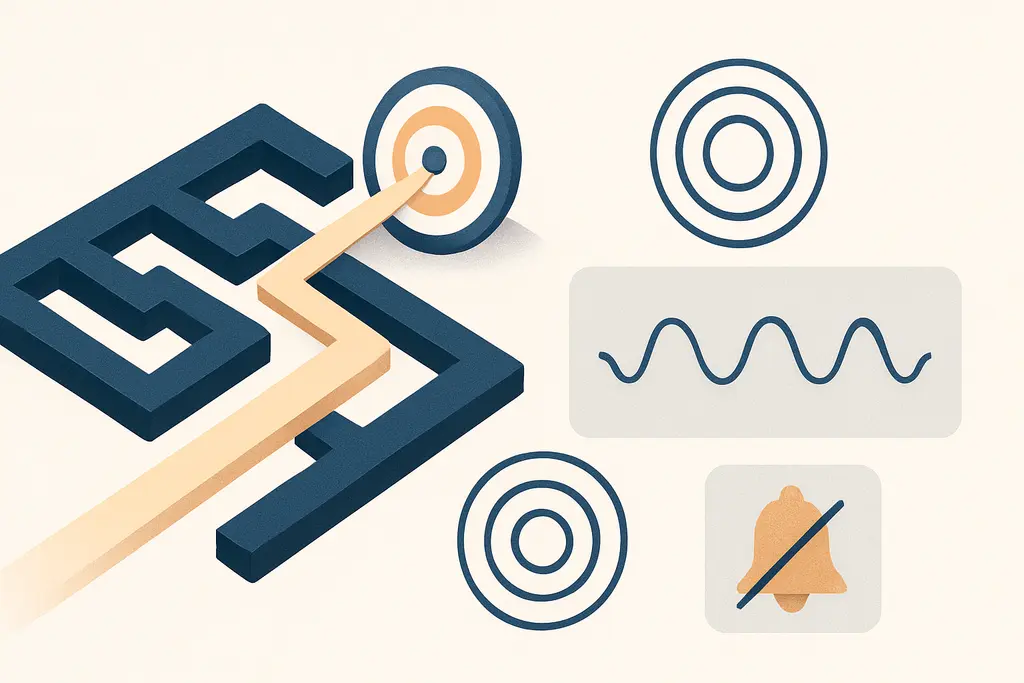
What it really means
At its core, distraction stacking is about sequence and momentum: one brief detour invites another, and switching costs accumulate. Rather than rare, high-impact interruptions, the pattern is a chain of low-friction distractions that together create sustained attention drift.
Underlying drivers
These causes are social and structural more than individual. Fixes therefore need policy and design changes, not just exhortations to “focus harder.”
**Tool overload:** Multiple communication platforms increase the number of touchpoints and expectations for instant replies.
**Implicit availability norms:** When teams don’t set clear windows for focus, workers feel pressure to respond immediately.
**Unclear priorities:** If priorities are changing or uncommunicated, people check in more often to confirm direction.
**Meeting fragmentation:** Frequent short meetings or ad-hoc huddles create start/stop rhythms that invite follow-ups.
**Reward for responsiveness:** Systems that praise quick answers (e.g., praise in chat, low SLA metrics) reinforce interruption-friendly behavior.
Observable signals
The visible signs can be subtle: calendars that look full of short blocks, long lists of half-finished tasks, and people who are always reachable but rarely finish work that requires sustained attention.
A product manager answers three Slack threads between design reviews and loses the train of thought on a prioritization memo.
A developer turns on email sound and spends the morning shifting between code and short clarifying messages.
A customer-support agent toggles between ticket queues and internal chat, increasing error rates on standard responses.
A quick workplace scenario
A marketing lead schedules a one-hour content review but keeps the meeting open for quick clarifications in chat. During the hour, three team members post screenshots asking for approval; the lead replies to each in turn, then gets pulled into a different thread about brand guidelines. By the end of the hour the review hasn’t progressed and the content deadline slips.
This example shows how short, well-meaning interactions stack to consume a block that should have been reserved for uninterrupted work.
Practical responses
Start with one structural change—such as instituting two daily 90-minute focus windows—and measure whether task completion improves. Small policy changes often have outsized effects because they change predictable behavior rather than relying on willpower.
**Create signal rules:** designate channels for urgent vs. non-urgent communication and set expectations for response times.
**Protect focus blocks:** reserve and respect regular, calendar-based no-interruption windows for deep work across the team.
**Simplify platforms:** reduce the number of tools or consolidate notifications so fewer touchpoints compete for attention.
**Design meeting hygiene:** limit meetings to necessary attendees and slot decision items early; avoid using meetings to solve minor confirmation tasks.
**Model behavior:** leaders should demonstrate protected focus time and delayed responses to teach new norms.
Often confused with
Because the terms overlap, leaders sometimes propose the wrong solution—e.g., training people to "multitask better"—instead of changing the environment that creates the stack.
Multitasking: often treated as the same problem, but multitasking is a cognitive strategy; distraction stacking describes an external flow of interruptions that makes multitasking the default response.
Context switching and attention residue: these are cognitive outcomes of distraction stacking; context switching refers to the act, attention residue is the lingering mental cost.
Procrastination: procrastination is motivational and intentional delay; distraction stacking can be externally driven even when people want to focus.
Questions worth asking before you change policy
- Which communication channels create the most brief, repeated interrupts? Can we turn off nonessential notifications?
- Where do late-stage clarifications or approvals cluster? Can those be scheduled instead of pinged?
- What norms implicitly reward immediacy, and who benefits from instant responses?
- Which meetings could be consolidated or converted to asynchronous updates?
Answering these points gives a practical roadmap: remove the small sources of friction first, then address the cultural incentives that sustain them.
Related patterns worth separating from it
- Attention economy effects: company-wide decisions (e.g., platform rollouts) that monetize immediacy can institutionalize distraction stacking.
- Role mismatch: when job descriptions expect deep analysis but workflows emphasize availability, stacking increases as people try to reconcile conflicting demands.
Distinguishing these helps avoid one-size-fits-all fixes. For example, platform consolidation addresses tool overload; role redesign addresses conflicting expectations.
Practical manager checklist
- Audit: map the top five sources of short interruptions for your team over a week.
- Intervene: pick one change (e.g., two daily focus blocks) and pilot for two weeks.
- Measure: track task completion rates and a simple team sentiment check-in.
- Iterate: keep successful changes and add another targeted fix.
These steps create a cycle of observation, small change, and assessment rather than punitive rules that breed resentment.
Where leaders commonly misread it
Leaders often treat distraction stacking as a personnel problem ("they can’t focus") or as a single-tool issue ("turn off notifications"). Both are partial views. The real pattern is systemic: it combines tool design, social expectations, meeting cadence, and reward signals. A manager who only blames individuals may lose trust; one who only turns off a notification sound may not stop the underlying social demand for instant replies.
Addressing stacking requires diagnosis across systems—communication habits, calendar design, and role expectations—and coordinated changes that align with how work actually flows.
Quick closing: what success looks like
Success isn’t perfect silence; it’s predictable rhythms where teams can do focused work, respond to true urgencies, and complete more high-value tasks. When distractions stop stacking, decisions are clearer, deadlines are met more reliably, and the team reports less task churn and frustration.
Related topics worth exploring
These suggestions are picked from nearby themes and article context, not just a flat alphabetical list.
Inbox zero myth
Why aiming for an empty inbox is often symbolic, how it shapes daily work behavior, common confusions, and practical fixes to reduce busywork and distraction.
Notification anxiety
Notification anxiety is the anticipatory stress about pings and messages at work — it fragments focus, shapes habits, and can be reduced by norms, batching, and targeted notification settings.
Deep Work for Managers
How managers create, protect, and scale focused, high-value work time—practical steps, pitfalls, and examples for turning attention into better decisions and fewer interruptions.
Focus residue recovery
How leftover attention from one task slows the next—and practical steps managers and teams can use to clear it, from short buffers to one‑line handoffs.
Decision batching
Decision batching groups similar workplace choices into scheduled sessions; it can boost focus and consistency but also cause delays and bottlenecks if misused.
Visual task queueing
How visible lines of work—sticky notes, Kanban columns, inbox piles—shape focus and coordination at work, why they form, and practical ways to manage them.