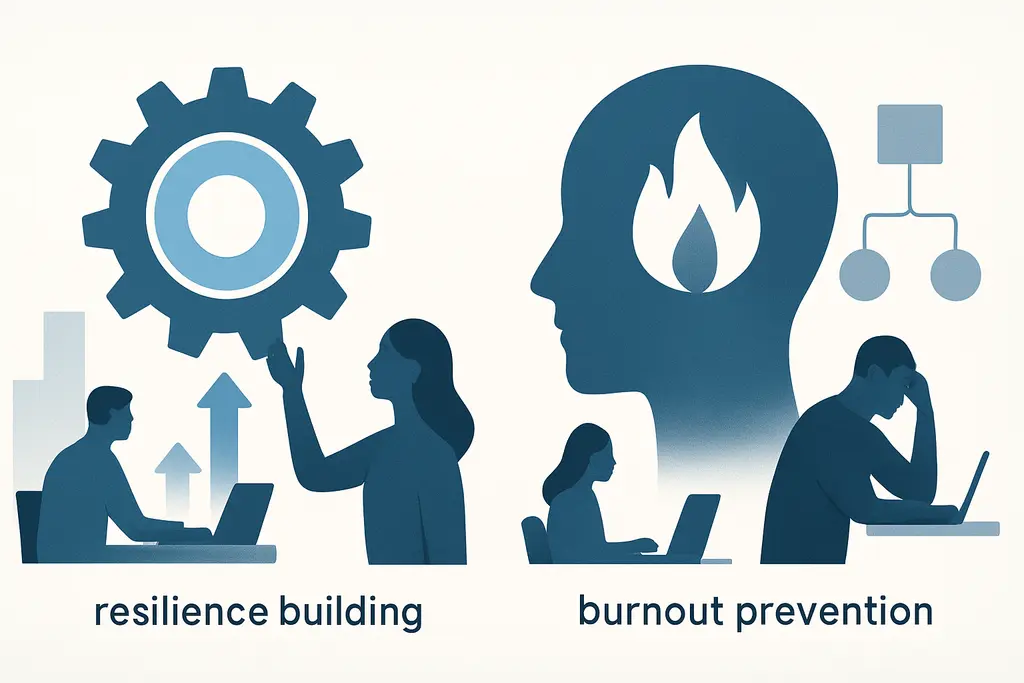
Quick definition
Resilience building is about cultivating the skills, routines and systems that help people adapt to stressors and recover after setbacks. It emphasizes learning, resourcefulness and supportive relationships so individuals and teams can sustain performance under pressure.
Burnout prevention focuses on identifying and reducing chronic demands and workplace conditions that exhaust energy and motivation. It aims to change workload, role clarity, and organizational practices to stop prolonged strain before it becomes entrenched.
Key characteristics:
Putting both approaches together creates a balanced strategy: strengthen people while fixing the work that wears them down.
Underlying drivers
These drivers include cognitive (decision fatigue), social (norms and comparison) and environmental (workload, role design) factors that interact to favor either resilience development or the need for prevention.
**Unclear priorities:** when teams face competing deadlines, people are forced into constant triage rather than steady progress.
**Excessive workload:** persistent high volume or scope creep without matching resources increases strain.
**Lack of control:** little autonomy over tasks or schedules reduces opportunities to adapt work to personal capacity.
**Social pressure:** norms that reward overwork or ignoring breaks push people to keep going beyond safe limits.
**Poor role fit:** skills mismatches or ambiguous responsibilities cause repeated friction and cognitive load.
**Insufficient recovery:** few built-in pauses, vacations, or transition buffers prevent restoration between demands.
**Cognitive load and decision fatigue:** continuous complex decisions without simplification exhaust mental resources.
**Inadequate recognition and feedback:** lack of meaningful feedback or reward diminishes motivation to sustain effort.
Observable signals
These patterns help distinguish whether the problem is mostly a capacity gap you can address through development, or a structural issue that needs workload and role change. Observing who is affected and how long effects persist gives a practical guide for next steps.
Frequent firefighting: cycles of crisis response that replace planned work
Persistent backlog despite long hours from team members
High variability in who copes well: some people sustain performance while others struggle
Rising mistakes on routine tasks, especially late in projects
Lower participation in learning or improvement initiatives
Shorter attention spans or reduced meeting engagement
Withdrawal from optional collaboration or mentoring
Spike in last-minute requests and urgent priorities
Public praise for “heroic” overwork that masks systemic issues
Teams that rebound quickly after a setback versus teams that remain depleted for weeks
A quick workplace scenario (4–6 lines, concrete situation)
A product team misses two quarterly milestones. The lead arranges resilience workshops and individual coaching, but the backlog and unclear scope remain. A third approach pairs coaching with role redefinition and a temporary hiring freeze adjustment, leading to steadier delivery and less emergency work.
High-friction conditions
Sudden increases in scope without additional staff or time
Leadership changes that alter priorities mid-cycle
Tight hiring freezes or budget cuts that leave gaps
Repeated all-hands requests outside normal hours
Ambiguous decision rights that cause duplication of work
Persistent unclear success criteria for projects
Reward systems that emphasize speed over sustainability
Frequent last-minute stakeholder demands
Lack of documented processes for recurring tasks
Practical responses
Combining individual support with concrete changes to work reduces rescue-only behavior. Small policy shifts and visible leader behaviors often accelerate cultural acceptance of healthier practices.
Clarify priorities: set and communicate a short list of true priorities each quarter
Adjust workload: redistribute tasks, change deadlines, or reduce scope to match capacity
Increase autonomy: let teams choose how to meet goals to reduce friction and increase ownership
Build recovery windows: protect focus time, enforce predictable break policies and encourage use of leave
Model boundaries: leaders role-model leaving on time, not sending late-night messages
Provide micro-skills training: time management, stress-aware planning, and adaptive problem solving
Embed peer support: buddy systems and regular debriefs to normalize recovery and learning
Redesign roles where needed: remove nonessential tasks and clarify responsibilities
Monitor workload signals: track volume, urgent requests, and overtime trends, then act on them
Recognize sustainable performance: reward consistent delivery and collaboration, not only heroic saves
Pilot structural changes: try shift rotations, flexible staffing, or temporary contractors for spikes
Communicate changes clearly and measure impact over time
Often confused with
Psychological safety — Connects because it enables people to admit strain and ask for help; differs by focusing on voice and risk-taking rather than workload or capacity per se.
Job design — Directly shapes prevention by altering tasks and roles; resilience work complements job design by equipping employees to adapt within those roles.
Workload management — Overlaps with prevention; specifically targets how much and how work is allocated versus resilience which builds coping skills.
Performance management — Can either drive burnout (if only output is measured) or support prevention (if it includes sustainable practices and capacity measures).
Recovery practices — Relate to resilience by improving restoration routines; prevention addresses the causes that make recovery necessary.
Compassionate leadership — Connects through leader behaviors that reduce stigma and model boundaries; resilience training can teach leaders how to be compassionate in practice.
Stress contagion — Shows how team norms spread overwork; prevention focuses on changing norms while resilience buffers individuals against spread effects.
Employee engagement — Sustained engagement reflects successful prevention and resilience; low engagement can indicate failures in both areas.
Change management — Necessary when introducing prevention policies or resilience programs; poor change management can undermine either effort.
Capacity planning — Ties to prevention through resourcing decisions; when capacity planning is weak, resilience efforts are taxed.
When outside support matters
- If multiple team members report persistent impairment to work functioning despite reasonable workplace changes, consult HR or occupational health resources
- Consider bringing in an external organizational consultant to audit workload, role clarity and systemic drivers
- Use employee assistance programs or qualified workplace health professionals for guidance on policy and program design
Related topics worth exploring
These suggestions are picked from nearby themes and article context, not just a flat alphabetical list.
On-Call Burnout
On-call burnout is the cumulative mental and physical strain from repeated after-hours responsibility; learn how it appears, why it persists, and practical fixes for teams.
Burnout rumination
How recurring, work-focused negative thinking drains teams, how it shows up, why it persists, and practical manager actions to reduce it.
Post-project burnout
A practical guide to post-project burnout: how the post-delivery slump shows up, why it persists, and concrete manager steps to restore team energy and follow-through.
Burnout recovery guilt
Burnout recovery guilt is the shame or hesitation people feel when returning from burnout. It shows as secrecy, overcompensation, and reluctance to use supports; clarified expectations and visible bou
Re-entry burnout after leave
When employees return from extended leave and face overload, confusion, or exhaustion—how it shows up, why it happens, and practical manager steps to ease the transition.
Boundary erosion burnout
A manager-focused guide to boundary erosion burnout: how blurred work/life lines build up, how it shows in team behaviour, and practical first steps to restore healthy boundaries.