Working definition
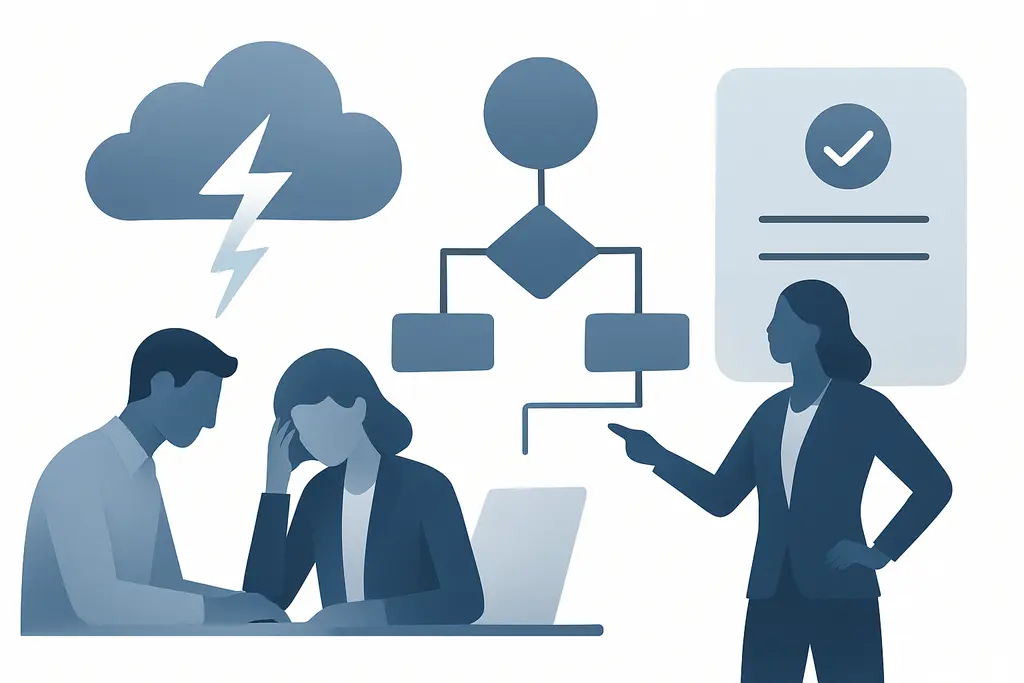
Stress appraisal is the mental process employees use to evaluate an event: is it a threat, a challenge, or something neutral? Coping is the set of strategies—thoughts and actions—they use after that judgment to manage demands and emotions. Together they determine short-term reactions and longer-term patterns of adaptation at work.
These characteristics mean appraisal and coping are not fixed traits but situational responses managers can influence through structure, communication, and resources.
How the pattern gets reinforced
These drivers interact: for example, high workload combined with unclear goals often leads to threat appraisals and reactive coping patterns.
**Cognitive appraisal:** uncertainty, ambiguous goals or unclear expectations lead employees to interpret situations as threats or challenges
**Perceived control:** low perceived control over tasks or schedules increases threat appraisals
**Workload and pace:** sustained high load narrows perceived options and favours short-term coping
**Social comparison:** observing peers handle (or struggle with) similar demands shapes one’s own appraisal
**Feedback climate:** critical, inconsistent, or sparse feedback makes employees default to worst-case interpretations
**Resource mismatch:** lack of time, training, or tools pushes people toward emotion-focused coping
**Organizational change:** restructuring or role shifts trigger fresh appraisals as people reassess demands and resources
Operational signs
These observable patterns help managers spot when appraisal and coping are shaping performance. Rather than assuming personality is the cause, look for situational triggers and resource gaps that explain the behaviour.
Increased reactivity to feedback or changes in plans
Repeated requests for clarification about goals or priorities
Preference for safe, familiar tasks instead of taking calculated risks
Short-term fixes that ignore underlying process problems (workarounds)
Withdrawal from collaborative activities or reduced participation in meetings
Surface compliance without ownership of outcomes
Shifts in communication tone: more tentative, defensive, or blunt messages
Visible effort to control small details (micromanagement from the employee side)
Rapid mood changes tied to workload peaks
Overreliance on a single coping style (e.g., avoidance or perfectionism)
Pressure points
Tight or shifting deadlines without clear prioritization
Conflicting demands from multiple stakeholders
Sudden changes in role, team composition, or reporting lines
Ambiguous success criteria or inconsistent feedback
High-stakes presentations or client escalations
Technology failures or missing tools needed to do the job
Public criticism or visible mistakes by team members
Lack of autonomy over how to complete work
Repeated interruptions and fragmented schedules
Competing incentives that reward speed over quality
Moves that actually help
Practical steps like clarifying priorities and offering choices change how situations are appraised and expand coping options. Over time these interventions reduce repeated reactive patterns and support more constructive problem-solving.
Clarify priorities: set explicit goals and rank tasks so appraisals focus on manageable next steps
Increase perceived control: offer choices about methods, timelines or teammates where possible
Model appraisal framing: describe challenges as solvable and outline concrete first steps
Resource match: align workload with training, tools and time; remove unnecessary work
Normalize coping diversity: make it acceptable to ask for help or change approaches
Teach simple decision rules: triage frameworks reduce cognitive load during peaks
Structure feedback: schedule regular, specific feedback to reduce uncertainty-driven threat appraisals
Create small wins: break projects into short deliverables that shift appraisal toward competence
Encourage peer coaching: pair employees so coping strategies and perspectives circulate
Adjust incentives: reward learning and adaptation, not only flawless outcomes
Plan recovery windows: ensure predictable low-intensity periods after peak efforts
Observe and adapt: track which coping strategies improve outcomes and reinforce those
A quick workplace scenario (4–6 lines, concrete situation)
A project slips two days behind after a vendor delay. A senior lead frames the delay as a manageable reroute, reassigns nonessential tasks, and asks the team to propose two recovery plans. Team members shift from anxious emails to concrete suggestions, choosing one plan and scheduling short daily check-ins to monitor progress.
Related, but not the same
Job demands-resources model — connects to appraisal by showing how demands and resources influence stress; differs by focusing on structural balances rather than moment-by-moment judgments
Psychological safety — links to coping choices: higher safety broadens acceptable coping behaviours; differs because it’s a team climate concept rather than an individual process
Emotion regulation — overlaps with emotion-focused coping but is narrower: regulation refers specifically to managing feelings, while coping includes problem-solving actions too
Cognitive reappraisal — a specific tactic within appraisal: changing interpretation of an event; connects as a tool managers can model
Learned helplessness at work — a pattern that can follow repeated threat appraisals; differs by describing a chronic state rather than transient appraisals
Burnout indicators — related long-term outcomes when appraisal and coping repeatedly favour strain; differs because burnout is an outcome pattern, not the appraisal process itself
Role ambiguity — a common situational trigger that alters appraisal; connects as a direct cause to address through job design
Adaptive performance — positive counterpart: successful appraisal and coping lead to flexibility and learning; differs by focusing on outcomes managers want to encourage
Team norms for coping — social rules that determine acceptable strategies; connects by shaping individual appraisal responses
When the issue goes beyond a quick fix
Consult a qualified occupational health professional, employee assistance program (EAP), or licensed clinician to evaluate workplace fit and recommend appropriate interventions.
- If an employee’s functioning at work is significantly impaired for an extended period despite adjustments
- If coping patterns include persistent withdrawal, severe sleep disruption, or safety concerns at work
- When repeated attempts to adapt job design and supports fail and distress remains high
Related topics worth exploring
These suggestions are picked from nearby themes and article context, not just a flat alphabetical list.
Adaptive stress vs toxic stress at work
How to tell when pressure at work fuels growth (adaptive) versus when it becomes chronic harm (toxic), what creates each, and practical steps leaders can take.
Perpetual On-Call Stress
Chronic expectation of immediate responsiveness at work that blurs boundaries, harms planning, and hides capacity issues — how it shows up and what managers can do.
Quiet stress at work: sustained low-level strain
Sustained low-level pressure at work that quietly drains focus and quality—how it forms, how it shows up day-to-day, common misreads, and practical manager actions to reduce it.
Rest guilt
Rest guilt is the anxious feeling that downtime is undeserved; it shows up as skipped breaks, constant connectivity, and over-justifying time off, and can be reduced by clearer handoffs and visible bo
Chronic Task Diffusion
Persistent loss of clear ownership where tasks repeatedly stall between people and processes — how it looks, why it happens, and practical fixes managers can apply.
Busy badge culture
When visible busyness becomes a status signal at work, outcomes suffer. Learn how it forms, how to spot it, and practical steps leaders can take to shift incentives toward impact.