Working definition
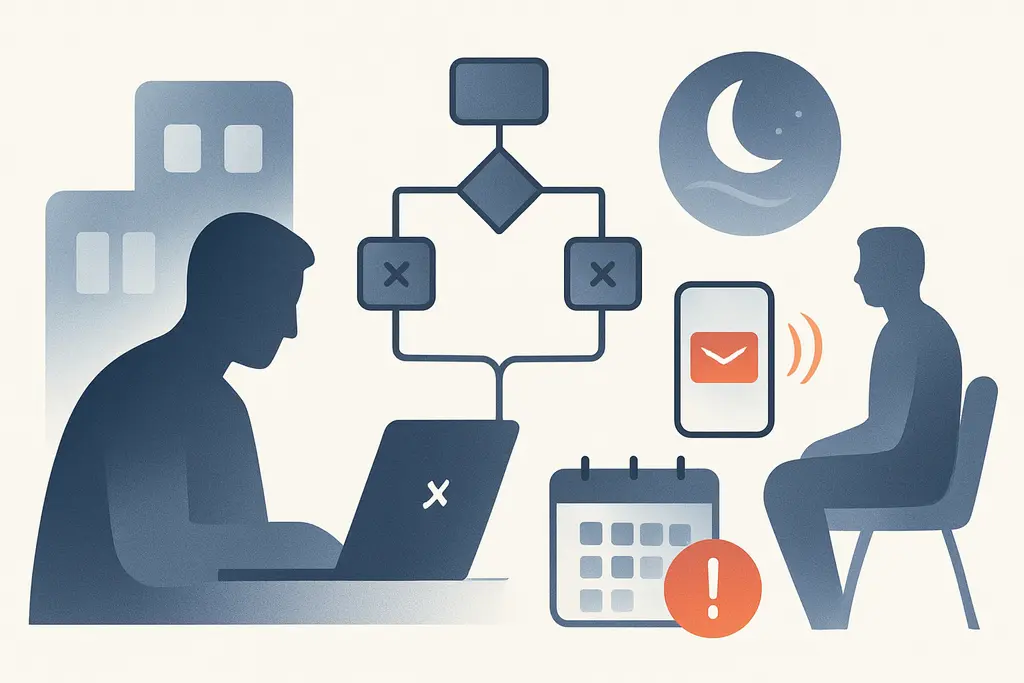
Work-Life Integration Stress describes the strain that results when work responsibilities, personal tasks, and the technologies that connect them overlap in ways that feel constant or unmanaged. Rather than a short spike from a busy week, this is a recurring pattern where people struggle to switch roles, protect personal time, or meet shifting expectations.
Key characteristics include:
Managers can view these characteristics as signals about team norms, resourcing, and role clarity. Noticing them early allows for structural adjustments (schedules, roles, communication rules) rather than only relying on individual willpower.
How the pattern gets reinforced
These drivers combine technical, social, and cognitive elements. Addressing them often requires changing team norms and workflows rather than only asking individuals to "manage better."
**Blurring of roles:** Remote/hybrid setups and flexible hours make it harder to separate work and home roles.
**Always-on communication:** Emails, chat apps, and push notifications create an expectation of immediate response.
**Unclear priorities:** When priorities shift without clear guidance, people keep working longer to avoid missing something important.
**Performance incentives:** Metrics that emphasize output without regard for timing encourage people to compress personal time.
**Social pressure:** Team norms that reward early/late availability create peer expectations.
**Cognitive overload:** Juggling many small tasks increases mental switching costs and makes boundaries feel impractical.
**Resource mismatch:** Small teams or unclear role design lead to frequent context switching and interruptions.
Operational signs
These are observable workplace patterns managers can log and measure (frequency, timing, affected roles) to design targeted responses.
Repeated late-night or weekend messages from multiple team members.
Regularly rescheduled personal commitments or canceled time off.
Employees answering messages during meetings or family events.
Declines in meeting engagement because people are multi-tasking.
Frequent “handoffs” where no one has clear end-to-end ownership.
Spike in short, reactive tasks rather than deep, planned work.
Uneven distribution of urgent work concentrated on a few people.
Informal praise of long availability as a norm (e.g., “she’s always online”).
Conflicts about scheduling or last-minute requests that affect personal time.
Pressure points
Tight deadlines or product launches that require extra coordination.
Leadership modeling availability at all hours.
Rapidly changing priorities without reassigning or dropping tasks.
Ambiguous role boundaries in small or cross-functional teams.
Hybrid schedules where in-office and remote expectations aren’t aligned.
Last-minute stakeholder requests or approvals.
Inadequate handover processes between shifts or roles.
Performance reviews that reward hours visible rather than outcomes.
A quick workplace scenario (4–6 lines)
A team lead notices several members replying to Slack after 9pm and booking last-minute PTO cancellations. The lead sets a trial rule: no routine messages after 7pm and a shared weekly priority list. Within two weeks late-night activity drops and fewer personal plans are rescheduled.
Moves that actually help
Implementing these steps usually requires communication, small experiments, and follow-up. Start with one or two changes, monitor effect on workload and morale, and iterate rather than applying all fixes at once.
Set explicit communication windows and modeling: visibly avoid sending routine messages outside core hours.
Create and publish weekly priorities so people stop working to chase shifting expectations.
Protect blocks for deep work and allow async updates instead of immediate replies.
Limit meeting density with meeting-free days or core meeting hours.
Redistribute urgent tasks by clarifying ownership and using backups to prevent single-person overload.
Define clear rules for time-off approval and enforce no-contact expectations during approved leave.
Measure outcomes and milestones rather than time spent online; report progress in check-ins.
Use handover templates so intermittent coverage doesn’t require constant availability.
Train leads to spot pattern signals (after-hours messages, canceled PTO) and intervene early.
Pilot small policy changes (e.g., quiet hours) and collect team feedback before scaling.
Encourage norm-setting conversations in team meetings so expectations are explicit.
Related, but not the same
Work–life balance — A classic idea focusing on separation and equilibrium; differs by emphasizing schedule separation, while integration stress arises when separation isn’t feasible or enforced.
Boundary management — Practices individuals use to separate roles; connects directly because poor boundary management magnifies integration stress at the team level.
Burnout — A longer-term response to chronic work stress; related but broader—work-life integration stress is a specific pattern that can contribute to burnout if unaddressed.
Presenteeism — Being physically or digitally present but not productive; relates because always-on norms can increase presenteeism.
Role conflict — When job demands clash with personal or other role demands; a direct driver of integration stress.
Psychological safety — The extent people can speak up about workload and boundaries; low psychological safety makes integration stress harder to solve.
Flexible working — Policies that allow variable hours; can reduce stress if managed, but can increase integration stress without clear norms.
Job crafting — Adjusting tasks and interactions to fit strengths; a potential mitigation when managers enable autonomy and reallocation.
When the issue goes beyond a quick fix
These suggestions are about consulting qualified workplace or health professionals for significant or persistent problems, and about using organizational resources (HR, occupational health) when team-level changes don’t help.
- If stress patterns are causing significant impairment in work performance or relationships at home.
- If attempts to resolve workload and boundaries at the team level consistently fail.
- If an employee reports prolonged sleep disruption, persistent inability to concentrate, or severe emotional distress—suggest discussing options with occupational health or an employee assistance program.
Related topics worth exploring
These suggestions are picked from nearby themes and article context, not just a flat alphabetical list.
Adaptive stress vs toxic stress at work
How to tell when pressure at work fuels growth (adaptive) versus when it becomes chronic harm (toxic), what creates each, and practical steps leaders can take.
Perpetual On-Call Stress
Chronic expectation of immediate responsiveness at work that blurs boundaries, harms planning, and hides capacity issues — how it shows up and what managers can do.
Quiet stress at work: sustained low-level strain
Sustained low-level pressure at work that quietly drains focus and quality—how it forms, how it shows up day-to-day, common misreads, and practical manager actions to reduce it.
Rest guilt
Rest guilt is the anxious feeling that downtime is undeserved; it shows up as skipped breaks, constant connectivity, and over-justifying time off, and can be reduced by clearer handoffs and visible bo
Chronic Task Diffusion
Persistent loss of clear ownership where tasks repeatedly stall between people and processes — how it looks, why it happens, and practical fixes managers can apply.
Busy badge culture
When visible busyness becomes a status signal at work, outcomes suffer. Learn how it forms, how to spot it, and practical steps leaders can take to shift incentives toward impact.